Cloud computing limits large-scale data processing
MEC, forward deployment on the user side, speed and security↑
Smart factory with MEC application, faster response to emergency situations As the number of wireless terminals increases, the amount of data to be processed increases. This raises issues regarding the stability of data servers, slow response speeds, and security issues due to integrated data management.

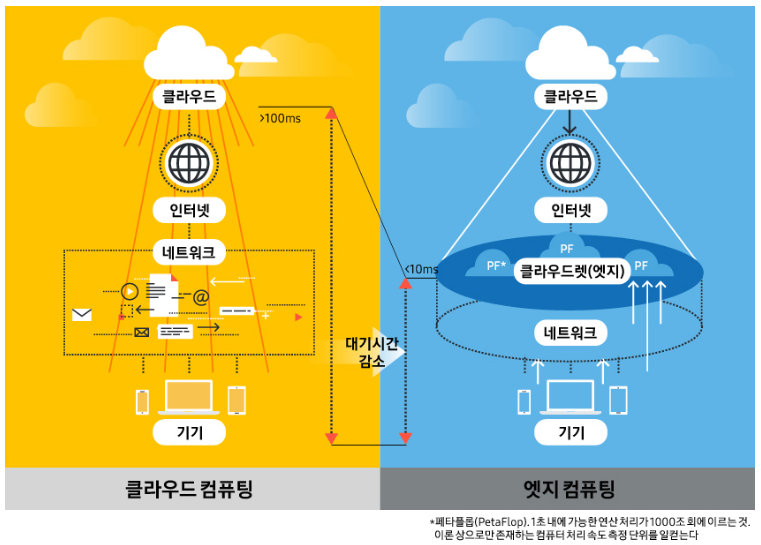
▲ Differences between existing cloud computing and edge computing
(Source = Samsung Newsroom)
Distributed cloud computing (Multi-access Edge Computing; MEC) provides fast, stable, and secure services by additionally deploying them on the user side rather than in the center like existing clouds.
3 Solutions to Implement MEC MEC, which is expected to be utilized in various fields, requires three solutions.
The first is the processor. For smooth data processing and control, a high-performance processor using CPU, APU, GPU, etc. is required.
The second is memory. This is because ultra-high-speed read/write speeds are required, utilizing not only existing memories such as DRAM and SRAM, but also next-generation memories such as MRAM, PCRAM, and ReRAM.
The last one is the network. Data processing with minimal delay is a key requirement in safety-related fields such as autonomous vehicles and aircraft.
MEC provides URLLC (Ultra-Reliable and Low Latency Communications) services with these three solutions.
Smart factories are the areas where MEC is most useful. This is because all processes, including product planning, design, production, distribution, and service, can be integrated with ICT to provide customized products for consumers, and the factory production system can be analyzed in real time to provide optimal solutions.
MEC modules are expected to be installed in various edge devices such as PLCs, robots, cameras, workers, and conveyor belts within the factory, leading to a software-centric, dynamic growth model rather than the existing hardware-centric model.
MEC in Smart Factories There are three key points to a smart factory utilizing MEC.

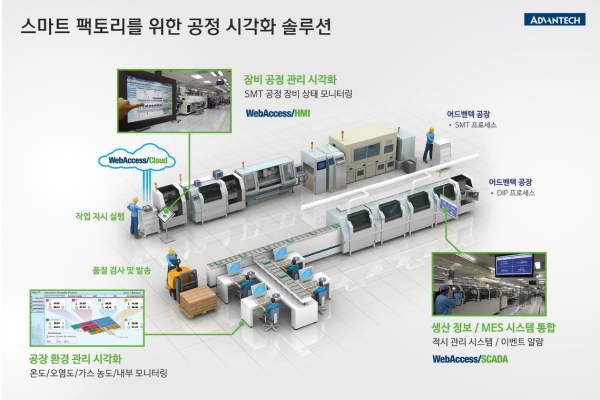
▲ MEC solution used in smart factories
(Image = Advantech)
The first is real-time factory management. It remotely collects factory operation status, production information, equipment and product information to manage data and enables rapid response in the event of defects or accidents.
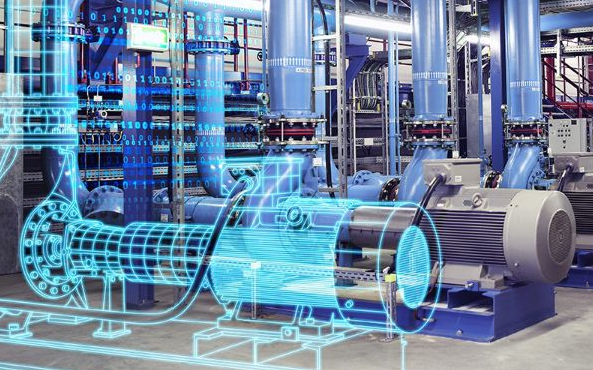
Digital twin technology can be used to copy real objects on a computer and simulate situations that may occur in the real world to predict outcomes.
The second is optimized control and production prediction. Technologies such as augmented reality (AR) and mixed reality (MR) can be used to facilitate process control to improve efficiency, and big data can be used to predict future situations and enable early planning.
Finally, quality control through machine learning. Smart factories utilizing MEC can perform imaging-based automatic inspection and analysis based on machine vision technology.
Current status of smart factory development at home and abroad According to market research firm MarketsandMarkets, the global smart factory market is expected to grow by 8% annually. In Korea, where manufacturing is developed, it is expected to grow by 11.2% annually.
Lotte Data Communication signed a partnership with Siemens in early 2019 to strengthen its smart factory business. POSCO ICT is working with General Electric to develop a smart factory optimized for steelmaking facilities.
In 2017, Rockwell Automation of the United States announced that it is working to implement a connected enterprise by converging IT technology and OT. In 2018, ABB of Switzerland introduced ABB Drive, a smart factory solution that can perform optimization and management processes remotely.
Earlier this year, US-based Emerson announced that it had agreed to acquire General Electric's Intelligent Platforms division. General Electric Intelligent Platforms has developed a family of cloud-connected controller devices.

▲ Digital twin technology applied to smart factories
(Image = Siemens)
Siemens' Amberg plant in Germany, which was selected as the Factory of the Year in 2019, is actively utilizing digital twins. Siemens, which analyzed in real time how various environmental changes affect products and optimized the production process, announced that productivity has increased 14 times since the plant first started operation in 1989.
MEC has a lot of potential to be utilized in a wide range of fields beyond smart factories, smart cities, self-driving cars, AI, VR/AR, etc. Therefore, now is the time to be challenging and create new business models.
This article is a summary of the writing of Dongwook Kim, a researcher at the e4ds Electronics Technology Research Institute.