Smart sensors, equipped with not only detection but also judgment
MEMS·Material·SoC·Embedded SW·AI Technology Requirements
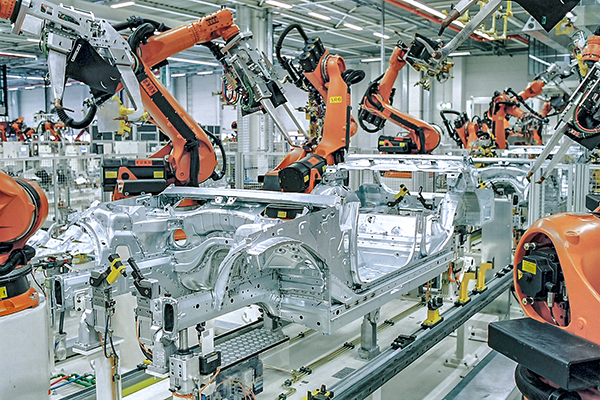
R&D on composite sensors capable of detecting multiple targets simultaneously in progress Smart factory, a concept that goes beyond existing factory automation, refers to an intelligent factory controlled by big data and AI analysis in an IoT environment.

▲ Smart factory expansion is essential to strengthen manufacturing competitiveness
A smart factory is based on a factory operation system that enables analysis and decision-making based on collected data. Through this, we can identify the correlation between phenomena and problems occurring at the production site, and identify and resolve the causes of sudden failures, poor quality, etc.
In particular, if various sensors and devices in industrial sites are integrated through wireless connections to automatically collect information and analyze and utilize the collected information, an AI-based production system can be created, allowing companies to build a system that can respond in real time to changes in manufacturing conditions and customer demands for products.
In March, Kang Byeong-hyeon, a researcher at the Department of Electrical and Electronic Engineering at Korea University, Park Yong-ju, a senior researcher at KETI, and Joo Byeong-gwon, a professor at the Department of Electrical and Electronic Engineering at Korea University, introduced and analyzed key trends in smart sensors related to smart factories in an article titled “Sensor Technology for Smart Factories” published in the Advanced Sensor 2025 Forum.
Smart Sensors, the Key to Smart Factory Implementation Sensors occupy a very large portion of smart factories, and research and development are currently being conducted under the name of smart sensors.
Existing sensors are limited to monitoring specific physical, chemical, and mechanical changes. Current sensors are evolving into a form that transmits detected signals and supports the central processing unit to make decisions.
For example, the technology that detects objects and makes objects react by grafting SoC technology onto sensors to perform functions such as data processing, self-diagnosis, decision-making, and communication is attracting attention as a core element not only of smart factories but also of the entire IoT.
The main core technologies used in sensors for implementing smart factories include MEMS technology, material technology, SoC technology, embedded software, and AI technology. By combining each technology, low-power/high-precision sensors can be implemented in a single-chip form.
Smart factory areas where sensors are utilized can be broadly divided into three categories. ▲Facility control field that monitors facility status in real time and remotely controls equipment ▲Energy/environmental efficiency field that identifies energy consumption and environmental pollution levels and analyzes their causes ▲Logistics efficiency field that automatically transmits inventory quantity information or analyzes appropriate inventory levels.
Smart sensors with high demands for lightweight, complex, and wireless The sensors used to implement smart factories are compact, lightweight, high-performance, multi-functional, highly convenient, and high value-added sensors that combine sensing elements and signal processing to process data and perform automatic correction, self-diagnosis, and decision-making functions. Therefore, there is a constant demand for lightweight, complex, and wireless sensors.

▲ As smart sensors become more powerful, various possibilities for use are emerging.
Existing industrial sensors were bulk sensors that implemented only specific functions regardless of size. After the advent of the mobile IT era, ultra-small MEMS sensors became the center. Since then, the focus has been on sensors that integrate bulk sensors and ultra-small sensors into a single semiconductor chip, sensors that implement both sensors simultaneously on a single chip, or sensors that integrate two sensors into one.
Recently, fine dust sensors that monitor fine dust inside factories to reduce product defect rates and improve work environments, and composite sensors that combine temperature and humidity sensors are being commercialized to implement smart factories.
In terms of materials, sensors using materials such as nanoparticles, nanowires, nanotubes, and nanocomposites as sensing materials are being developed to increase the sensitivity and low-power operation of the sensor. In addition, their performance is improving along with the expansion into various application fields such as gas sensors, water quality sensors, biosensors, optical sensors, and physical sensors.
Another area where smart sensors can be utilized in smart factories is smart logistics, which requires inventory quantity information. Smart logistics is an eco-friendly, advanced logistics system that can provide product history tracking, product quality indicators, and various logistics information services based on logistics containers that combine RFID (Radio Frequency IDentification) and infrared sensor technology.
RFID is mainly classified by frequency band, and each frequency band has different characteristics such as recognition distance, price, and penetration, and the industries and work fields to which it is applied are also different.
In the case of RFID and sensors applied to smart logistics, software and platforms that are linked with the sensors must be researched and developed together, so unlike existing single sensor companies, it is necessary to build a market where smart factory demand, sensor design, and software development companies work together.
Recently, it has gone beyond the level of simply checking inventory and is being used to automatically load and unload products by linking with weight sensors and forklifts. In addition, it is being developed for the purpose of preventing damage by monitoring the temperature and humidity of the product inside the box or container in real time in conjunction with temperature and humidity sensors and detecting risk factors such as product damage in advance.
In smart factories, sensors are not limited to simply detecting and responding to environmental changes, but are also used to monitor and predict machine facilities. Measurement technologies such as position and speed control inside the machine, temperature monitoring, checking tools and workpieces around the machine, and monitoring tool breakage can improve process functions, and by increasing convenience of operation, it is expected that production costs will be reduced.
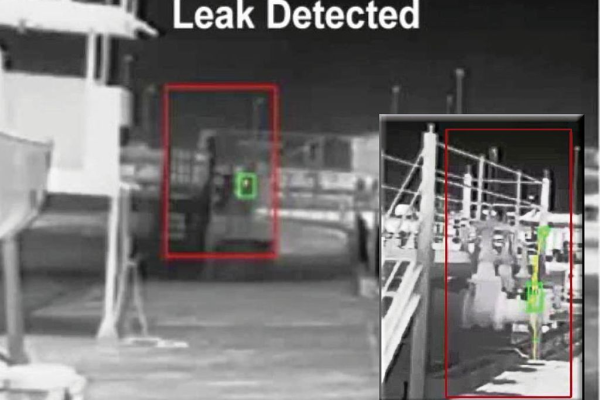
The infrared sensor, which is most commonly used to monitor machine equipment, is an electronic device that detects infrared rays emitted from objects and can be used to detect obstacles and measure temperature and humidity. In the smart factory industry, infrared sensors can be used in transportation vehicles such as forklifts to prevent collisions inside warehouses. In addition, it can be used in a wide range of fields, such as detecting changes in the amount of infrared rays emitted and measuring the heat of moving objects.
The main issues in smart factory technology can be divided into sensor, circuit, and system technology. In particular, the key issues for sensors are detection methods and detection structures, and the main issues are high performance (mechanical/electrical, optical/electronic sensors), miniaturization (MEMS sensors), multi-functionality (composite sensors), and low power consumption (nano materials).
In the future, iMEMS (integrated Micro Electro-Mechanical System) that directly integrates MEMS and CMOS in the form of SoC will appear, and research and development are being conducted toward miniaturization, low-power operation, and complex sensors that can detect multiple targets simultaneously with the advancement of nanotechnology.
IoT Sensor Market to Grow 33.6% Annually by 2023 According to Markets and Markets, the IoT sensor market was valued at approximately USD 5.28 billion in 2018 and is expected to grow at a CAGR of 33.6% through 2023.

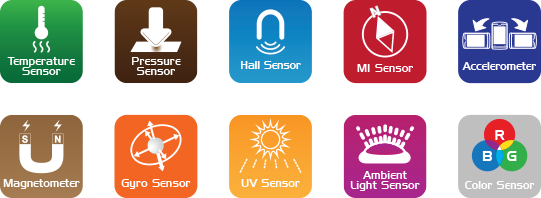
▲ Various types of sensors [Source = Rohm]
In particular, image sensors and pressure sensors are expected to have the largest market size and are expected to be actively utilized in robots and safety fields of smart factories.
However, the sensor industry has high technological entry barriers, so advanced countries and some companies are securing competitiveness in the industry and monopolizing it, with the US, EU, and Japan occupying 70% of the global market.
Companies such as Texas Instruments, STMicroelectronics, NXP, Infineon, Microchip, Bosch, Analog Devices, Qualcomm, and BroadcomIt is considered a representative company that produces smart sensors.
Domestic demand companies are procuring their sensor needs from overseas companies due to issues with the reliability of domestic products and the performance of advanced sensors, but recently, smartphone image sensors, chemical sensors that measure gas and water quality, and optical sensors that diagnose building safety using optical fibers are being supplied by domestic products.
The level of domestic sensor technology is evaluated to be at 65% of that of major countries.
As the era of the 4th industrial revolution arrives, the market is changing rapidly. Manufacturing innovation through the convergence of smart sensors, AI, and big data technologies will be of great help in securing international competitiveness. In particular, it will bring even more positive results to Korea, a manufacturing-centered country.
Park Yong-joo, a senior researcher at KETI, said at an online technology seminar of the Advanced Sensor 2025 Forum held on the 20th, "With the advent of the 4th Industrial Revolution, smart factory technology development and standard establishment are actively underway," adding, "It is concerning that American and German companies are monopolizing related technologies and standards."
He also advised, "Korea should continue to develop smart factory technology that suits its domestic circumstances through a close understanding of corporate demand and level."