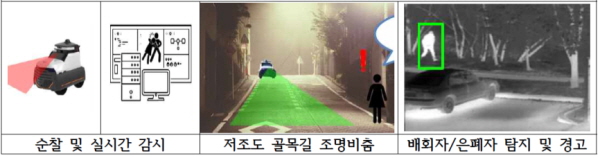
▲A patrol robot with autonomous driving functions drives through the patrol area, collects video and audio information through onboard cameras and microphones, and transmits it to the Gwanak-gu control center to provide situational analysis and rapid response services in emergency situations.
Ministry of Land, Infrastructure and Transport Approves 4 Special Cases for Smart Service Regulations
Smart city-related regulations that had prevented the application of new technologies due to regulations will be lifted as special cases, and smart city-related technologies such as autonomous driving safety patrol and AI traffic flow control are expected to be applied in earnest.
The Ministry of Land, Infrastructure and Transport (Minister Roh Hyung-wook) recently approved smart services to solve urban problems in four regions - Seoul, Sejong, Pohang, and Jeju - as part of the Smart City Regulatory Sandbox (hereinafter referred to as the Regulatory Sandbox) agenda, after deliberation by the National Smart City Committee.
With the approval of four new demonstration special cases this time, a total of 36 regulatory issues related to smart city technologies and services have been resolved since the introduction of the system in February 2020.
First, Gwanak-gu, Seoul is testing the 'Autonomous Driving Safety Patrol Service' (Gwanak-gu Office Consortium) to improve the safety of residents' lives.
A patrol robot with autonomous driving function patrols the area, collects video and audio information, transmits it to the control center to analyze the situation, and provides a service to respond quickly in emergency situations, enabling 24-hour patrols of vulnerable areas, making residents more aware of the situation. It is expected that a foundation for living with peace of mind will be established.
'Traffic Flow Control Service Using AI Technology' (Neurodyme) will be tested in Jeju City. AI cameras installed at intersections will identify the number of vehicles in each lane and automatically generate the optimal traffic signal cycle, improving the existing fixed traffic light system in which signals change at a set time cycle regardless of traffic volume.
Sejong City is demonstrating a ‘traffic signal control system using optical communication technology’ (ITS). The plan is to verify the effectiveness of the system by reducing construction costs and increasing communication speed by utilizing the existing optical communication network without installing a separate communication network for traffic signal control.
In Pohang, demand-responsive mobility (forty-two-dot) is being tested, which allows taxi sharing and sets routes in real time according to travel demand.
If this is reflected in public transportation policy, it is expected that citizens' waiting time for public transportation will be reduced and convenience will be increased.
To more quickly apply the smart city regulatory sandbox and improve convenience for businesses, some improvements will be made to the way the system operates.
Currently, regulatory confirmation and special exception applications are only possible through the Korea Agency for Infrastructure Technology Advancement, but starting this year, the Smart City Regulatory Sandbox can also be utilized through the Korea Chamber of Commerce and Industry.
With the business-friendly Korea Chamber of Commerce and Industry added as an applicant organization, it is expected that companies will be able to utilize regulatory exceptions more conveniently.
For regulatory exceptions with simple content or those that have already been reviewed, the fast track system will be utilized to shorten the processing period from an average of 100 days to less than 60 days.
In addition, in order to support applicant companies that are experiencing difficulties due to a lack of expertise in law and patents, lawyers and patent attorneys with expertise in various technical fields such as transportation, logistics, energy, and medicine will be utilized as support personnel.
Kim Bok-hwan, director of urban policy at the Ministry of Land, Infrastructure and Transport, said, “We will continue to work to ensure that companies seeking to experiment with new innovative services can obtain the benefits of practical regulatory exceptions more quickly and conveniently.”