▲ 2022 Kia Investor Day video capture
EV Acceleration… 1.2 Million Electric Vehicles to be Sold by 2030
Technology-centered product strategy… Connectivity and autonomous driving Kia plans to launch at least two electric vehicles per year by 2027, building a total lineup of 14 vehicles, and is targeting domestic and international markets with a technology-centered commercialization strategy.
Kia held the '2022 CEO Investor Day' on the 3rd and revealed its 2030 mid- to long-term business strategy.
The core goals of the strategy include the 'EV acceleration strategy' to record 1.2 million electric vehicle sales by 2030 and the 'connectivity service' to always keep the vehicle's condition and various technologies up to date.
■ EV Acceleration Strategy
Kia also announced its EV acceleration strategy to launch two or more electric vehicles every year until 2027, including the flagship EV9 model in 2023, to build a full lineup of 14 electric vehicles and achieve sales of 1.2 million electric vehicles by 2030.
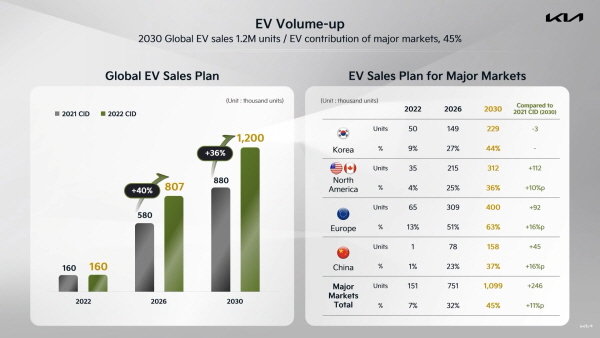
Starting with 160,000 electric vehicles this year, the goal is to sell 807,000 units by 2026 and 1.2 million units by 2030.
This is based on last year's 'CEO Investor Day&r' as of 2030.This figure is approximately 36% higher than the target number (877,000 units) announced at the time.
In particular, it plans to sell 1.099 million units in the four major markets and increase the proportion of electric vehicle sales in total sales in those markets to 45% by 2030.
All new vehicles released in 2025 will be equipped with connectivity services to enable performance to be updated and optimized through wireless updates (Over the Air, OTA), and all new vehicles sold in advanced markets will be equipped with advanced autonomous driving functions in 2026.
Kia plans to launch at least two electric vehicles per year, including the EV9, starting in 2023, and build a full EV lineup of 14 models by 2027.
This is an addition to the existing plan to launch 11 models by 2026, including a dedicated electric pickup truck, a strategic electric pickup truck for emerging markets, and three economical (entry-level) electric vehicles.
Kia expects its flagship electric vehicle, the EV9, to prove its competitiveness in electric vehicles.
Despite being a large SUV measuring 5m in length, the EV9 has secured a maximum driving range of approximately 540km on a single charge, a driving range of 100km with a 6-minute charge, and acceleration performance that reaches 100km/h in 5 seconds from a standstill.
It will be the first Kia model to implement the controller OTA and the FoD (Feature on Demand) service that allows customers to selectively purchase software functions according to their needs, thereby implementing electric vehicles as smart devices. It will also be the first to apply advanced autonomous driving technologies, including the Level 3 autonomous driving technology HDP (Highway Driving Pilot).
Kia is establishing a battery supply and demand strategy and is advancing battery technology as the demand for batteries is expected to increase significantly from 13 GWh in 2022 to 119 GWh in 2030 due to the expansion of electric vehicle sales.The fire is also being promoted.
In addition, we plan to establish a stable battery supply system by procuring batteries from an Indonesian battery cell joint venture and outsourcing to global battery companies in parallel, and by advancing battery technology, we plan to increase battery energy density by 50% and reduce system costs by about 40% by 2030, thereby enhancing performance and price competitiveness.
■ Product strategy centered on connectivity services and autonomous driving technology
Kia has selected connectivity services, autonomous driving technology, performance, and design as its core products to lead the future mobility market, and will mobilize all of its capabilities to develop differentiated products.
Kia plans to launch all new vehicles as connected cars by 2025. As connectivity services enable OTA and FoD services, customers will be able to keep their vehicles' status and various technologies up to date at all times.
To this end, we plan to build a car cloud with 10 million user data within this year, and are developing an integrated controller that centrally controls all vehicle functions.
Furthermore, we will also accelerate the discovery of new business opportunities in various mobility service areas such as car sharing, car hailing, and delivery services based on software and connectivity services.
In relation to autonomous driving, Kia has branded its own specialized autonomous driving technology and named it 'AutoMode', and in 2023, the EV9 will apply a more advanced 'AutoMode' such as HDP that does not require driver intervention on highway sections.
Kia's 'Auto Mode' goes beyond Highway Driving Assist (HDA) to support △performance optimization through wireless updates △HDP that does not require driver intervention on highway sections △autonomous lane change △smart cruise control linked to navigation based on high-precision maps, and plans to implement fully autonomous driving in the future.
The plan is to increase the rate of application of 'auto mode' autonomous driving technology to 100% of new cars sold in major markets such as Korea, North America, and Europe by 2026, and to more than 80% of all vehicles.
Meanwhile, Kia announced that it plans to sell 3.15 million units worldwide in 2022, taking a 3.8% market share, and that it will achieve its financial goals of KRW 83.1 trillion in sales and KRW 6.5 trillion in operating profit in 2022, with an operating profit ratio of 7.8%.