Next-generation mobile communications: Preparations must begin 10 years in advance.
6G, 1Tbps speed, 10km aerial coverage
The Ministry of Science and ICT will provide 200 billion won in support over five years, starting next year. The government announced that it will take the lead in 6G mobile communication technology following 5G.
On the 6th, the Ministry of Science and ICT established and announced a 6G mobile communications R&D promotion strategy at the 12th Science and Technology Ministerial Meeting.

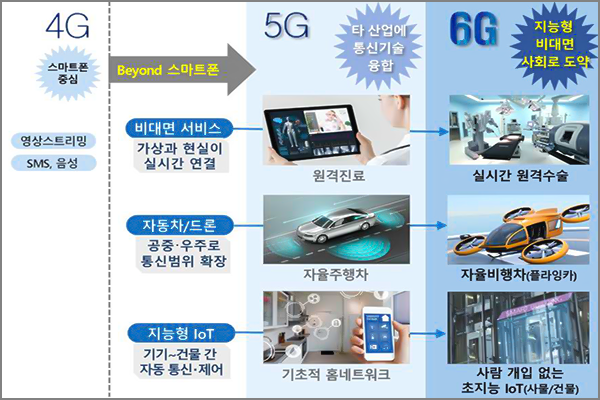
▲ 6G-based service forecast [Image = Ministry of Science and ICT]
6G is a technology that surpasses 5G, such as transmission speeds of 1 Tbps and communication coverage extended to 10 km in the air based on low-orbit satellite communication, and is the basis for popularizing advanced convergence services such as real-time remote surgery, level 5 autonomous vehicles, and flying cars.
Mobile communications infrastructure is a key component of the data highway, a key pillar of the Digital New Deal, and an essential foundational technology for national convenience and social and industrial development. Its generation typically transitions every ten years.
South Korea began preparing for 5G in 2011, immediately following the commercialization of LTE. It initiated research and development in 2013, successfully achieving the world's first commercialization of 5G. However, challenges such as a high dependence on imported core components and the slow expansion of 5G B2B services remain to be overcome.
The government has developed this strategy to secure leadership in future networks, respond to the accelerated non-face-to-face and digital transformation following COVID-19, and lay the foundation for growth in new future industries.
The Ministry of Science and ICT launched a preliminary feasibility study for the 6G core technology development project in September 2018. Through approximately 90 rounds of consultations with industry, academia, and research experts, as well as a public hearing (July 9, 2019), the basic direction of the project was established and key priorities were identified. In April of this year, a preliminary feasibility study worth a total of 200 billion won was finally approved, covering five years, starting next year.
The government anticipates commercialization of 6G to begin around 2028 to 2030, a decade later. To address the uncertainty surrounding external factors, the project will be divided into two phases. Core technology development will be focused on by 2025, while commercialization support will continue until 2028. Overall, the government will pursue eight tasks across three strategic areas: securing next-generation technologies, securing standards and patents, and fostering research and industrial infrastructure.
Pilot service starting in 2026 to secure next-generation technology We plan to overcome the technological limitations of 5G by developing core 6G technologies at a challenging level that is difficult to attract private investment in right now, such as low-orbit satellite communication technology.
Considering the uncertainty surrounding external factors such as international standardization and market requirements, a two-stage rolling plan (Stage 1: 3 years, Stage 2: 2 years) will be introduced, allowing for a partial reset of the project direction after three years of project implementation.
Considering the intensifying competition for technological leadership among major countries, including the United States and China, we will also strengthen international cooperation, including sharing the latest technological trends and promoting joint research through technological exchanges with leading research institutes and standardization organizations in each country.
Starting in 2026, when technology development is completed, we plan to support the establishment of the developed technology as a service through a 6G-Upgrade pilot project that applies Pre-6G technology (before commercialization) to the five major 5G+ services.
Leading standards and securing patents through international cooperation The International Telecommunication Union (ITU) is expected to begin international standardization of 6G starting next year. Accordingly, we plan to minimize uncertainty in the standards competition by strengthening international cooperation and conducting preemptive research at each stage of the ITU's international standardization process, including establishing a 6G vision and defining requirements.
In cooperation with the Korean Intellectual Property Office, we are developing a standard patent strategy map that focuses on technologies with a high potential for securing standard patents. We are also applying an IP-R&D approach that analyzes patents worldwide from the outset to provide R&D funding and standard patent acquisition strategies as a package to companies and institutions.
In addition, we plan to increase Korea's share in the international standardization market by fostering specialized standardization laboratories, hosting international standardization conferences, and supporting international standardization activities of domestic companies.
Expanding talent and markets through research and industrial infrastructure development We plan to develop prototypes (HW, SW) that can be used to verify the performance requirements of 6G core technologies and for the domestic production of core components and equipment, and at the time of commercialization, we plan to support R&D in the form of vouchers for promising small and medium-sized enterprises to commercialize their technologies.
We plan to strengthen the link between universities and companies participating in R&D, including theoretical training for employees and field trips for students, and to foster 6G talent through providing excellent online educational content and a real-time idea and know-how sharing platform.
Following the world's first commercialization of 5G, the first quality assessment results were unsatisfactory, sparking widespread discontent. To prevent similar issues from recurring during the 6G commercialization process, this strategy must be implemented without a hitch.