반도체 AI 인더스트리 4.0 SDV 스마트 IoT 컴퓨터 통신 특수 가스 소재 및 장비 e4ds plus

Palladium, More Expensive Than Gold, Opens Way to Recycling

기사입력2021.04.23 08:12

UNIST and Chungbuk National University, Breaking the Bonds of MOF Structures and Adding Metals
It can be used as a recyclable catalyst by adding highly active metals.


A new synthetic technology has been developed that can recycle expensive catalyst materials such as palladium, which is more expensive than gold. It is attracting attention as a technology that can reduce process costs by allowing expensive materials to be used multiple times and reduce the consumption of limited precious metal mineral resources.


A joint research team consisting of Professor Myung-Soo Na, Research Professor Seung-Bin Baek from the Department of Chemistry at UNIST (President Yong-Hoon Lee), and Professor Min Kim from the Department of Chemistry at Chungbuk National University announced on the 22nd that they have developed a synthetic technology to transform a metal-organic framework (MOF).

This is a technology that intentionally breaks the skeletal structure and inserts new metal ions. If metals such as palladium or cobalt are inserted into MOF using this synthetic technology, recyclable catalysts can be created.

The palladium catalyst synthesized with this technology maintained similar performance even after being reused more than five times. Palladium is a catalyst material essential for the synthesis of high value-added compounds such as pharmaceuticals and cosmetics, and is a precious metal whose price has recently skyrocketed to 1.5 times the price of gold due to the increasing demand for vehicle exhaust gas reduction catalysts.

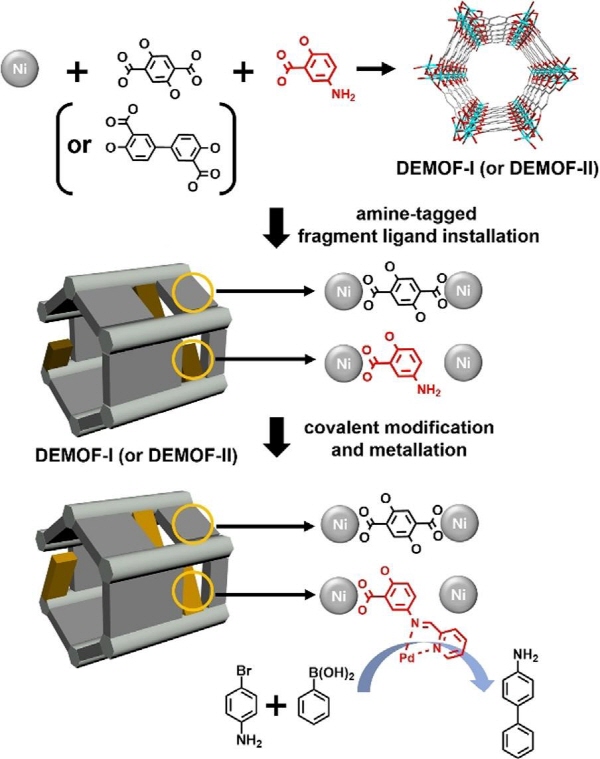
The MOF modified by the research team is MOF-74. MOF is a material that combines metal and organic matter to form a porous structural framework. Because it has many holes, it is attracting attention as a catalyst support or gas storage material. Although MOF-74 has the advantage of being easy to synthesize and very stable among MOFs, it was considered almost impossible to modify the material framework by inserting highly active catalytic metals such as platinum or palladium.

The research team artificially created a 'defect structure' where the chemical bond between metal and organic molecules was broken, and then attached an amine functional group (-NH2) to the cut site. They induced this reaction by adding an organic ligand containing an amine functional group while inducing the defect. If the functional group at the cut site is further modified, it is possible to attach palladium, cobalt, or copper metal ions to the functional group. Metal ions are attached to both ends of the organic substance, and only one of them is broken, so the three-dimensional structure is maintained.

Palladium-doped MOF-74 showed an efficiency of 70-99% as a catalyst for the Suzuki-Miyaura reaction. The Suzuki-Miyaura reaction is a chemical reaction widely used in the production of high value-added compounds such as pharmaceuticals, and uses a palladium catalyst. While general palladium catalysts cannot be reused (homogeneous catalysts), the newly developed MOF-74 catalyst (heterogeneous catalyst) can be reused. The experimental results showed that similar performance was maintained even after being reused five times.

Professor Namyeong Su said, “This has great academic significance in that it is a new approach that induces defects in the structure, allowing us to insert functional groups into MOFs as desired to impart additional functionality.” He added, “If we are successful in commercializing the manufacturing technology, it will also be valuable as a new catalyst manufacturing technology that can drastically reduce the soaring consumption of precious metal palladium.”

This study was recognized for its excellence and was selected as the front cover paper of Angewandte Chemistry (Angewandte Chemistry, Int. Ed.), an authoritative journal in the field of chemistry, and was published online on April 19. The research was conducted with the support of the Leading Research Center (SRC) and the Creative Challenge Research Base Support Project hosted by the National Research Foundation of Korea.