Microchip LAN8770 Ethernet PHY
Consumes less than 15µA of power in sleep mode
No need to use a separate external reference clock Vehicular networks rely heavily on partial networking, where parts of a segment go to sleep and wake up as needed.

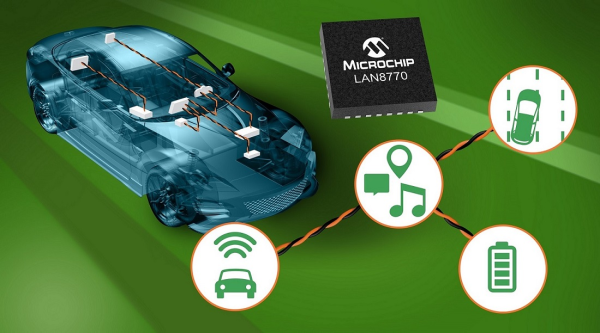
▲ LAN8770 Ethernet PHY [Image = Microchip]
Microchip Technology Inc. announced on the 29th the OPEN Alliance TC10 sleep standard Ethernet PHY 'LAN8770' that consumes less than 15 µA in sleep mode.
The LAN8770 is a single-port configuration 100BASE-T1 Ethernet PHY that is compliant with IEEE 802.3bw-2015 and is available in a 5×5 mm or 6×6 mm wettable-flank QFN package. It provides Internet transmission and reception speeds of up to 100 Mbps over a single UTP (Unshielded Twisted Pair), meets automotive EMI requirements, and satisfies automotive AEC-Q100 Grade 1 (-40°C to +125°C) specifications.
Additionally, as a product that has received Microchip Functional Safety Ready certification, it supports hardware safety-specific Function, Effect, and Diagnostic Analysis (FMEDA) and safety manual, simplifying the ISO26262 safety certification process for the final product.
The LAN8770M and LAN8770R support communication with Ethernet MAC based on the standard MII/RMII and MII/RMII/RGMII interfaces, respectively. For RGMII and RMII applications, a 125MHz or 50MHz reference clock output is provided, eliminating the need for an external reference clock.
“Typically, an automotive module will consume up to 100 µA of power in sleep mode,” said Charles Forni, vice president of Microchip’s USB and Networking business unit. “If the PHY alone consumes more than 50 µA, additional circuitry is needed to ensure that the target current budget is not exceeded.”
“Microchip’s new PHY eliminates the need for additional wires or CAN buses to enable or disable power, minimizing time and cost,” he said.