인피니언 7월21일부터
Physical AI HBM Smart Factory SDV AIoT Power Semicon 특수 가스 정정·반론보도 모음 e4ds plus

Strong, flexible soft robots made with 3D printers

Google 우선 소스 기사입력2020.08.27 15:51

Development of a method for fabricating soft robots with tensegrity structures
Implementation using 3D printing and etching manufacturing methods simultaneously


A technology to create a strong yet flexible soft robot has been developed by domestic researchers.
▲ UNIST Professor Jiyoon Kim’s team [Photo = UNIST]

Professor Ji-Yoon Kim's team from the Department of Materials Science and Engineering at Ulsan National Institute of Science and Technology (UNIST) announced on the 27th that they have developed a soft robot manufacturing technology. This achievement was published online on August 26th in the authoritative journal in the field of robotics, 'Science Robotics', under the title '3D Printed Programmable Tensegrity for Soft Robotics'.

Recently, new types of robots such as care robots and pet robots are emerging. These robots that accompany people must be soft and flexible. However, when making soft robots, it is difficult to implement a complex robot drive system if you only rely on the soft properties of the material itself. This is why research is being conducted on methods of implementing robots by mixing various materials and creating special structures.

Accordingly, Professor Kim Ji-yoon's team developed a product manufacturing method that can apply tensegrity structures to various soft robot designs. Tensegrity structures are structures in which materials with different properties are connected in the air, making it difficult to create robots with this structure using general 3D printing techniques.
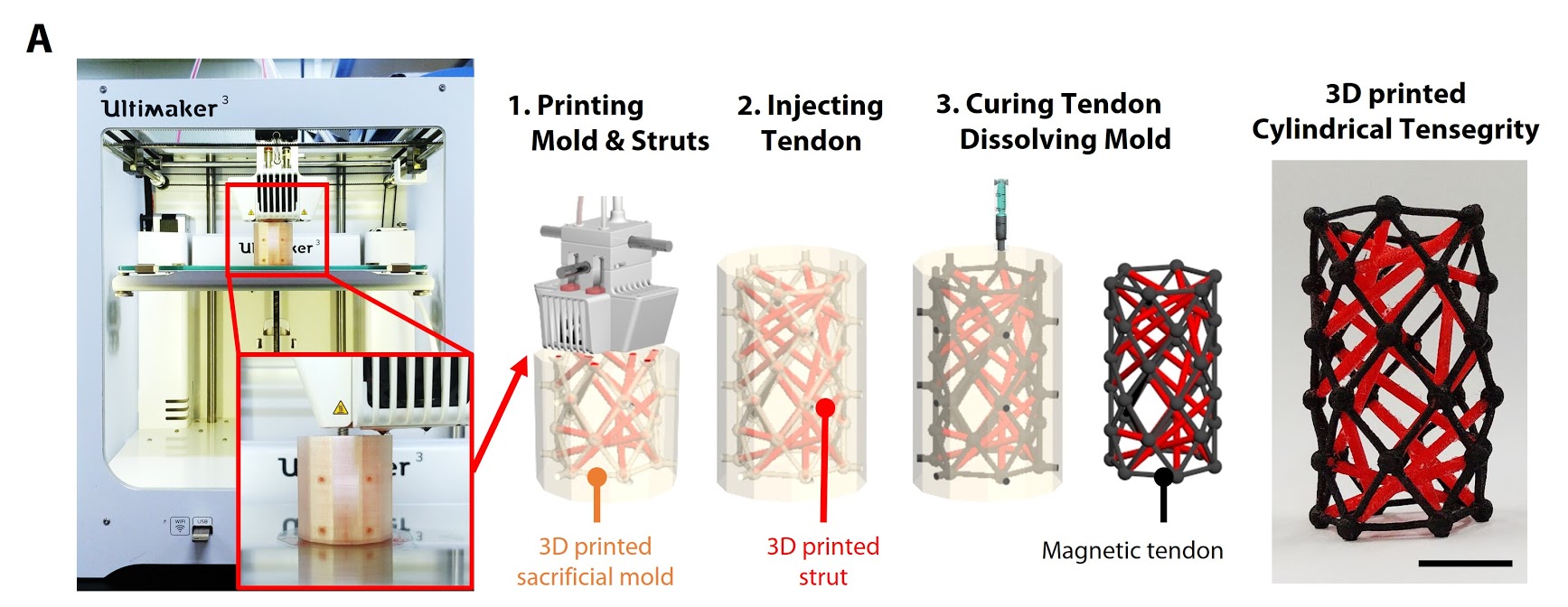
▲ Tensegrity structure manufacturing process [Image = UNIST]

The research team devised a method to implement a tensegrity structure using 3D printing techniques and a sacrificial mold that can dissolve in water. Using a 3D printer, they print a material (compressive material) that can withstand a large load and a sacrificial mold, and then insert a flexible material (tensile material) inside the sacrificial mold. Since the sacrificial mold dissolves in water, it can be easily removed.

Researcher Lee Ha-jun, the first author, said, “We were able to easily implement a complex tensegrity structure by combining 3D printing, a representative bottom-up manufacturing method, with etching, a top-down manufacturing method.”

Bottom-up manufacturing is a manufacturing method that gradually creates a desired shape by stacking, attaching, and connecting small basic units, and 3D printing is a representative example. Top-down manufacturing is a manufacturing method that gradually creates a desired shape by cutting, carving, and removing large blocks, and includes CNC lathes.

◇ Smart magnetic materials can be used to move on their own

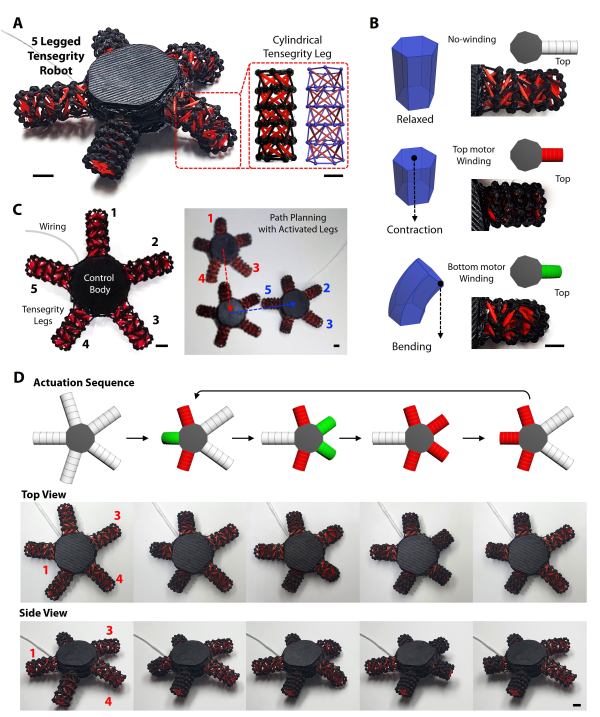
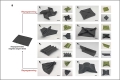
The research team used the developed structure manufacturing method and design technique to create tensegrity structures of various shapes, including a cube, toroid, and prism. They also assembled a five-legged, electrically-driven starfish robot using the created tensegrity structure as a basic module.

Since the tensegrity structure is applied, it is possible to walk forward or change the direction of movement. If a smart material that moves on its own with external stimuli is applied here, a robot that moves on its own can also be created. In fact, the starfish robot that the research team created can shrink and unfold on its own by applying a smart magnetic material.
▲ Shape and behavior of the snail robot [Image = UNIST]

Professor Kim Ji-yoon explained, “By utilizing the characteristics of the tensegrity structure, we can create various metastructures (artificial composites with different properties from the materials that make up the structure) that have unique mechanical properties that do not exist in nature.”
이수민 기자
기사 전체보기