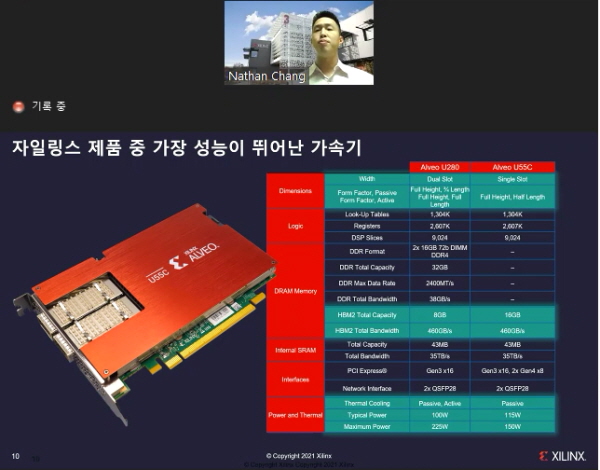
▲네이선 창 자일링스 매니저가 온라인 발표를 하고 있다.
가장 높은 컴퓨팅 밀도·HBM 용량 제공뛰어난 컴퓨팅 성능·대규모 스케일 아웃
적응형 컴퓨팅 부문의 선두주자인 자일링스(Xilinxⓡ)가 HPC 및 빅데이터 작업부하를 위해 가장 강력한 성능의 알베오 U55C 가속기 카드를 출시하며, 기존의 데이터센터 인프라 및 네트워크에서 강력한 FPGA 기반 HPC 클러스터링 구현에 나섰다.
자일링스는 16일 기자간담회를 개최했다.
기자간담회 발표를 담당한 네이선 창(Nathan Chang) 자일링스 데이터센터 그룹 HPC 제품 매니저는 고성능 컴퓨팅(HPC : High Performance Computing)이 전력소모 문제가 차기 과제로 대두될 것이며, 일반적인 HPC 아키텍처는 적정한 와트 당 성능을 제공하는데 어려움을 겪게 될 것이라며, 클럭주기 낭비, 작업량 감소, 전력소모의 증가 문제를 지적했다.
이에 자일링스가 ‘SC21 슈퍼컴퓨팅 컨퍼런스’를 통해 대규모로 FPGA를 구축할 수 있는 새로운 표준 기반 API 지원 클러스터링 솔루션과 알베오 U55C(Alveo™ U55C) 데이터센터 가속기 카드를 출시한다고 밝혔다.
HPC 및 빅데이터 작업부하를 위해 특별히 구현된 새로운 알베오 U55C 카드는 자일링스 알베오 가속기 포트폴리오 중 가장 높은 컴퓨팅 밀도와 HBM 용량을 제공하는 가장 강력한 알베오 가속기 카드이다.
또한 대규모 컴퓨팅 작업부하를 처리하는 광범위한 고객들은 새로운 자일링스 RoCE v2 기반 클러스터링 솔루션을 이용해 기존의 데이터센터 인프라 및 네트워크에서 강력한 FPGA 기반 HPC 클러스터링을 구현할 수 있다.
알베오 U55C 카드는 낮은 150W의 최대 전력으로 단일 슬롯 FHHL(Full Height, Half Length) 폼팩터로 구현됐다.
이전 제품인 듀얼 슬롯 알베오 U280 카드 대비 두 배에 이르는 16GB HBM2와 탁월한 컴퓨팅 밀도를 제공한다. U55C는 고밀도 알베오 가속기 기반 클러스터를 생성할 수 있도록 더 작은 폼팩터로 더욱 뛰어난 컴퓨팅 성능을 지원한다.
이는 빅데이터 분석 및 AI 애플리케이션과 같이 확장이 필요한 빅 컴퓨팅과 고밀도 스트리밍 데이터 및 높은 IO가 수반되는 수학 문제를 해결할 수 있다.
RoCE v2 및 데이터센터 브릿징과 200Gbps 대역폭을 활용하는 API 기반 클러스터링 솔루션은 공급업체에 종속되지 않고 성능 및 처리지연 측면에서 인피니밴드(InfiniBand)에 준하는 알베오 네트워크를 구현할 수 있다.
또한 HPC 개발자들은 통합 MPI를 통해 자일링스 바이티스(Vitis™) 통합 소프트웨어 플랫폼에서 알베오 데이터 파이프라인을 스케일 아웃(Scale-Out)할 수 있다.
이제 기존의 개방형 표준 및 프레임워크를 활용하여 서버 플랫폼 및 네트워크 인프라와 공유 작업부하 및 메모리와 상관없이 수백 개의 알베오 카드를 확장할 수 있다.
소프트웨어 개발자 및 데이터 과학자는 바이티스 플랫폼을 활용하여 애플리케이션 및 클러스터의 하이-레벨 프로그래밍 기능으로 알베오와 적응형 컴퓨팅의 이점을 누릴 수 있다.
자일링스는 하드웨어 전문지식이 없는 소프트웨어 개발자와 데이터 과학자들이 적응형 컴퓨팅에 보다 쉽게 접근할 수 있도록 바이티스 개발 플랫폼과 툴 플로우에 상당한 투자를 진행했다.
파이토치(Pytorch) 및 텐서플로우(Tensorflow)와 같은 주요 AI 프레임워크는 물론, C, C++ 및 파이썬(Python)과 같은 하이-레벨 프로그래밍 언어를 지원함으로써 개발자들이 특정 API 및 라이브러리를 사용해 도메인 솔루션을 구현하거나 자일링스 소프트웨어 개발 키트를 활용하여 기존 데이터센터 내의 주요 HPC 작업부하를 쉽게 가속화할 수 있도록 지원한다.
네이선 창(Nathan Chang) 자일링스 데이터센터 그룹 HPC 제품 매니저는 “새로운 자일링스 HPC 클러스터링 솔루션을 통해 기존의 고객 인프라 및 네트워크 전반에 걸쳐 대규모 스케일 아웃이 가능하고, 소프트웨어 개발자 및 데이터 과학자들은 애플리케이션 및 클러스터의 하이레벨 프로그래밍 기능을 통해 자일링스 적응형 컴퓨팅의 이점을 활용할 수 있다”고 전했다.

▲자일링스 알베오 U55C