ISSCC 2022, 韓 역대 최다 41편 논문 채택
기사입력 2021.11.17 14:52
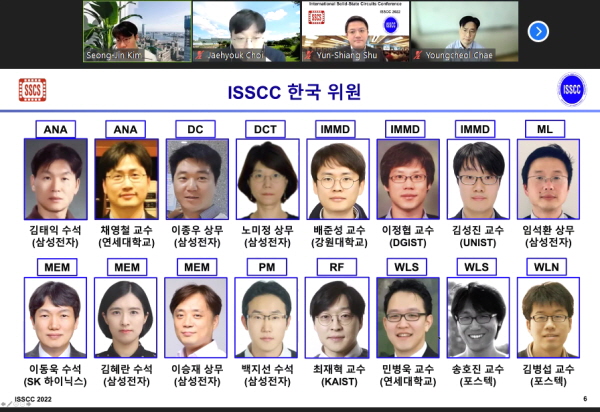
▲ISSCC 한국 위원 명단
삼성전자 16편 기관 1위·KAIST 10편 대학 1위
IMMD·MEM 각 6편 활발, TD·WLN 1편 아쉬움
IMMD·MEM 각 6편 활발, TD·WLN 1편 아쉬움
내년 2월 미국에서 개최되는 국제고체회로학회(ISSCC 2022) 행사에서 우리나라가 역대 최다 논문 편수인 41편이 채택돼 반도체 관련 연구에서 우수한 성과를 거두고 있는 것으로 나타났다.
ISSCC는 17일 온라인을 통해 기자 간담회를 갖고 내년 2월20일부터 24일까지 5일간 미국 샌프란시스코 메리어트 호텔에서 ‘ISSCC 2022 컨퍼런스’를 개최한다고 밝혔다.
이번 행사는 지속 가능한 세상을 위한 지능형 반도체를 주제로 전력 소모를 낮추기 위한 복잡한 디지털/아날로그 회로와 이에 기반한 새로운 기계학습용 하드웨어 및 다양한 센서 시스템뿐만 아니라 전력소모를 최적화하면서 최고의 성능을 유지하는 망 내외 통신 회로를 소개할 예정이다.
또한 시스템 구동 시간을 늘리기 위한 전력관리 회로 기술과 제조 공정에 영향을 덜 받으면서 재활용에 용이한 혁신적인 회로 기술도 소개될 예정이다.
기조연설에는 강인엽 삼성전자 시스템 LSI사업부장 사장이 ‘The Art of Scaling : Distributed and Connected to Sustain the Golden Age of Computation’을 주제로 발표를 할 예정이다.
기업 초대 발표는 8개 발표가 진행되며, 34개의 테크니컬 세션과 6개의 포럼, 6개의 이브닝 이벤트가 열릴 계획이다.
이번 행사에서는 651편의 논문이 제출돼 200편의 논문이 채택됐으며, 한국 채택 논문은 41편으로 역대 최다를 기록했다.
이중 삼성이 16편으로 전체 기관 1위를 기록했고, KAIST가 10편으로 전체 대학 순위 1위를 기록했다. 발표 기관은 △삼성전자 16개 △KAIST 10개 △포항공대 5개 △SK하이닉스 3개 △UNIST 3개 △연세대학교 2개 △서울대학교 2개 △고려대학교 1개 △DGIST 1개로 총 9개 기관이 발표했다.
기술 분과별로는 우리나라가 IMMD(Imagers, MEMS, Medical and Displays) 및 MEM(메모리) 분과에서 각각 6개로 가장 많은 논문이 채택됐고, TD(Technology Directions) 및 WLN(Wireline)에서는 각각 1개로 국내 반도체 연구의 취약한 분야를 반영했다.
행사 발표 이후에 진행된 Q&A 세션에서는 국내 반도체 현주소 및 위기와 기회 등에 대해 질문과 답변이 오갔다.
삼성전자의 경우 메모리분야 이외에도 시스템 반도체 관련 논문이 증가하고 있으며, ISSCC 논문의 경우 엔지니어의 기술적 성과 및 산업에 기여하는 점 등을 고려해 회사 차원에서 장려하고 있는 것으로 나타났다.
전기차와 관련해서는 GAN 발표는 중국 및 유럽 발표가 많은 편으로 GAN 디바이스를 이용해 수백볼트의 고전압을 바로 1∼5볼트로 떨어트리는 시도에 관련 논문 등이 제출된 것으로 알려졌다.
또한 자동차 반도체 연구와 관련해서는 삼성전자 등에서 최근 중시하는 분야로 자동차 산업 특성상 안정성이 중시되므로 일반 스마트폰 반도체보다 3배 이상의 개발 및 테스트 시간이 걸릴 것으로 보고 있으며, 삼성전자의 경우 전장 반도체를 긴 시간을 두고 기술을 리딩하려고 애쓰고 있는 것으로 전해졌다.
입출력을 담당하는 와이어라인 부분은 투자비가 많이 드는 연구분야로 연구비 확보 문제 등으로 인해 선진국대비 기술격차가 점점 벌어지고 있는 것으로 전해지며, 국내 반도체 분야 중 가장 취약한 분야로 적극적인 투자 및 육성이 절실한 것으로 분석됐다.

관련뉴스
-
반도체 올림픽 ISSCC 2017 '스마트한 세상 위한 지능칩’ 주제로 열려
1954년 처음 개최돼 내년 64회째(2월 5일~9일 미국 샌프란시스코)를 맞이하는 이 학회는 IEEE 반도체 집적회로 시스템 및 시스템 집적 분야의 학회 중 가장 권위 있는 학회로 IEDM(국제전자소자회의)와 함께 반도체 및 고체회로 분야의 양대 산맥을 이루고 있다. 현재 25개국 3천여 명의 학자들과 연구원들이 참여하고 있는 이 학회에서는 인텔과 삼성전자 등이 자신들의 새로운 CPU나 DRAM을 이곳을 통해 발표해왔으며 KAIST, 유럽의 IMEC 등 세계적인 연구기관들은 시대에 앞선 기술들을 선보이며 주목을 받았다.
2016-11-21 오후 4:55:42by 신윤오 기자

많이 본 뉴스
[열린보도원칙] 당 매체는 독자와 취재원 등 뉴스이용자의 권리 보장을 위해 반론이나 정정보도, 추후보도를 요청할 수 있는 창구를 열어두고 있음을 알려드립니다.
고충처리인 장은성 070-4699-5321 , news@e4ds.com