KITECH Webinar_~7.22
Physical AI HBM Smart Factory SDV AIoT Power Semicon 특수 가스 정정·반론보도 모음 e4ds plus

Semiconductor Design Competition, 'KAIST' Wins Presidential Award

Google 우선 소스 기사입력2021.11.23 09:32


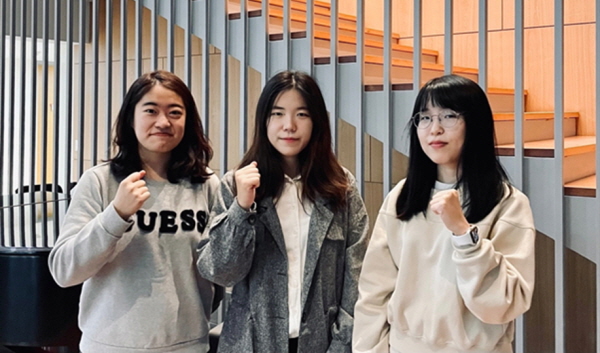
▲KAIST ICSL (from left) received the Presidential Award at the '22nd Korea Semiconductor Design Competition', PhD candidate Jo Yoon-seo (26), PhD candidate Park Seon-ui (27), and PhD candidate Bang Ju-eun (26)


Ultra-low-noise W-band PLL for 6G communications

At the '22nd Korea Semiconductor Design Competition', a venue for talent and ideas that will lead K-semiconductors, KAIST won the prestigious Presidential Award for its 'Ultra-low-noise W-band PLL for 6G communications'.

The Ministry of Trade, Industry and Energy (Minister Sung Yun-mo) and the Korea Semiconductor Industry Association co-hosted and hosted the '22nd Korea Semiconductor Design Fair' awards ceremony at COEX in Yeoksam-dong, Gangnam-gu on the 22nd.

The 'Korea Semiconductor Design Competition' was first held in 2000 to foster human resources in the semiconductor design field and discover creative ideas. This year marks the 22nd event. Since 2017, it has been co-hosted by the Ministry of Trade, Industry and Energy and the Korea Semiconductor Industry Association, and is currently the only specialized semiconductor design competition in Korea.

The 'Korea Semiconductor Design Competition' selects the final work through a document review based on the design results created by simulating and implementing the participant's ideas into semiconductor chips and verifying them, and then awards them through presentation and demonstration.Select the small ones.

This year, a total of 40 teams from 17 universities and graduate schools across the country participated in the Semiconductor Design Competition.

The Presidential Award went to KAIST ICSL, the Prime Minister's Award went to Yonsei University's VLSI System Lab., the Minister of Trade, Industry and Energy Award went to Korea University's Integrated Systems Laboratory, Sogang University's ICLAB, Ewha Womans University, and Chung-Ang University's Low-Power SoC Lab, and the Patent Office Commissioner's Award went to Kangwon National University's RACAS and Pohang University of Science and Technology's EPIC Lab.

The KAIST Integrated Circuit System Laboratory, which won the Presidential Award, has introduced the first ultra-low noise 6G communication module of less than 100 fs (1,000 trillionths of a second) in the academic world. This technology is expected to advance the commercialization of 6G communication by securing a wide bandwidth for ultra-high-speed communication.

The VLSI System Lab at Yonsei University, which won the Prime Minister's Award, is expected to contribute to the popularization of OTT services such as Netflix and Disney Plus and video streaming content by introducing high-performance super-resolution technology that reduces power consumption by 32% compared to existing hardware using artificial intelligence.

The Special Corporate Awards went to Korea University (Samsung Electronics Award), Seoul National University of Science and Technology (Silicon Mitus Award), Korea University (Silicon Works Award), Pohang University of Science and Technology (Synopsys Korea Award), Korea University (SK Hynix Award), Chung-Ang University (AD Technology Award), Korea Aerospace University (Telechips Award), KAIST (Cadence Korea Award), Gwangju Institute of Science and Technology (MathWorks Korea Award), and Catholic University of Korea (Siemens EDA Award). The Korea Semiconductor Industry Association Chairman’s Award went to Gwangju Institute of Science and Technology and Kangwon National University.