“Wireless BMS, Accelerating the Transition to the Future of Automobiles”
Complete support for assembly, repair, lifespan, disposal, and data management
Increase battery pack profitability and improve electric vehicle economics
■ BMS, little interest, but support is necessary for battery innovation The electrification of passenger cars and commercial vehicles is entering a new phase. The transition from the stage of proving the feasibility of technology to the stage of mass production of luxury vehicles is clearly evident. The commercialization of technology leads to the launch of more optimized and affordable vehicles.
However, most electric vehicles (EVs) are still considered expensive or less attractive than conventional internal combustion engine vehicles, so reducing costs and improving performance are key to ensuring successful and sustainable market growth.
Reducing size, weight and cost can increase the competitiveness of battery systems throughout the vehicle's life cycle. Extending driving range also has a significant impact on the vehicle's attractiveness and competitiveness. On the other hand, as a growing number of electric vehicles reach the end of their useful life, automakers are competing to extract value from second-life batteries recovered from scrapped vehicles.
News about battery innovation often focuses on new battery packaging concepts and new materials that can store more charge than today's lithium technology.
On the other hand, there is less interest in battery management systems (BMS), which monitor the other aspects of batteries, such as the state of charge (SOC) and state of health (SOH), but there is a need to pursue and support battery innovation.
General Motors (GM) is leading the way in mass production of a new wireless BMS (wBMS) technology developed by Analog Devices (ADI) for its modular Ultium battery platform.
Wireless BMS provides automakers with new competitive advantages throughout the life of a battery, starting from when the battery module is first assembled, through use in an electric vehicle, through disposal, and if necessary, into the battery’s second life.
■ Wired battery connection - high cost, weight, and complex connection method The wireless BMS technology was developed based on an analysis of the shortcomings of the communication wiring for existing electric vehicle battery packs. This analysis was based on ADI’s expertise in providing the most accurate BMS ICs in the wireless communications field. ADI also developed the world’s most robust mesh networking technology for industrial environments.
In a conventional electric vehicle battery pack, each cell is measured by a battery management IC. The data measured by the battery management IC is transmitted to the battery pack ECU through wiring. The complexity of large battery pack structures is a result of the communication requirements within these batteries.
Battery packs are typically made up of modules, each module containing several cells. Due to natural production differences, each cell has slightly different characteristics within a specified tolerance range. To maximize battery capacity, life, and performance, key parameters of battery operation (voltage, charge/discharge current, temperature) must be individually monitored and recorded for each module.
.jpg)
▲Figure 1: A typical wired BMS network consisting of multiple components (left) and a simpler arrangement using wireless BMS technology (right)
For this reason, electric vehicle batteries require a means to measure voltage and temperature in each module or cell and transmit the measured data to the ECU processor (Figure 1). Traditionally, these connections have been made using wired methods, which have the advantage of being familiar and easy to understand.
■ Disadvantages of wired BMS However, wires also have several disadvantages. Copper wiring harnesses add weight and space.
If this space were filled with battery cells, it could provide more energy capacity.
In addition, since the wiring must be secured to the battery housing structure, there is always a potential for the connectors to experience mechanical failure, especially from vibration and shock.
In other words, wires increase development effort, manufacturing costs, and weight, while reducing mechanical reliability and usable space. This results in shorter driving ranges. Eliminating the wiring harness gives automotive OEMs new flexibility in meeting design requirements for battery pack form factors.
The complexity of battery wiring harnesses not only makes battery pack assembly difficult, but also increases costs. Wired battery packs require manual assembly and connection termination. This is not only expensive, but also a dangerous process, as high-voltage electric vehicle battery modules are delivered in a charged state. To maintain the safety of the assembly process and protect production line workers, safety rules are strictly enforced.
This is precisely why automotive OEMs need to embrace robust wireless technologies in their new electric vehicle battery system platforms.
■ Wireless BMS – The new and smart way The wireless BMS is a complete solution that automotive OEMs can easily integrate into their battery pack designs. The wireless BMS includes a wireless cell monitoring controller (wCMC) unit for each battery module and a wireless manager unit that controls the communication network, wirelessly connecting multiple battery modules to the ECU.
In addition to the wireless section, each wCMC device includes a BMS that performs highly accurate measurements of various battery parameters, allowing the application processing unit to analyze the battery's SOC and SOH.
Wireless BMS technology not only completely eliminates the issues associated with wiring harness design and assembly, but also creates additional value in the following areas over the battery life cycle:
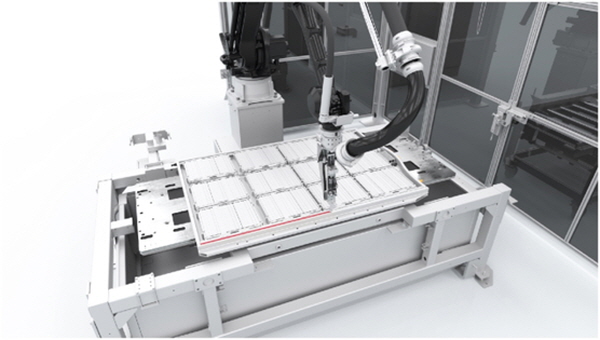
▷Battery Assembly - The only connection required on the battery module is the power connection. This connection can be easily made with a highly automated process. It also increases the safety of assembly line workers by eliminating manual assembly and testing (Figure 2). Additionally, modules can be tested and aligned before being installed into the battery.

▲Figure 2: Using a wireless BMS, battery packs can be produced using automated robots by eliminating the BMS signal wiring harness.
▷ Repair - Secure wireless functionality allows authorized service centers to conveniently analyze the condition of the battery pack using diagnostic equipment without physically checking the battery pack. If an abnormality is found, the defective module can be easily removed and replaced. The wireless configuration simplifies the installation of new modules into the battery system.
▷Secondary Life - As electric vehicles increase in number, a new secondary life battery market is emerging, where batteries from scrapped electric vehicles are recovered and repurposed for applications such as renewable energy storage systems and power tools. Wireless BMS enables modules to be more easily integrated for secondary life applications, thereby creating additional new value for EV manufacturers who are responsible for recycling or disposing of batteries from scrapped electric vehicles.
▷Disposal - Recyclable metals or hazardous materials inside the battery pack must be disposed of according to the prescribed disposal procedures. The battery module can be removed more easily and quickly than a wired battery because of the simple connection and lack of communication wiring harness.
▷Data Management - Wireless BMS technology allows for easy reading of critical battery data from each intelligent module. This means that battery health can be individually monitored. This data can provide information such as the SOC and SOH of the module, which when combined with data from the module’s initial production run can be used to optimize use in second-life applications and provide individualized detailed specifications for modules sold. Making this data readily available also increases the resale value of the module.
■ ADI’s Complete Wireless BMS Solution The wireless network protocol implemented by ADI in the wireless BMS system is based on time synchronization technology for the entire network and meets the automotive industry’s requirements for reliability, safety and security under all operating conditions. The wireless BMS has been used in GM’s mass-produced electric vehicles to demonstrate the reliability of the wireless BMS in the harshest environments. Batteries based on the wireless BMS have been installed in over 100 test vehicles and have driven hundreds of thousands of kilometers in extremely harsh environments, from paved and unpaved roads, to deserts and the frozen Arctic.
In connection with wireless BMS, ADI also supports automotive manufacturers’ programs according to the ISO 26262 functional safety standard. The wireless technology and networking protocols have been developed to ensure that the system operates resiliently in noisy environments and to provide secure communication between the monitoring device and the manager through sophisticated encryption techniques. Security measures prevent spoofing of data transmitted over the wireless network by unauthorized attackers, such as criminals or hackers. In addition, the transmitted data is received without content modification, and the intended recipients can know the exact source of the message.
■ Battery value life management Throughout the entire life cycle of a battery pack, from initial assembly through disposal and into its second life, the wireless BMS functionality embedded in the battery pack ensures that vehicle manufacturers and owners can easily track the condition of the battery, maintain performance and safety, and maximize value. The entire system, including the interaction between the cell monitoring unit and the ECU in the battery module, is handled by ADI technology, and the configuration settings are defined by the automotive OEM.
Additionally, the wireless BMS technology is supported by ADI’s battery lifecycle insight service (BLIS) technology, which provides tracking, production optimization, monitoring during storage and transport, early failure detection, and life extension through edge-based and cloud-based data software. Wireless BMS and BLIS technology help automotive OEMs increase their return on investment in battery pack development and production, improve the economics of electric vehicle business strategies, and accelerate the transition to a low-carbon and sustainable future for personal mobility.
The key to designing and implementing these battery solutions using wireless BMS lies in the understanding of the system, along with the methods and tools to support the design and technology described above. AVL provides extensive simulation, testing, and engineering capabilities and experience to successfully drive these innovations with customers and bring products to market through strategic production. AVL is developing battery ecosystem solutions by developing virtual development and data analysis methodologies and predictive functions utilizing vehicle and battery data to improve battery life and performance.
AVL and ADI are working to combine their strengths to provide smarter BMS solutions to customers worldwide.
※ author
- Stephan Prufling, Product Manager, AVL Battery Management Systems
- Norbert Bieler, Director of E-Mobility Business Development, Analog Devices (ADI)