Physical AI HBM Smart Factory SDV AIoT Power Semicon 특수 가스 정정·반론보도 모음 e4ds plus

[IT 인사이트] [Electronics: Survive the Super Cold Wave] 6G is the Key to Extreme Environment Communications

Google 우선 소스 기사입력2023.01.26 16:02


Delay must be addressed from the design stage of communication equipment.
Satellite communications in remote areas and disaster areas… Opportunities in the 6G era
SpaceX's entry into Korea is expected in the second quarter of this year.

Over the past few days, a cold wave from China has hit, causing electronic devices to suddenly malfunction.

In our country, with its subtropical and temperate climate, there was no need to worry too much, but the unexpected cold winds have brought home the need for countermeasures to ensure uninterrupted wireless communication even in disaster or extreme environments.

In reality, the connectivity of communications networks in the natural environment hinges on the communications equipment. Like automobiles, communications network equipment from companies like Ericsson, Nokia, and Samsung Electronics each have a temperature range they can withstand. They are generally earthquake-resistant and are designed and manufactured from the ground up, ensuring they can withstand temperature fluctuations, even sub-zero temperatures.

According to a telecommunications industry official, repeaters within the entire network are managed remotely to respond to environmental factors such as temperature changes such as cold waves, and additionally, engineers are checking the condition of the equipment on site.

So how can wireless communication be possible in extreme environments? Research is underway to explore new methods beyond ultrasound, optical, and RF to enable wireless communication in extreme environments like deserts, polar regions, and space. Although its potential can be found in quantum communications and satellite communications, numerous challenges remain, and research on its application to local communication networks is still in its very early stages.

Satellite communications are increasingly becoming a hot topic in the communications market, prompting calls for Korea to respond quickly. A communications industry insider stated, "While it's difficult to comment on the timing of implementation, given the lack of a national development plan, satellite communications is a next-generation communications technology undergoing high-level research globally."

■ Low-orbit satellite communications connecting the world

▲Changes in the communications service paradigm (Source: Ministry of Science and ICT)

Satellite communications is a system that provides mobile communication services using artificial satellites. Because satellites are launched into the sky, they can be used for special purposes, such as in disaster situations where standard wireless communications are unavailable, in remote areas, and on ships at sea. They are expected to be a key component of future 6G technology.

Market research firm Markets and Markets estimated the satellite communications equipment market size at $22 billion in 2021 and predicted that it would grow to $53.7 billion by 2026, at a compound annual growth rate of 19.6%. Among these, the North American market accounts for 31% of the global satellite communication equipment market, which is analyzed to be due to the high demand for small satellites in the defense, energy, and agricultural industries within the United States.

Starlink, the satellite internet business of SpaceX, of which Elon Musk is the CEO, has become a hot topic as it improves on the shortcomings of existing satellite communication networks and underwater optical cables.

Most satellite internet services are located 35,786 km above the ground, causing long latency between users and the satellite, making it difficult to provide high-speed, real-time data processing. SpaceX's low-Earth orbit communication satellites, positioned 200 to 2,000 km above the ground, compensate for this communication delay. SpaceX has announced plans to launch over 40,000 satellites by the end of the 2020s, providing high-speed internet service of up to 1 Gbps anywhere in the world.

Interest in small satellites has grown, especially since SpaceX's performance in the Russo-Russian War. The benefits of providing a communications environment independent of terrestrial wide-area networks are expected to expand into civilian areas such as autonomous vehicles and cloud services.

Earlier this year, SpaceX applied to the Ministry of Science and ICT to register as a corporation to be established as a non-equipment telecommunications service provider, and its entry into the Korean market within the second quarter of this year is becoming more visible. Although the high cost of the plan does not yet offer significant benefits to general consumers, some argue that this is a move to strengthen the competitiveness of the space industry, including Tesla's autonomous driving capabilities and satellite communications.

KT SAT Usheres in the 6G Era with Communication Satellites


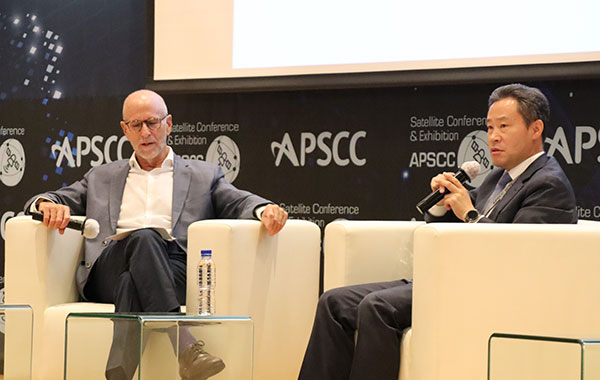
KT SAT participating in APSCC 2022
5G services via satellite complement the limitations of ground-based base stations. In the event of a disaster that disrupts terrestrial 5G networks, satellite communications can provide backup.  
KT SAT has been interested in satellite communications since 2019 and has been working hard to develop technology. The 'P-VSAT (Portable Very Small Aperture Terminal) Antenna' technology, which was introduced as a solution that can ensure network survivability and business continuity by utilizing communication satellites, is a technology that provides a backup communication network by configuring equipment such as portable satellite antennas, modems, and switches to suit the user's network.

KT SAT said, “Currently, in case of an emergency, we are using the wired network or LTE of a telecommunications company that is not affected by the disaster as a backup communication network, but since these networks are connected by wires with some exceptions, it is difficult to guarantee complete network survivability in the event of a large-scale disaster.” They added, “If this technology is applied, even if a problem occurs in the wired network, a selective detour can be created through satellite communication, which will ensure the continuity and survivability of the communication networks of the government and public institutions and create an environment where important tasks can be continuously processed.”

Additionally, KT SAT announced that it can support stable communication anytime, anywhere with satellite phones (GSPS, Global Satellite Phone Service) used as an emergency communication means in disaster situations or on ships.

Meanwhile, KT SAT is aiming for the 2024 launch of its next-generation satellite, "Mugunghwasat 6A," featuring cutting-edge satellite technology. Mugunghwasat 6A will utilize "High Throughput Satellite (HTS)" technology, which promises 10 times the data transmission throughput of existing satellites. This is expected to help address the growing traffic demand from 5G users.

The 'variable beam (S/W Defined Sat)' technology, which allows for coverage change, is also planned to be applied here. Equipped with this technology, coverage can be changed even after launch, allowing for efficient provision of communication services.

Stable 5G advancements and 6G support are also essential for developing new markets. The 6G era is expected to see a revival in next-generation mobility, such as urban air mobility (UAM). In this 6G era, where ground and air communications are integrated, fostering the K-satellite communications industry appears to be an urgent priority.