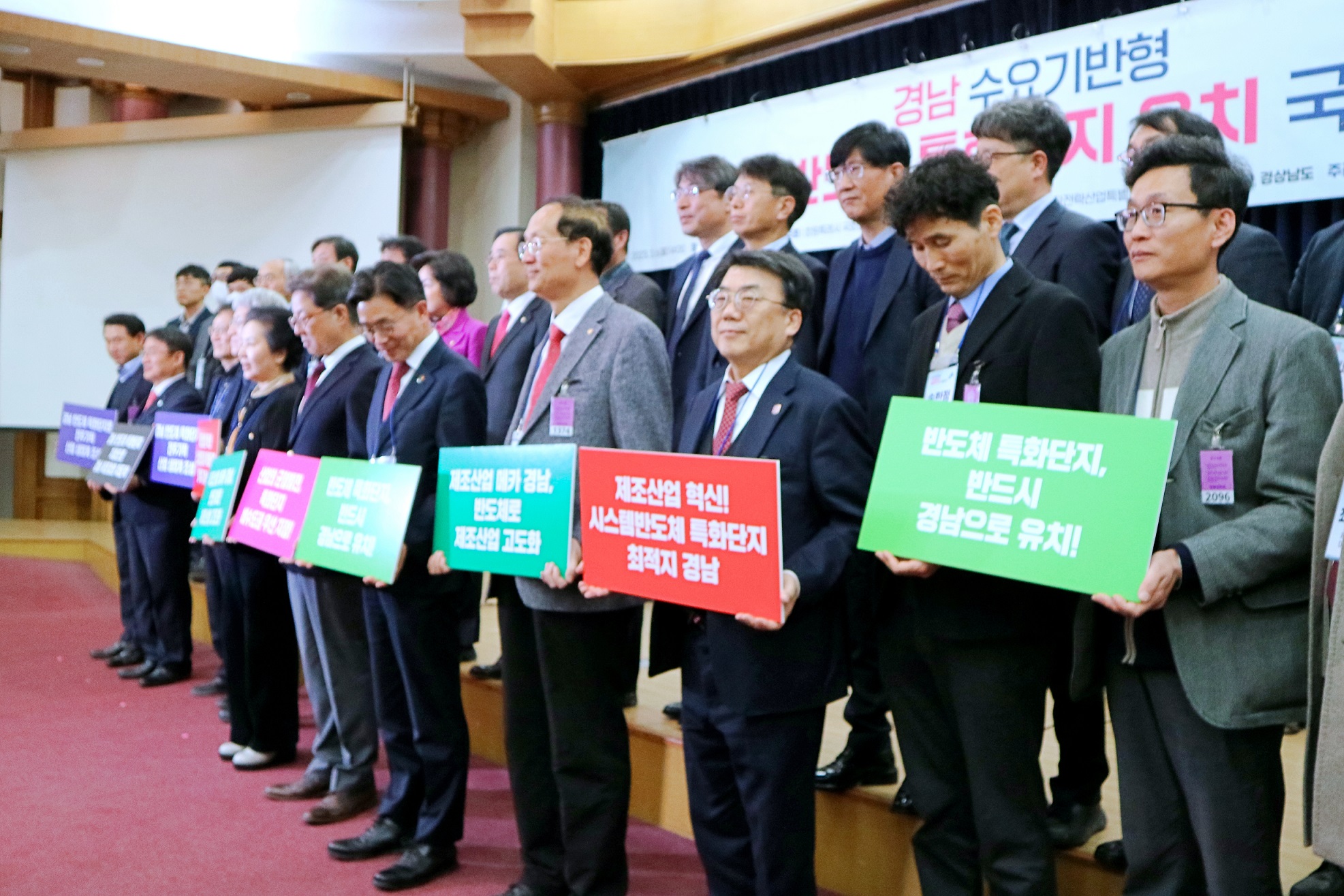
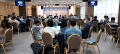
▲Panel members and officials taking a commemorative photo holding placards expressing hope for the attraction of the Gyeongsangnam-do Semiconductor Specialized Complex Attraction Strategy Forum
Gyeongnam demand-based system semiconductor specialized complex attraction strategy
The decline of the main machinery industry is being countered by specializing in power semiconductors.
As semiconductors are being praised as a key industry for national competitiveness, local governments are risking their lives in the fierce competition to attract semiconductors in the government-sponsored national high-tech strategic industry special complex public offering.
On the 8th, the ‘Gyeongnam Demand-Based System Semiconductor Specialized Complex Attraction National Assembly Forum’ was held at the National Assembly Members’ Hall in Yeouido. This forum, hosted by Gyeongsangnam-do, included presentations on the direction of fostering and training human resources for attracting specialized complexes.
Gyeongsangnam-do officials expected that the semiconductor specialized complex, which was put forward as a solution to overcome the crisis in the era of local extinction, would have great synergy effects with the region and existing major industries.
Lee Dal-gon, a People Power Party lawmaker who emphasized that Gyeongnam’s strength is its demand-based nature, expressed concern, saying, “At a time when convergence between different industries is active, such as the electrification of automobiles and robotics in the machinery industry, if Gyeongnam’s main industries of automobiles, shipbuilding, and machinery remain stuck in the past, it could face an era of regression.”
President Jeon Min-hyun of Inje University said, “The sales of the top 100 companies in Gyeongnam fell from approximately 81 trillion won in 2012 to 65 trillion won in 2021, resulting in a decrease of approximately 20% in sales.” He added, “Inje University has been working hard to foster semiconductor-related personnel by creating a convergence engineering department over the past 20 years, but more than 90% of graduates are leaving for the metropolitan area.”
Amid concerns about the regional industrial decline crisis and talent drain, local officials have raised their voices in expressing the urgent need to attract a semiconductor-specialized complex to strengthen regional competitiveness and the national industrial base.
■ Supporting the forward-looking industry with next-generation power semiconductors, GaN and SiC 
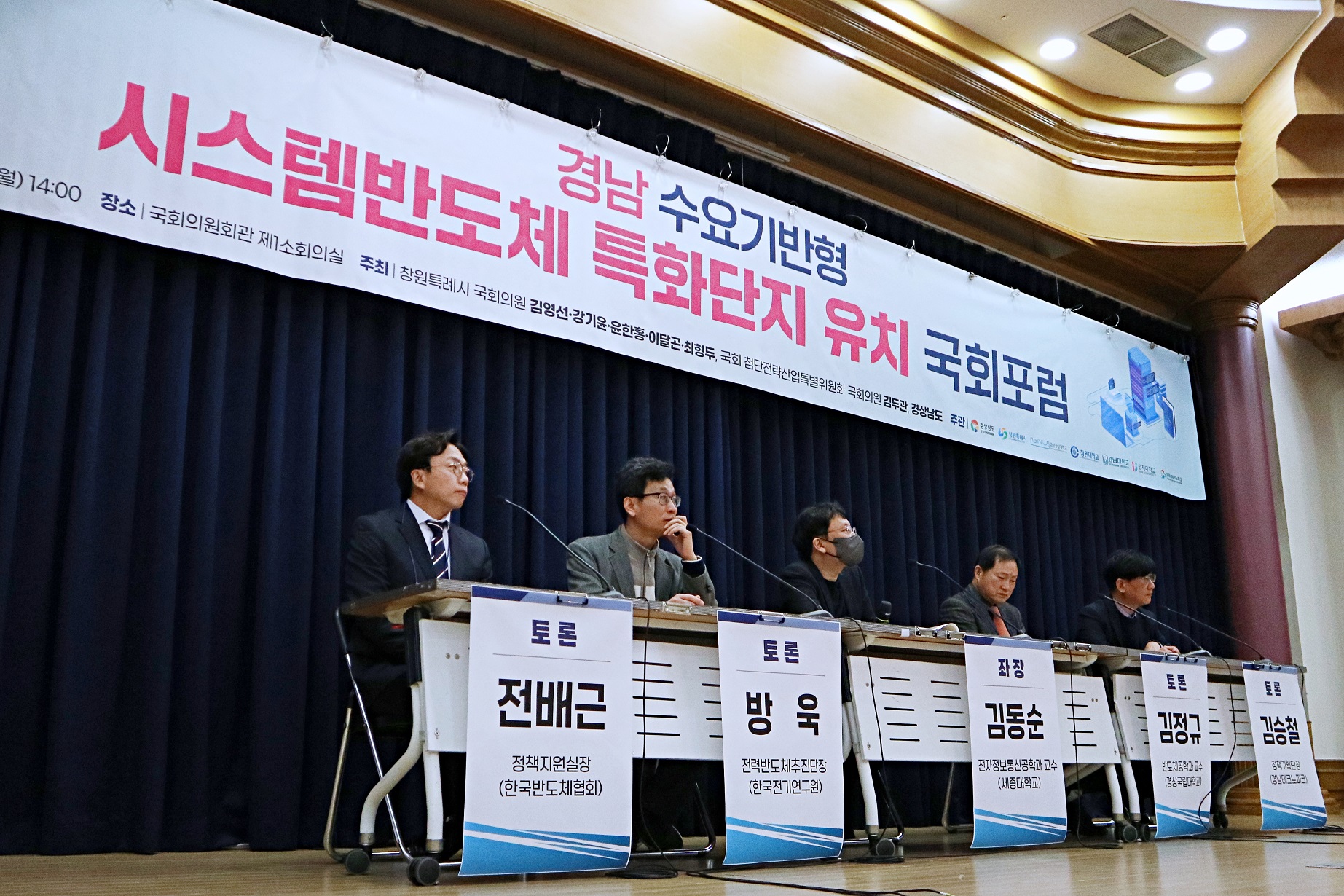
▲The panelists are conducting a discussion. (From the far right) △ Jeon Bae-geun, Director of Policy Support Office, Korea Semiconductor Association
△ Bang Wook, Director of Power Semiconductor Research Group, Korea Electrotechnology Research Institute △ Kim Dong-soon, Professor of Electronic Information and Communication Engineering, Sejong University (chair) △ Kim Jeong-gyu, Professor of Semiconductor Engineering, Gyeongsang National University △ Kim Seung-cheol, Director of Policy Planning Group, Gyeongnam Technopark The basic idea of Gyeongnam's semiconductor specialization complex blueprint is 'compound power semiconductors'. Semiconductors based on gallium nitride (GaN) and silicon carbide (SiC), which are evaluated as next-generation power semiconductors, are just beginning to form a market and are considered promising markets with high average annual growth rates.
As global compound semiconductor manufacturers such as Infineon and Wolfspeed are seeking to expand their markets, the will to foster related infrastructure and expand market position in Korea is interpreted as being included in the strategy to attract the Gyeongnam Semiconductor Specialized Complex.
Bang Wook, head of the Power Semiconductor Research Group at the Korea Electrotechnology Research Institute, evaluated Gyeongnam as the region with the highest demand for power semiconductors. Since a significant number of power modules are installed in industries such as defense and automobiles, fostering the power semiconductor ecosystem in the Gyeongnam region is the most realistic alternative.
Director Bang Wook was planning a plan to foster next-generation power semiconductors through research and development and industry technology transfer at a power semiconductor specialized complex based on the power semiconductor technology capabilities of the Electric Power Research Institute and the Materials Research Institute. In particular, the ceramic heat sink technology of Materials Research Institute is said to be excellent in responding to high heat generation in power modules.
Director Bang said, “Recently, power semiconductors have been in the spotlight for solar power generation and electric vehicle module solutions, and demand is expected to expand in the future for industrial robots and electric ship supplies,” and asserted, “Gyeongnam is well-positioned to secure competitiveness in next-generation power semiconductors and power modules.”
However, since there are not many foundry companies that can handle domestic compound semiconductor manufacturing, there is a lack of specific plans for the next step after research and development and technology transfer, which is actual product production. Therefore, attention is focused on how this issue will be resolved.
■ A total of 10 companies, including Hanwha Group, are expected to move in 
▲Hanwha Aerospace, which has a business site in Changwon, announced plans to expand by 2025. (Image: Hanwha Aerospace)
Gyeongnam is boasting of its location as an abundant location for forward and backward semiconductor demand companies linked to the Busan-Ulsan area industries in the fields of aerospace, shipbuilding and marine plants, machinery industry, and automobile parts, led by large corporations such as Hanwha Systems and Daewoo Shipbuilding & Marine Engineering.
Gyeongnam Province reported that a total of 10 companies, including Hanwha Aerospace and Hanwha Precision Machinery, have expressed their intention to move in, with plans to invest in expansion by 2025, and to build a 250,000-pyeong site in Bulmosan-dong, Seongsan-gu, Changwon-si for the Gyeongnam Semiconductor Specialized Complex.
△HL Optics (optical lens field) △JMJECO (manufacturing other semiconductor devices) △QRT (semiconductor testing & middo)t; Inspection) is scheduled to move in as a new occupant, and IceSpec (EMI/EMC filter manufacturing), Haesung DS (semiconductor packaging), Sungwoo Techron (semiconductor parts/equipment), Sungwoo Semitech (manufacturing other semiconductor devices), and Sungwoo Micron (semiconductor parts) are reported to be expanding by 2025.
Gyeongnam Province is planning to establish a high-tech specialized industrial complex and an electrical and mechanical convergence research complex on this site. Kim In-su, head of the Industrial Policy Division, said, “We see this as a region where research and development capabilities are concentrated, starting with the Electric Power Research Institute in Changwon, Gyeongnam,” and “In addition, we have a blueprint to secure 1 million pyeong of land in the Uichang-gu area of Changwon and establish the Changwon National Industrial Complex in the second phase, focusing on defense and nuclear power industries and related industries.”
Meanwhile, as of the closing date for the National Advanced Strategic Industry Specialization Complex public offering on the 27th, a total of 21 local governments have applied for hosting, and 15 of them have chosen the semiconductor industry. In particular, 7 cities in Gyeonggi Province, including Anseong, Icheon, and Pyeongtaek, have entered the public offering competition, so fierce competition is expected.