With the development of artificial intelligence, virtual reality, etc., the amount of data to be processed is increasing, but the limits of integrated circuits are approaching. So instead of gates made of transistors, quantum computers that use the principles of quantum mechanics as their operational rules are emerging as an alternative. What exactly is quantum, and how can it be an alternative? A reporter who has no connection with science takes a close look at everything from quantum to the recently popular quantum computer with a learning mind. Quantum computers utilize the superposition state of quantum. Therefore, simultaneous processing is possible. Quantum computers perform calculations through the process of maintaining the superposition state and finally obtain results by measuring.
The problem is that decoherence must be prevented in order for the superposition to be maintained. This means that it must not be measured. However, it is very difficult to avoid decoherence.
Computer work is a combination of sequential work and conditional branching. Conditional branching is to decide whether to execute the instructions that belong to a certain condition when a certain condition occurs. However, in order to decide whether to execute the instructions, we need to know whether a certain condition has occurred, which is an observation, so decoherence occurs. In other words, we need to branch without measuring. How do we do this?
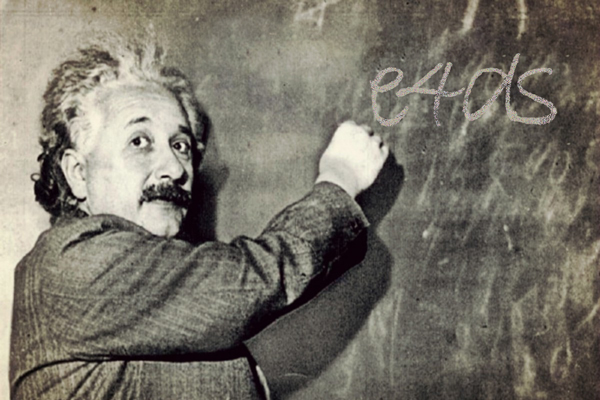
When quantum mechanics gets stuck? The answer is 'Einstein'.
EPR paradox Previous '[Quantum Review] 5. Einstein's EPR paradox, as described in the article 'The Copenhagen Interpretation Explains Quantum Mechanics', serves as an important principle for the operation of quantum computers.
In 1935, Einstein resumed his 'Quantum Mechanics Crackdown', which had been put on hold while he moved to the United States to escape Hitler. In a paper titled "Can Quantum Mechanics Explain Physical Reality Completely?", published with Boris Podolsky and Nathan Rosen, Einstein stated,
“Every element of physical reality must have a counterpart in physical theory. If, without disturbing a system in any way, the value of a physical quantity can be predicted exactly, that is, with a probability equal to 1, then there exists a physical reality corresponding to this physical quantity.”
The paper explains this with examples.

Quantum mechanically, the information in both pills is nonlocal. Put a red pill and a blue pill in each of the two boxes. Then, take any box and go to Alpha Centauri, which is 4 light years away. When you arrive and open the box, there is a blue pill. Then, the box left on Earth must have a red pill. The observation was made only on Alpha Centauri. The results were obtained without affecting the target on Earth. The color of the pills in the box left on Earth is real.
Not only the color of the pill, but also its position and momentum depend on observations from Alpha Centauri. If the two pills are moving away from each other at the same speed and in opposite directions, when one pill arrives at Alpha Centauri, the position of the other pill can be known without measuring it, because the other pill's position is real. According to the uncertainty principle of the Copenhagen interpretation, position and momentum cannot be known simultaneously. Measurement disturbs position and momentum, so they are not real. But can't we know the position and momentum of a pill on Earth based on what we measured from Alpha Centauri?
To paraphrase Erwin Schrödinger, the moment we learn that the pill brought from Alpha Centauri is blue according to the Copenhagen interpretation, the pill on Earth is determined to be red. But nothing moves faster than light in the universe. The observation result from Alpha Centauri will reach Earth in four years at the earliest. So does that mean that by then, the probability that the pill on Earth is either red or blue is 50%? But if the pill on Earth is blue and the observation result from four years later is also blue, isn't that a contradiction in the universe?
EPR concluded that this situation was wrong and that quantum mechanics was incomplete.
Einstein argued that quantum mechanics was wrong because quantum mechanical interactions appeared to travel faster than the speed of light, and because of these "nonlocal" interactions. Schrödinger called this quantum mechanical interaction entanglement and believed it to be an inherent property of quantum mechanics.
Verification of the EPR paradox If, contrary to the claims of quantum mechanics, physical quantities are determined before measurement, the paradox of EPR reality disappears. Wouldn't there always be perfect information about all physical quantities due to hidden variables that are not yet known? Then everything would be completely determined, as in classical mechanics.

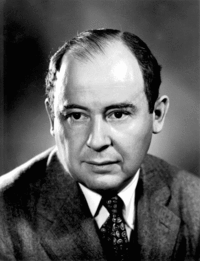
John von Neumann "There are no hidden variables" If there are hidden variables, the results of quantum mechanics are not because nature was originally like that, but because we do not yet know about it. However, von Neumann, who is called the father of computers, argued that there are no hidden variables in quantum mechanics.
In 1952, David Bohm proposed a classical quantum mechanical theory that used hidden variables to achieve exactly the same results as quantum mechanics. However, in order to properly represent entanglement, these hidden variables had to allow information to be transmitted faster than light. Bohm's nonlocal hidden variable theory was rejected by the academic community.
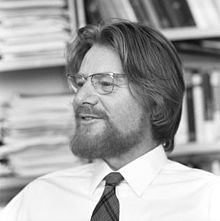
The only exception was John Stuart Bell of the European Organization for Nuclear Physics. In 1964, Bell refuted von Neumann's claim that there were no hidden variables, while at the same time insisting on verifying the EPR paradox. Bell's idea of testing the EPR paradox experimentally brought the EPR paradox out of the "philosophical" debate about whether it was real or not, and into the "physics" debate.
Bell's inequality and local hidden variables There are two more pills in the box.
Local reality means that the color of a pill is determined the moment you pick it up. Even if you take one pill far away and measure it, the color is not determined at that moment. It is only confirming that it has already been determined. Of course, you cannot know the color before measuring it. It is hidden.

How much have you researched? To achieve local reality, Bell assumed that the two pills would spin, or rotate, and behave like people.
The two pills have a list of results that they should show depending on the direction being measured. When measuring along the X-axis and asking for the direction of rotation, the red pill shows clockwise (+1) and the blue pill shows counterclockwise (-1). The answer to the two pills when split is already determined, but the observer cannot know this.
This information is the local hidden variable.
Two variables x and y can only be +1 or -1. When xy is multiplied, xy≤1. This is Bell's inequality.
However, Bell's inequality does not hold in quantum mechanics. This is because we cannot guarantee that we know exactly x and y at the same time. This is because x and y may be physical quantities that follow the uncertainty principle. What if x represents position and y represents momentum? We cannot even guarantee that this inequality holds.

John Bell: "There's a hidden variable" Therefore, if Bell's inequality holds, then there is a local hidden variable, and if it does not hold, then quantum mechanics is correct.
The answer depends on the results of the experiment. And in 1982, Alain Aspe's experiment and in 2015, the experiment of the Dutch research team proved that Bell's inequality does not hold. However, this does not mean that nonlocal realism and local non-realism are denied, but that there are no local hidden variables.
Anyway, in quantum mechanics, we assume that objects exist independently of our consciousness. We cannot confirm their reality because measurement affects them.
How Quantum Computers Work Let's recap. Computer work is a combination of sequential work and conditional branching. Conditional branching is the act of deciding whether to execute instructions that fall under a certain condition when a certain condition occurs. However, in order to decide whether or not to execute an instruction, we need to know whether a specific condition has occurred, and since this is an observation, there is a mismatch.
That is, to figure out how to branch without measuring, we need the EPR paradox and Bell's postulate.
When we look at Bell's hypothesis from the perspective of a computer, when A is 0, B becomes 1, and when A is 1, B becomes 0. If we think of A as the answer, yes (1) or no (0), and B as the action of erasing (0) or leaving it (1), then we can think of the answer and the action as being tied together. And this process is superimposed and occurs simultaneously. It is possible to proceed with the task without measuring.
In this way, quantum superposition and entanglement, which Einstein and Schrödinger claimed were nonsense, have become the key to making quantum computers possible.
Quantum computers are gradually developing. In 2001, IBM succeeded in factoring 15 using Shor's algorithm. To do this, they used seven nuclear spins. They used seven qubits. What I want to tell people who say that factoring 15 is not that great is that increasing the number of qubits is not easy.
Because it becomes difficult to prevent misalignment.
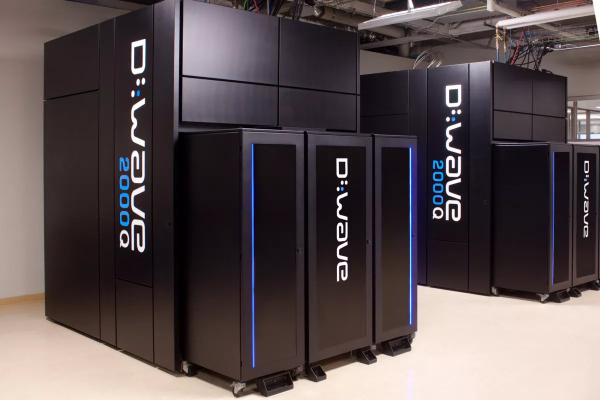
Then, in 2011, D-Wave Systems announced that it had developed a 128-qubit quantum computer.

D-Wave Systems' 2000Q quantum computer, believed to be the first quantum computer In the following article, we will learn about commercial quantum computers and their applications.
References - Kim Sang-wook's Quantum Study, Science Books, 2017.