Germany begins discussions on revising road laws to allow level 4 autonomous driving
Korean autonomous driving technology combines AI with perception, judgment, and control
Patent applications are increasing, but there is no discussion on related laws and regulations. In May, the German Bundestag voted to amend road traffic laws to allow Level 4 autonomous driving on certain fixed sections of public roads. If the amendment passes the Bundesrat, Germany will become the first country to allow fully autonomous vehicles on public roads starting next year.

▲ German House of Representatives pushes for Level 4 autonomous driving legislation [Photo = Pixabay]
Level 4 autonomous driving means that the computer has full control of the car, and no driver intervention is required. Currently, Germany only allows autonomous driving tests with safety personnel on board. If the revision passes, it is expected that self-driving cars without human safety personnel on board will also be allowed.
The German Automotive Research Center forecasted that the global autonomous vehicle market will reach 60 billion dollars by 2030. In this situation, domestic patent applications for autonomous driving technology are also increasing by an average of 9.3% per year, from 2,860 to 4,082 from 2016 to 2020.
Among these, the application rate for AI-related technologies is also increasing. According to the Korean Intellectual Property Office, domestic applications for AI technology in the autonomous driving field were less than 15 cases per year until 2015, but increased rapidly to 31 cases in 2016 and 155 cases in 2020, with an annual average increase of more than 50%. This trend appears to reflect the growing potential for AI technology in the autonomous driving field.
As autonomous driving accidents have been occurring in succession recently, skepticism about fully autonomous driving has grown, and demand for AI technology to improve the safety and reliability of autonomous driving is growing. In terms of specific technologies, applications for autonomous driving support infrastructure technologies such as dispatching and traffic control were the most numerous at 285 cases (46%), compared to autonomous driving core technologies such as recognition, judgment, and control.
In relation to autonomous driving-based technologies, 171 applications (28%) were filed for cognitive technology, 113 applications (18%) for judgment technology, and 48 applications (8%) for control technology. In particular, the large number of applications related to cognitive technology seems to be because AI technology has emerged as a key technology for accurately identifying static environmental information such as lanes and traffic signals that are important for autonomous driving, as well as dynamic environmental information such as vehicles and pedestrians.
In terms of nationality of applicants, domestic applicants accounted for over 90%, while foreign applicants accounted for less than 10%. Among domestic applicants, large corporations accounted for 23% (140 cases), universities and research institutes accounted for 22% (136 cases), medium-sized companies accounted for 5% (31 cases), small and medium-sized companies accounted for 30% (186 cases), and individuals accounted for 8% (49 cases).
Recently, applications from small and medium-sized enterprises account for nearly half of the total, indicating that technology development by small and medium-sized enterprises and venture companies in this field is actively underway.

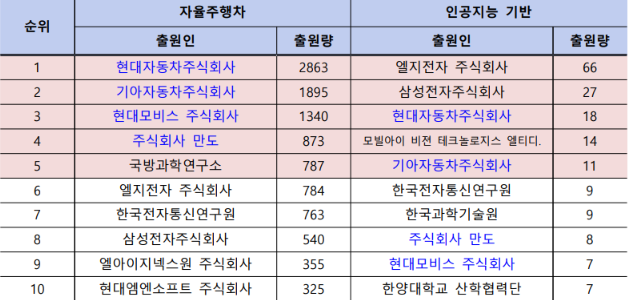
▲ Ranking of multiple applications for autonomous driving technology (1-10) [Table = Patent Office]
The companies that filed the most applications for autonomous driving technology overall are Hyundai Motor Company and Kia Motors, but when it comes to AI, IT companies are leading the way, with LG Electronics (66 applications), Samsung Electronics (27 applications), Hyundai Motor Company (18 applications), Mobileye (14 applications), Electronics and Telecommunications Research Institute (9 applications), and Mando (8 applications), followed by automakers and parts companies.
In the case of foreigners, the mainstream was global autonomous driving leading companies such as Mobileye (14 cases), Baidu (5 cases), and Waymo (5 cases). From 2011 to 2015, there were only 5 foreign applications, but in the past 5 years, the number has increased to 58, showing that foreign companies are entering the domestic market.
Kim Hee-joo, an examiner at the autonomous driving examination team of the Korean Intellectual Property Office, said, “In order to implement fully autonomous driving that humans can trust, the use of AI is essential not only in the field of cognition but also in the fields of judgment and control,” adding, “It is expected that patent applications in related fields will increase in the future.”
◇ Technological advancements are cruising, but regulatory improvements are stagnant Autonomous vehicles are expected to have the functions of perception, judgment, and control. First, the cognitive function is to identify the surrounding environment information using sensors such as cameras, radars, and lidars. Next, the judgment function is to select the safest and most effective driving option based on the recognized information, and the control function is to move the car according to the selected option.
Looking at the domestic autonomous driving technology patent application trends by technology from 2011 to 2020, there were 21,270 patents related to perception, judgment, and control, and 8,121 related to infrastructure. Of these, 617 are AI-based technologies, and their proportion is steadily increasing.
These technologies are suitable for application to robots, drones, and autonomous transport vehicles that share the same characteristics as unmanned vehicles that run on roads, in addition to complete vehicles. Since the mechanisms are similar, if adjusted to each area, they can be used in daily life as well as across industries.
The Ministry of Science and ICT announced in July that it would develop and commercialize drones and basic systems that can be used for collecting information on coastal debris sites, resurveying the national land and land, and crime prevention and patrol missions in islands and mountainous areas by the year after next. However, having the technology does not lead to commercialization right away. It is a situation where related laws and regulations need to be revised.
Currently, there are significant restrictions on attaching cameras to the outside of a vehicle to acquire video information for purposes such as creating movement paths and maps, as this may violate the Personal Information Protection Act’s provisions on the collection and use of identifiable personal information. In addition, outdoor autonomous robots are classified as vehicles under the current Road Traffic Act, and their passage on sidewalks and crosswalks is restricted. There is also no clear distinction as to whether the operator or the producer will be held responsible in the event of an unmanned vehicle accident.
There is no bird that flies with one wing. No matter how much technology is developed, if regulations block its use, the unmanned vehicle market cannot develop. It is time for us to hasten discussions like Germany.