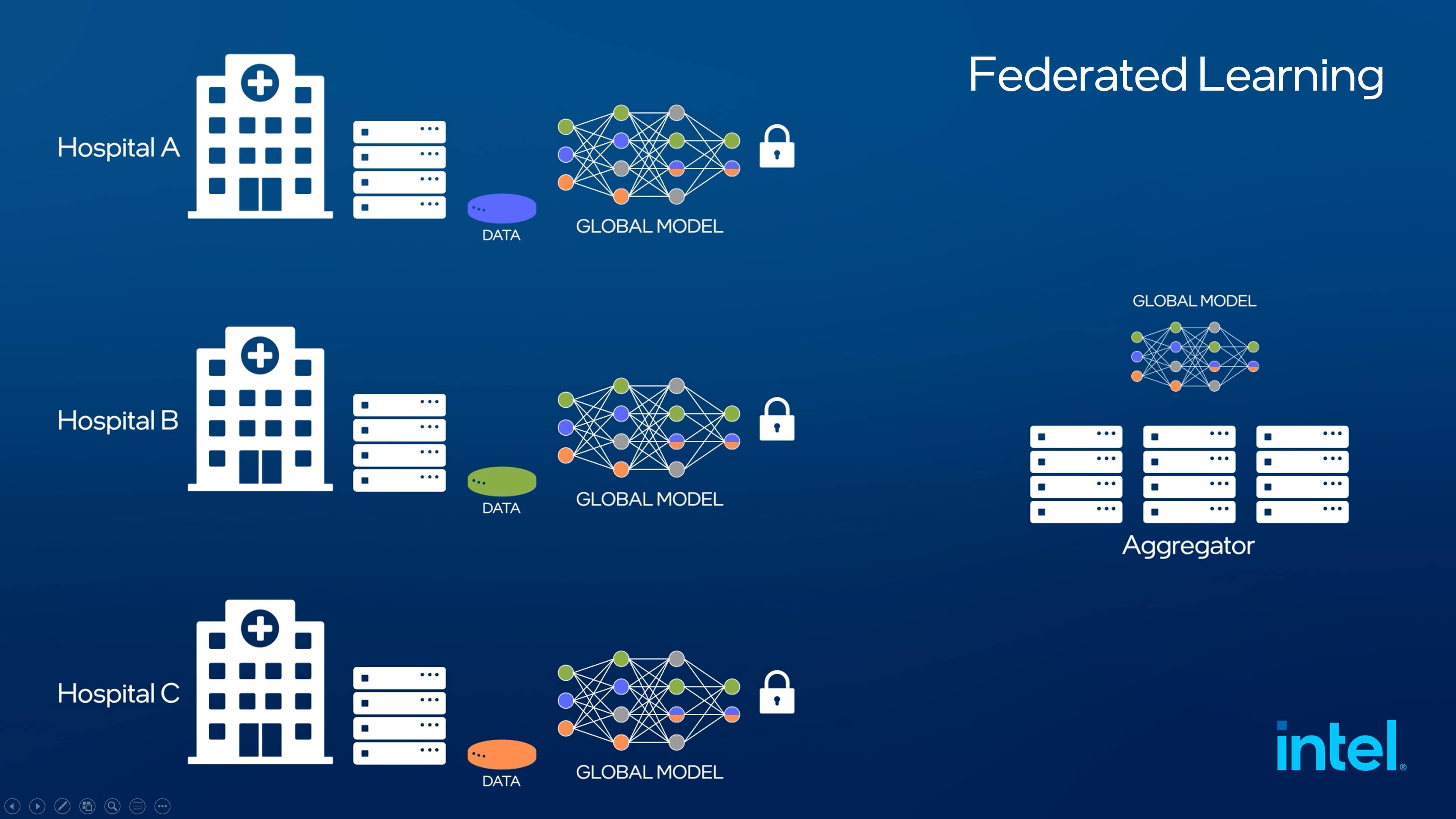
▲Federated Learning Concept Diagram (Image - Intel)
Privacy-Preserving AI Accelerates Healthcare Innovation with Federated Learning
Extensive training on 6,000 GBM patient data from 71 institutions across 6 continents
In healthcare, data accessibility issues have long existed due to national data privacy laws such as the Health Insurance Portability and Accountability Act (HIPAA), making it nearly impossible to conduct medical research and share data on a scale that would be necessary without compromising patient health information.
Accordingly, privacy-preserving AI that complies with personal information protection regulations through federated learning hardware and software and maintains data integrity, privacy, and security through confidential computing is expected to be utilized in the advancement of medical technology in the future.
■ Intel SGX, Removing Data Sharing Barriers 
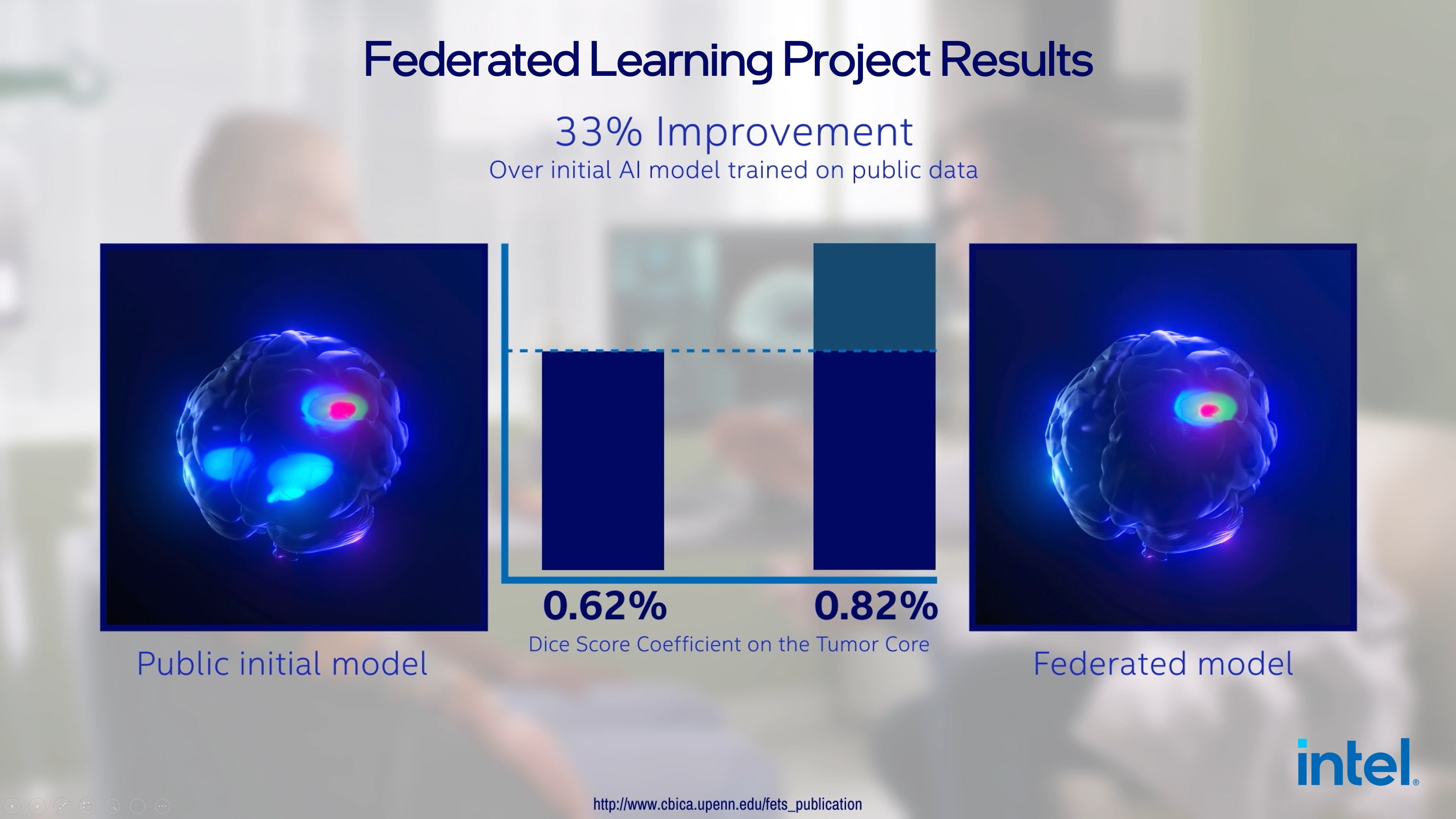
▲The AI model based on federated learning recorded a detection rate 33% higher than that of AI trained with existing public data. (Image - Intel)
Intel Labs announced on the 6th that it has completed a study utilizing federated learning, a distributed machine learning (ML) artificial intelligence (AI) method, to help identify malignant brain tumors through joint research with the Perelman School of Medicine at the University of Pennsylvania (Penn Medicine).
This study is the largest-scale federated learning study in healthcare to date, spanning a wide dataset from 71 institutions across six continents, and has demonstrated the ability to improve brain tumor detection by 33%.
The research conducted by Intel and Penn Medicine explored how to process large amounts of data in a distributed system using Intel Software Guard Extensions (SGX) and Intel Federated Learning technology. Intel SGX has played a role in removing data sharing barriers that have limited collaboration in similar cancer and disease research.
Distributed systems address numerous data privacy concerns by keeping the original data within the data owner’s infrastructure and only sending model updates based on that data to a central server or aggregator.
“As our work with Penn Medicine demonstrates, federated learning has tremendous potential across a range of domains, particularly in healthcare,” said Jason Martin, principal engineer at Intel Labs. “The ability to protect sensitive information and data, especially when data sets are not accessible, creates opportunities for future research and collaboration.”
“This study demonstrates the potential for federated learning to be a paradigm shift, enabling many institutions to collaborate by providing access to the vast and most diverse set of glioblastoma patient data without having to move that data,” said senior author Spyridon Bakas, PhD, an assistant professor in the Department of Pathology, Laboratory Medicine and Radiology at Penn Medicine. “The more data we feed into the machine learning model, the more accurate it will be, ultimately enhancing our ability to understand and treat rare diseases like glioblastoma.”
These Intel and Penn Medicine research findings were published in the peer-reviewed journal Nature Communications.
■ 6,000 GBM patient data trainingBWOM6Z.jpg" style="width: 600px; height: 338px;" />
▲Through federated learning, the model is updated where the original data is stored and then moved to the central server. (Image - Intel)
Advancing research to combat disease requires researchers to have access to large data sets that, in many cases, exceed the threshold that a single institution can generate.
This study demonstrates the potential benefits that the healthcare industry can realize when large-scale federated learning is effective and the multi-data silo phenomenon is eliminated, including early detection of disease, improved quality of life, or increased patient lifespan. You can do it.
“All the computers in the world can’t do much without analyzing a large amount of data,” said Rob Enderle, senior analyst at Enderle Group. “AI is in a situation where it can’t analyze the vast amount of data that is already available. “Large-scale medical innovations that promise to be significantly delayed,” he said. “This federated learning study shows a viable path forward for AI to become one of the most powerful tools available to fight incurable diseases and unleash its potential.”
Intel and Penn Medicine are partnering on a federated learning study to improve tumor detection capabilities and treatment outcomes for a rare form of cancer called glioblastoma (GBM), the most common and deadliest adult brain tumor with a median survival of 14 months after standard treatment in 2020. announced that it would cooperate in its use.
Despite expanded treatment options over the past 20 years, overall survival rates have not improved. First, Penn Medicine and 71 international medical and research institutions used Intel’s federated learning hardware and software to improve how they detect the boundaries of a rare cancer.
And radiologists used a new, cutting-edge AI software platform called Federated Tumor Segmentation (FeTS) to determine the tumor's boundaries and improve identification of the "operable zone" of the tumor, or "tumor core."
Radiologists annotated the data and ran federated learning using OpenFederated Learning (OpenFL), an open-source framework for training machine learning algorithms. The platform was trained on data from 6,000 GBM patients across six continents, the largest brain tumor dataset to date.
Intel Labs and Penn Medicine have created a proof of concept for using federated learning to gain knowledge from data through this project. The solution is expected to have significant impacts in medicine and beyond, particularly in the study of other types of cancer.
In particular, Intel is developing the OpenFL open source project to help customers adopt real-world cross-silo federated learning and deploy it on Intel SGX. In addition, the new FeTS initiative has established a collaboration network to provide a platform for continued development and to encourage collaboration between the FeTS platform available on GitHub and Intel’s OpenFL open source toolkit.