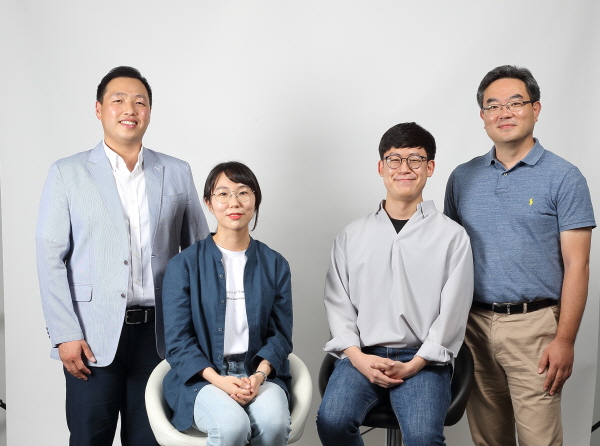
▲(From left) Professor Son Jae-seong, Researcher Joo Hye-jin, Researcher Chu Seung-jun, and Professor Chae Han-gi who led this research
Development of copper-selenide honeycomb-shaped 3D printing technology
A technology has been developed that greatly improves the durability and efficiency of thermoelectric generators. It is a technology that prints the thermoelectric material of the generator in a honeycomb structure. It prevents damage to the thermoelectric material by utilizing the honeycomb structure's characteristic of dispersing power well. It also effectively suppresses heat diffusion, improving the efficiency of the generator.
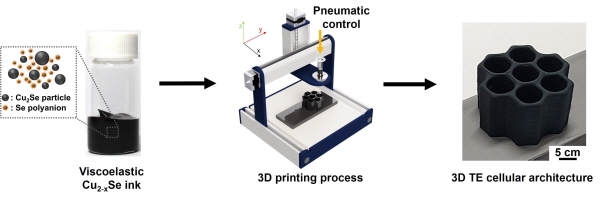
UNIST (President Yong-Hoon Lee) Department of Materials Science and Engineering Professor Jae-Sung Son and Professor Beom-Jin Kwon of Arizona State University announced on the 15th that they have developed a technology to increase the durability and efficiency of generators by 3D printing copper-selenide (Cu2Se), a thermoelectric material, in a honeycomb shape. Thanks to the newly developed ink made of thermoelectric material, it was possible to print complex honeycomb structures through 3D printing.
Thermoelectric power generation is a next-generation power generation that converts temperature differences into electricity. It is a power generation technology that is also drawing attention as an energy recycling technology because it can convert the heat of waste gas from factories, airplanes, and automobiles into electricity. It uses the principle (Seebeck effect) that when a temperature difference occurs at both ends of a thermoelectric material, a force is generated that causes current to flow inside the material.
The thermoelectric material at the core of this generator has weak mechanical durability compared to other materials, such as those that can withstand impact. In addition, it is prone to structural damage such as micro-cracks due to repeated thermal expansion and contraction and mechanical vibration during operation. This is why new technologies that enhance durability are needed.
The joint research team has newly introduced a technology to manufacture thermoelectric materials in cellular architectures. Cellular architecture refers to a form in which multiple unit cell structures are connected without any gaps. If the unit cells are made in a hexagonal column shape like a honeycomb, not only can external force be effectively distributed, but also the thermoelectric material can be made lighter by using less raw materials.
“In this experiment, we significantly increased the mechanical strength by fabricating copper-selenide material in a cellular structure,” said Seungjun Choo, the first author and a researcher in the combined master’s/doctoral program in the Department of Materials Science and Engineering at UNIST. “This material originally had excellent thermoelectric performance at high temperatures (approximately 800℃), but its durability was easily weakened by thermal expansion.”
The research team used an inorganic binder (selenium) to create ink for 3D printing. A binder is needed to create a thermoelectric material in the form of high-viscosity ink, but the organic binders that are commonly used are not completely removed during the heat treatment process. The residual organic binder has the problem of lowering the efficiency of the thermoelectric material by lowering the electrical conductivity.
Professor Chae Han-ki explained, “This technology can prevent the deterioration of the material’s properties, such as its electrical conductivity, and can be applied as a source technology for 3D printing various semiconductor materials.”
The performance of a generator made of a honeycomb-structured thermoelectric material was also simulated on a computer. The experimental results showed that the honeycomb structure was 26% more efficient in converting temperature differences into electricity than a rectangular flat-plate generator. This is because the honeycomb structure is effective in suppressing heat diffusion from the electrode attached to the thermoelectric material. As heat spreads to the surroundings and the temperature difference decreases, the thermoelectric power generation efficiency decreases.
Professor Son Jae-seong said, “This is an excellent technology that can implement complex structures that complement the mechanical properties of materials using 3D printing technology and minimize the loss of discarded raw materials,” adding, “It is expected to be applied to space and aviation technology and the automobile industry, which require both lightweighting and durability.”
This study was published online on June 10 in the international scientific journal Nature Communications. The research was supported by Samsung Electronics’ Samsung Future Technology Promotion Project.

▲3D printing process of copper-selenide (Cu2Se). Using the newly developed thermoelectric material ink for 3D printing, copper-selenide with a cell-like structure using hollow hexagonal columns as unit cells is printed.