Promising electric vehicle battery parts company
The Korea Institute of Materials Science (KIMS, President Lee Jeong-hwan) established a research institute company with electric vehicle battery component technology.
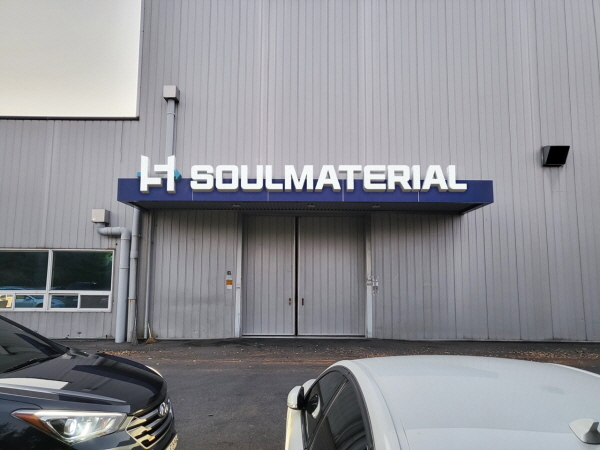
The Korea Institute of Materials Science announced on the 1st that Soul Material Co., Ltd., which provided technology, was designated as Research Institute Company No. 1283 by the Ministry of Science and ICT through the Daegu Research and Development Special Zone Promotion Foundation (Director Oh Young-hwan).
Soul Material Co., Ltd. is a promising research institute for future electric vehicle battery parts, with a scale of approximately KRW 1.65 billion, jointly established with KRW 500 million investment from Korea Science and Technology Holdings (CEO Kang Hoon), with technology investment from KIMS based on domestic and three foreign patents, support for technology value assessment and FTO investigation from the Intellectual Property Profit Reinvestment Support Project of the Korean Intellectual Property Office, and KRW 1.65 billion investment from Korea Science and Technology Holdings Co., Ltd.
Our main products are magnesia (MgO) filler material, a heat-insulating material, and chemical-resistant, low-temperature sintering industrial ceramics.
KIMS has developed a new magnesium oxide material with thermal conductivity about twice that of alumina, suggesting the possibility of replacing the market currently monopolized by Japanese companies.
It is expected to be able to replace alumina in the long term as it is 90% lighter than alumina and has more than twice the heat dissipation performance.
Magnesium oxide has good performance, but it is expensive to manufacture because it requires high temperatures during the sintering process to turn ceramic powder into lumps, and it has the disadvantage of reacting with moisture in the air.
The KIMS research team used additives to achieve lower temperatures than alumina. The company has developed a new magnesium oxide material that can be sintered at a temperature of 1,400℃ while also solving the hygroscopicity problem, and has contributed the related technology to Soul Material Co., Ltd.
Soul Material CEO Jeong In-cheol said, “In order to expand the supply of electric vehicles, it is important to increase the driving distance by developing batteries with high energy density, but above all, preventing fires caused by battery thermal runaway is a top priority to ensure the safety of electric vehicles.” He expressed his aspirations, saying, “Soul Material will do its best to become a leading company that takes the lead in solving this problem.”
KIMS President Lee Jeong-hwan, who invested in the technology, said, “This designation as a research institute is very significant in that it has laid the foundation for the development of technology to replace existing alumina heat-conducting materials to lead to domestic production of the technology,” and added, “We will continue to provide full support so that the magnesia heat-conducting ceramic material can be domestically produced and commercialized, and so that it can also enter overseas markets.”