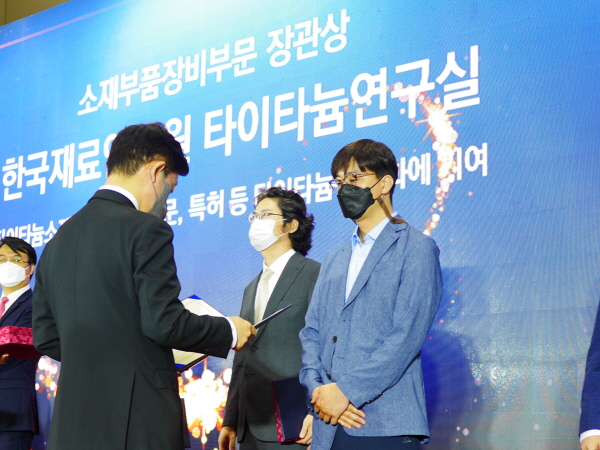
▲The Titanium Research Lab (Director Park Chan-hee, Principal Researcher) of the Korea Institute of Materials Science receives a commendation from the Minister of Science and ICT at the '3N Achievement Exchange' held at the 20th International Nanotechnology Symposium and Convergence Exhibition.
Titanium Research Lab, '3N Performance Exchange' Excellence Achievement Minister's Award
The Korea Institute of Materials Science (KIMS, President Lee Jeong-hwan), a government-funded research institute under the Ministry of Science and ICT, has been recognized for its contribution to achieving self-sufficiency in domestic titanium (Ti) materials.
The Korea Institute of Materials Science announced on the 7th that the Titanium Research Lab of the Metal Materials Research Headquarters was recognized for its excellent performance among the materials, parts, and equipment national research infrastructure (3N) designated institutions and received a commendation from the Minister of Science and ICT at the '20th International Nanotechnology Symposium and Convergence Exhibition (Nano Korea 2022)' and '3N Achievement Exchange Meeting' held on July 6th.
The Titanium Research Lab is a national research lab (N-Lab) with excellent capabilities and has been recognized for its outstanding research performance in securing core technologies.
Since being designated as a national research lab in 2019, the Titanium Research Lab has achieved the following results: △ technology fee contract of 1.8 billion won, △ technology fee income of 1 billion won, △ 59 papers published, △ 26 patent applications and 11 registrations. In addition, it has faithfully fulfilled its role as a hub for technology exchange between industry, academia, and research by hosting △ 3 technology exchange meetings, △ 3 technology training sessions, and △ 174 cases of corporate technology support, contributing to the independence of titanium materials.I got a scholarship.
The Titanium Research Lab has raised the operating temperature limit of existing high-temperature titanium blades used in gas turbines for combined cycle power generation from less than 800 degrees to over 900 degrees, thereby increasing gas turbine power generation efficiency by over 5%.
Another notable achievement is the successful development of a new high-strength titanium material with a strength of 1.2 gigapascals (GPa) without adding rare metals, while existing titanium blades for steam turbines have high manufacturing costs and low strength due to the addition of the rare metal vanadium (V) and the use of materials with a strength of 1 gigapascal (GPa).
Another notable achievement is that the blade prototype was manufactured using purely domestic technology, from materials to components (ingot → billet → die forging → processing).
Director Lee Jeong-hwan of the Korea Institute of Materials Science said, “I am very proud that our excellent research lab was recognized for its capabilities among 25 national research laboratories (N-Labs) and 11 national research facilities (N-Facility), 3 government-funded research institutes (2 N-Labs/1 N-Facility), and 1 university institution selected.” He added, “The Korea Institute of Materials Science will continue to make every effort to widely publicize the excellence of titanium materials and promote the diffusion of technology.”