Neon gas is used as a working fluid instead of helium gas.
Creating cryogenic temperatures by expanding fluid through high-speed rotation
Reduce the expander rotation speed by 1/3 to ensure system stability The Korea Institute of Machinery and Materials (KIMM) announced on the 17th that it had developed the Brayton cryogenic refrigerator system that uses neon gas as a working fluid for the first time in Korea and successfully demonstrated 2kW output at an extremely low temperature of -200℃.

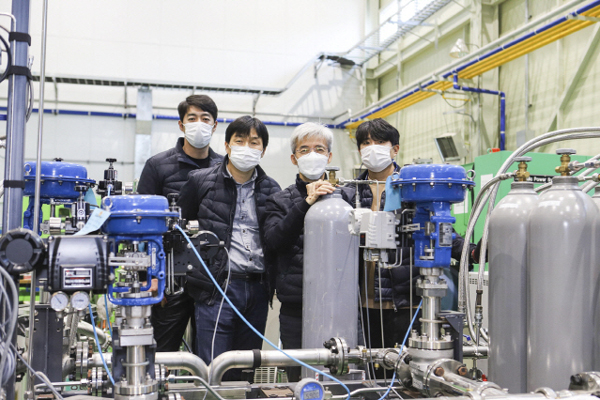
▲ The Korea Institute of Machinery and Materials developed the Brayton Cryogenic Refrigeration System
Research team led by Yeom Han-gil, head researcher, Energy Conversion Machinery Research Lab [Photo = Korea Institute of Machinery and Materials]
The successful development and demonstration of this cryogenic refrigerator system has laid the foundation for domestic production of cryogenic refrigerator systems, which currently depend entirely on imported products. The technology is expected to contribute to expanding the use of eco-friendly energy by enabling more efficient liquefaction of natural gas, hydrogen gas, etc.
The research team led by Han-Gil Yeom, a principal researcher at the Energy Conversion Machinery Laboratory of the Korea Institute of Machinery and Materials, used neon gas instead of helium gas as a working fluid, and reduced the rotation speed of the expander to 1/3 to create ultra-low temperature conditions by rotating it at high speed and expanding the working fluid, thereby increasing the stability and lifespan of the entire system.
The research team plans to conduct follow-up research to demonstrate 10kW output so that it can operate an ultra-low temperature refrigerator system made with domestic technology on domestic LNG carriers that are currently operated entirely with foreign technology.
In addition, by utilizing the developed cryogenic cooling technology in domestic superconducting cable systems, a foundation has been established to provide a total solution for superconducting cable systems, including cable cores, cryogenic cooling devices, and auxiliary facilities, as well as installation and operation.
In addition, since the operating temperature can be expanded from the temperature of hydrogen gas liquefaction (-253℃), an eco-friendly fuel, to the temperature of natural gas liquefaction (-162℃), it is expected to be utilized to strengthen technological competitiveness in the LNG sector and to realize a hydrogen society at an early date.
This study was conducted as part of the 'Development of an ultra-low temperature cooling system for future energy' project, which is a major project of the Korea Institute of Machinery and Materials.