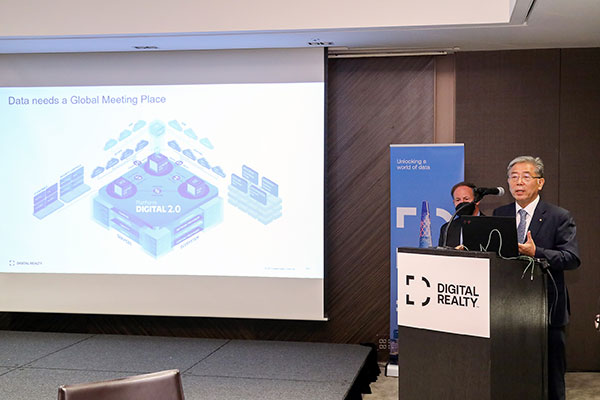
▲Kim Jae-won, Digital Realty Korea Branch Manager
Phase 1 in the first half of 24 years… Expected to create 281 trillion won in value annually
Building a Metro Campus, Acting as a ‘Bridgehead’ to Support Connectivity
Sustainable Management, Absorption Cooling and Renewable Energy Solutions
In the post-pandemic era, investments in domestic digital transformation are accelerating thanks to the government's digital New Deal policy, and as data centers that gather data connected to the Internet serve as the central nervous system that forms the foundation of the digital economy, Digital Realty is expanding its domestic market by starting construction of its second data center in Gimpo following Sangam.
Digital Realty announced on the 29th that it had started construction on its second data center in Korea and held a media conference to announce the status of its Korean expansion and global growth strategy.
Digital Realty's research projected that by 2030, it could create an economic value of KRW 281 trillion (USD 236 billion) annually in Korea.
The 'Digital Seoul 2 (ICN11)' to be established in Gimpo will support up to 64MW of critical IT capacity when fully operational, and will be 970,000 square feet and 12 floors. The first phase of construction is scheduled to be completed in the first half of 2024 with a capacity of 12MW. In addition, following ICN10, the domestic IT capacity will expand to 76MW when ICN11 is fully operational.
Kim Jae-won, President of Digital Realty Korea, said, “Digital Realty has invested $23 billion to build a global platform and will accelerate our digital transformation strategy by building a global platform that can meet our needs from a single data center provider.”
■ Building a Metro Campus… Centered on a Connected Data Community ICN11 is connected to Digital Seoul 1 (ICN10), an NVIDIA-certified colocation facility based on PlatformDIGITAL®, via Metro Connect, a fiber optic cable multiplexing (DWDM) network that provides diversity.
Customers can use Digital Realty’s service orchestration platform, ServiceFabric, to bring together network-connected service elements from the PlatformDigital® community to create end-to-end service combinations needed to meet hybrid IT requirements and support business objectives.
CEO Kim said, “With the metro campus that guarantees operator and network neutrality, customers can build servers through the data center and achieve their business goals through connectivity with data centers around the world.”
In addition, “Digital Realty will support connectivity with more than 4,000 companies in more than 305 data centers in 27 countries, serving as a bridgehead for global companies to expand into Korea or for domestic companies to enter the global market,” and “We will provide customer-centered customized services.” "He said, "
■ Obtaining sustainable building certification… Supporting decarbonization In line with its commitment to achieve carbon neutrality by 2050, Digital Realty told ICN11 it will reduce its energy requirements through a range of renewable energy solutions, including district cooling and geothermal systems.
The building uses absorption chillers that improve the building's cooling efficiency through an engineering process that recycles excess heat from fuel cells and district cooling systems to create chilled water.
John Curry, vice president of operations for Asia Pacific, said, “Digital Realty has set a goal of reducing its carbon dioxide emissions by 68% by 2030 for Phase 1 and Phase 2, and 24% by 2030 for Phase 3. We have secured certifications for compliance with sustainable building standards, and 75% of our data centers are decarbonized, 64% are powered by renewable energy and some are net zero.”
Meanwhile, Digital Realty, a Schneider partner, attended the event in July and presented its sustainable data center strategy, and officials said that they are still maintaining a friendly partnership.