Commercialization of autonomous driving… Tesla and Waymo ‘not yet’
Frequent occurrence of obstacles such as tram line road recognition
While expectations for the commercialization of autonomous vehicles are growing, it appears that there is still no clear answer as to which image sensor combination is optimal for driving and safety. Therefore, finding the optimal sensor combination is analyzed as important for the commercialization of autonomous driving.
According to recent reports from the autonomous driving industry, automakers are putting forth various autonomous driving perception sensor strategies that can satisfy safety.
Experts are citing 'safety' as the most important factor in autonomous vehicle sensing. MC Nex's Director Young-Hyun Jeong emphasized safety during a discussion on technology development and market trends for camera modules and image sensors, saying, "Sensing systems are for 'safety' rather than 'convenience.'"

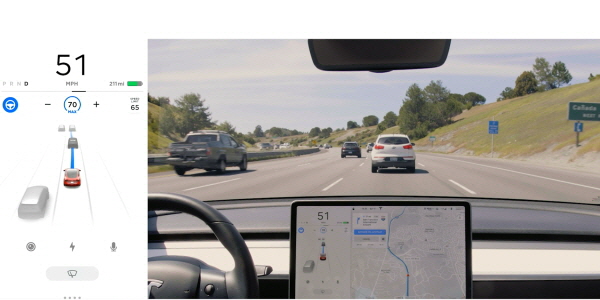
▲ Tesla FSD (Source: Tesla website)
Looking at the trends of existing autonomous driving companies, Tesla has adopted a Pseudo LiDAR strategy using radar and cameras.
Lidar pseudo-lidar means a sensor that is not a lidar but has an equivalent level of accuracy. Just as drivers drive by looking with their eyes, this is a technology that allows cars to recognize situations with cameras and drive on their own.
This can use SLAM techniques to enable autonomous driving even in the absence of an HD map, and can reduce the burden on consumers with a camera that is cheaper than LiDAR. However, it has the problem of reduced recognition ability in congested traffic and at night. Experts also express the opinion that it does not yet have the performance to replace LiDAR.
Tesla also demonstrated autonomous driving without lidar and radar. They eliminated the high price and power consumption of lidar, and eliminated radar for reasons such as phantom braking and cost reduction. This demonstration did not demonstrate perfect autonomous driving capabilities, but it is significant in that it greatly increased the importance of camera sensors.
Some argue that corner and long-range radars will continue to be needed for 'safety' reasons.
NXP expressed the opinion that radar, which is not affected by the external environment (weather, season) like cameras and lidar, is essential for driver safety in autonomous driving.

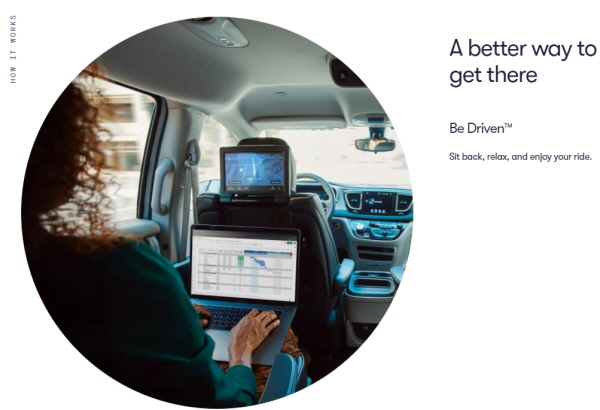
▲ Waymo autonomous driving (Source: Waymo homepage)
Volvo, Waymo, Hyundai Motors, etc. use a strategy of using lidar and HD maps together to match the lidar to the information stored in the HD map to determine the location. This has the advantage of being able to accurately determine the location of autonomous vehicles through a precise map. On the other hand, autonomous driving is impossible without an HD map, and the high price of lidar is a hindrance.
Despite these efforts by the autonomous driving industry, the industry believes that it will take some time to find the optimal sensor combination for autonomous driving due to the continued occurrence of accidents and errors.

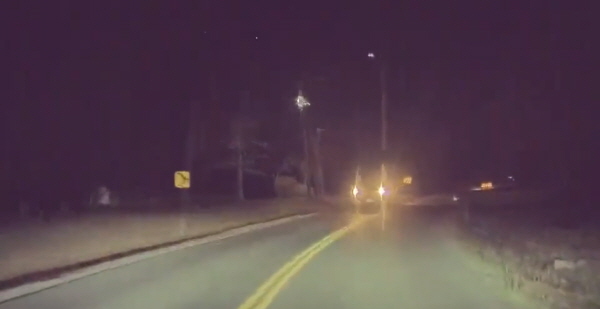
▲ A Tesla Model Y vehicle crossed the center line and almost collided with an oncoming car (Source: Twitter video capture)
If you look at social media such as Twitter, you can see that Tesla's self-driving cars are frequently having accidents and experiencing cognitive impairment. There are life-threatening dangers, such as a video of a car almost colliding with a large truck coming from the opposite lane in the middle of the night, or a video of a car in Europe mistakenly entering the wrong lane by mistaking the tracks of a tram for a lane.

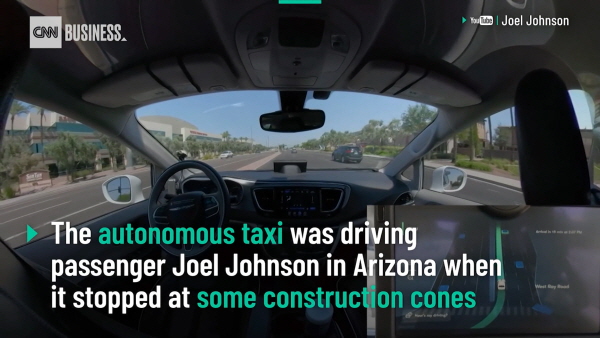
▲ A Waymo vehicle stopped in front of a lava cone (Source: CNN video capture)
Waymo's vehicle is no different. CNN posted a video of a vehicle that stopped in front of a lava cone on the road while driving and didn't move until someone removed it. At the time, a passenger strongly criticized Waymo, saying, "If you want to get there on time, don't take Waymo." Last April, Waymo CEO John Krafcik also resigned voluntarily, unable to shake off the burden of commercialization, so it seems that commercialization will still take time.
Meanwhile, the three representative image sensors for autonomous vehicles are △camera △radar △lidar.
Cameras provide shape recognition information about the target object through visible light, thereby reading information such as lanes, signs, and signals. They have the advantage of being able to see far away and being cheaper than other sensors. However, they also have the disadvantage of being difficult to recognize when there are external obstacles such as bad weather, fog, and impurities.
Radar detects the distance and speed of surrounding objects by emitting electromagnetic waves and measuring the time and frequency of returning waves. It boasts an effective detection range of 200m, which is about twice as long as lidar. On the other hand, it is less effective than lidar in detecting the driving speed of surrounding vehicles.
Lidar uses high-power pulsed lasers to obtain distance information. It collects 3D data about the surrounding environment in real time. The disadvantage is that pulsed lasers are vulnerable to weather conditions, such as snow and rain, and are expensive.