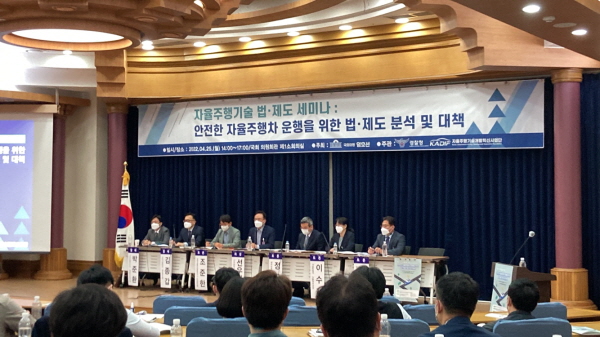
▲From left, Researcher Park Jun-hwan, Senior Researcher Kim Jong-gap, Senior Researcher Jo Jun-han, Professor Seonwoo Myeong-ho of Korea University, Attorney Jeong Gu-seong, Manager Lee Su-jin, and Manager Kim Han-cheol
It should be made in the form of a special law rather than a case law.
There are many inconveniences encountered during autonomous driving demonstrations. As autonomous driving becomes commercialized, various issues are expected to arise in all areas including safety, transportation, and insurance. A place has been created to analyze laws and systems for autonomous vehicle operation and hear opinions from experts.
The 'Analysis of Laws and Systems and Countermeasures for Safe Autonomous Vehicle Operation: Seminar on Autonomous Driving Technology Laws and Systems' hosted by the National Police Agency and the Autonomous Driving Technology Development Innovation Center and organized by Rep. Lim Ho-seon was held in the first conference room of the National Assembly Members' Hall.
As autonomous driving has a wide range of impacts beyond industry to society as a whole, and as related laws are diverse, a legal and institutional system is needed to resolve related issues. Accordingly, Rep. Lim Ho-seon said that he held the seminar to identify and establish a foundation for resolving current issues in the Road Traffic Act, which are closely related to autonomous driving.
The designated discussion held at the seminar began with presentations by Park Jun-hwan, researcher at the National Assembly Research Service, and Kim Jong-gap, senior researcher at the Road Traffic Authority, and was moderated by Professor Seonwoo Myeong-ho of Korea University. The panelists included Cho Jun-han, a senior researcher at Samsung Traffic Safety Culture Research Institute, Jeong Gu-seong, an attorney at JC&Partners, Lee Su-jin, head of the Seoul Metropolitan Government’s Traffic Information Division, and Kim Han-cheol, head of the National Police Agency’s Traffic Operation Division.
Researcher Cho said, “I think it’s difficult to keep holding the car manufacturer responsible when a self-driving car causes an accident. The manufacturers have no choice but to take a passive stance,” and added, “We need to set the overall scope of responsibility between the manufacturer, ICT company, and car owner through mandatory laws and systems.” He continued, “When standing at a crossroads where we have to choose between the public interest and the owner’s life in the event of an accident, the philosophical aspect is also very difficult because the owner could face death that was not their choice.”
Attorney Jeong said that when autonomous vehicles become commercialized, there will be significant changes in civil and criminal issues. Looking at the current general provisions of Korean civil law or criminal law, it is not that such accidents cannot be handled. However, he argued that the part about civil compensation or criminal liability in the event of an accident is about the responsibility and duty of the people, so it should be specifically created as a special law by the legislature rather than within the scope of case law. He predicted that as the level of autonomous driving increases, the possibility of driver intervention will decrease, so cases of criminal punishment for driving behavior will disappear. He argued that a new law should be established that punishes vehicle owners for negligent maintenance of vehicle functions or safety management rather than driving behavior when an accident occurs.
Director Lee Soo-jin passionately spoke about the many inconveniences she encountered while conducting autonomous driving demonstrations in Sangam and other places. Although she announced that she would operate autonomous taxis in Gangnam, there is no such thing as an autonomous taxi under current law. She said that in order to vitalize the business, the Autonomous Driving Business Activation Act and the Transportation Business Act also need to be revised. He then shared his concerns about how to handle minor autonomous driving violations of the Road Traffic Act that do not threaten the safety of citizens. He could not find an answer as to whether the algorithm should calculate it that way because it allows for a very small violation of the law. For example, Seoul City has been operating autonomous shuttle buses in Cheonggyecheon since June, but there is only one lane and a bicycle lane next to it. If a car is slightly blocking the road, the autonomous vehicle cannot pass until that car passes first. A regular driver can slightly encroach on the bicycle lane, but he said he was concerned about whether such flexibility should be included in autonomous driving AI.
Kim Han-cheol, head of the Traffic Operations Division of the National Police Agency, said that the government is currently investing over 1 trillion won in a budget by 2027, and the National Police Agency is also investing about 150 billion won to carry out about 40 tasks. He said, “With the release of Roadmap 2.0, we are trying to ease regulations as much as possible in all areas where they can and are working hard for the development of autonomous vehicles.” He continued, “There are also concerns that if the National Police Agency, the Ministry of Land, Infrastructure and Transport, etc. impose many regulations, research activities will be greatly hindered,” and “For areas such as criminal responsibility, one way is to gather opinions from countries that have been conducting research ahead of Korea, such as Germany and the United States, and find a more flexible answer.”
In her final remarks, Manager Lee Soo-jin said that the most frequently asked questions about autonomous driving business are about accident safety measures. This is because they face realistic issues such as how to handle accidents and what should be done in the field. The insurance issue has been resolved to some extent. All autonomous vehicles currently operating in business sites are covered by the autonomous vehicle special contract for automobile insurance that ordinary passenger cars are covered by. Even if a traffic accident occurs in autonomous vehicle mode, the driver is not held liable. Even if an additional traffic accident is caused by a person, the current insurance company is required to cover all compensation for accidents involving all vehicles, and in the case of an autonomous driving accident, there are regulations that allow the insurance company to claim compensation from the automaker. Therefore, in the case of an accident that occurs on-site or while riding an autonomous vehicle, all compensation insurance that is generally available for traffic accidents can be received under the current law.