Han Ja-yeon, “HUD will become a differentiated technology for safety”
The Value of HUDs Is Highlighted Amid Concerns About Information Overload Due to Infotainment
With the development of in-vehicle infotainment, the value of HUD in preventing information overload for drivers is becoming more prominent, and HUD is expected to continue to develop as a differentiated technology for safety until the era of fully autonomous driving.
The Korea Automobile Research Institute (KARI) reported on the 16th through a report that the head-up display (HUD) will establish itself as a differentiated technology for safety.
A head-up display (HUD) is a device that projects images onto the windshield of a vehicle, and its basic advantage is to reduce driver distraction and improve forward visibility.
HUD is a convenience device that projects text and images onto the windshield to display driving-related information. It mainly provides drivers with information such as vehicle speed, vehicle status, route guidance, and accident risk warning information.
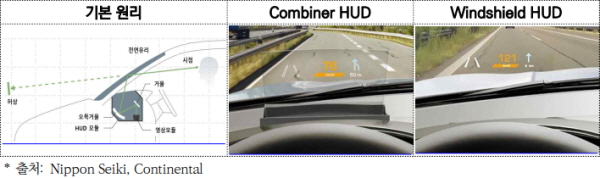
HUDs for vehicles are mainly of the combiner type and windshield type.

▲HUD basic principles and examples (Source: Korea Automobile Research Institute)
The Combiner type is directly connected to a dedicated reflective panel. Since it projects images, the screen size is somewhat limited, but it is mainly installed in compact cars because it allows stable image expression and is advantageous in securing installation space.
The Windshield type is a screen that projects an enlarged virtual image on the windshield by a concave mirror.
Although there are few size restrictions, it is characterized by being mainly applied to large and luxury cars due to its large volume and relatively high price.
HUDs have the fundamental advantage of reducing driver distraction and improving forward visibility.
When driving, the driver's gaze is divided between the windshield and the instrument panel, so if the instrument panel is moved upward to reduce the gaze dispersion, the problem of the front view from the driver's seat narrowing occurs.
On the other hand, HUD projects images onto the transparent windshield, so it can secure a full front view while fundamentally eliminating distraction while driving.
The value of HUD is increasingly being highlighted amid concerns about information overload due to recent advances in infotainment.
The rapid development of in-vehicle infotainment can cause information overflow for drivers, so the importance of HUDs that help drivers focus on key information is rising.
In this regard, there is also an opinion that the yoke steering wheel that Tesla and Lexus have recently attempted to remove by removing the top of the steering wheel is intended to make the driver's line of sight - instrument panel (or HUD) - external situation awareness through the windshield more natural.
In particular, as demand for route guidance and ADAS warnings increases, AR HUDs using AI and AR technology have recently been installed to display optimal routes and safety-related information in three dimensions on the windshield.
In addition to route display support, it also provides advanced driver assistance systems (ADAS) such as forward collision warning and vehicle/pedestrian detection.It can also be linked to provide drivers with visual information such as object recognition and distance measurement.
Major automakers are also gradually expanding the installation of AR HUDs, focusing on newly released electric vehicles.
HUD is expected to remain a differentiated technology for safety until the era of fully autonomous driving.
HUD is likely to develop in parallel with other infotainment systems as an independent device for driver assistance until the era of fully autonomous driving arrives where the distinction between driver and passenger disappears.
The global market size of HUD is expected to grow from $1.3 billion in 2020 to $2.4 billion in 2022, $6.4 billion in 2027 (Markets and Markets), and $18.2 billion in 2030 (The Brainy Insights).
Recently, the expansion of HUD distribution has slowed down somewhat due to the shortage of semiconductors for vehicles, but in the long term, HUD is expected to become widespread even in entry-level vehicles due to decreasing production costs and increasing demand.
In the future, HUD is expected to develop in conjunction with technologies such as motion recognition, and the projection range may be expanded to the entire windshield, depending on consumer demand.
It is expected that a more upgraded HUD will be introduced, with the addition of a function to display POI information by linking with UI/UX technology that recognizes movements such as hand gestures or eye movements, or by applying 3D holograms.