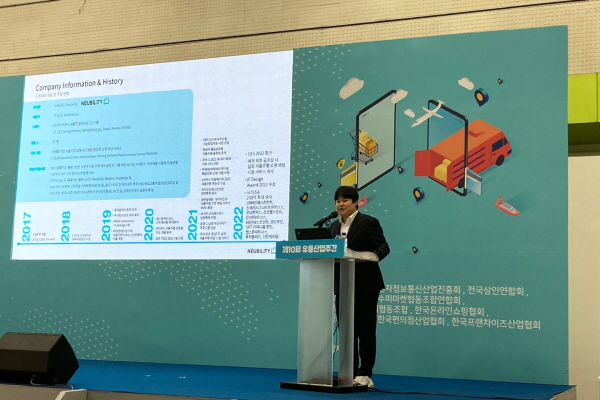
▲Lee Sang-min, CEO of Newbility, is presenting on the 'future of distribution logistics and response tasks changing with autonomous driving.' (Photo: Seong Yu-chang)
Autonomous robots: A solution that satisfies both self-employed individuals and consumers.
Newbility develops hardware and internalizes autonomous driving software, boosting price competitiveness. As the delivery market, which has grown rapidly since 2015, faces issues such as delivery fees, the possibility of autonomous robots as an alternative has been suggested.
Newbility is realizing its potential by developing an autonomous delivery robot and is moving to dominate the market by conducting tests with 7-Eleven to establish a convenience store robot delivery service model.
Lee Sang-min, CEO of Newbility, presented on the topic of “The future of distribution logistics and its challenges as it changes with autonomous driving” at the “Distribution/Logistics Digital/New Technology Trend Seminar,” a conference program of the 10th Distribution Industry Week held at COEX on the 9th.
Based on the growth and challenges of the last-mile delivery market, Newbility has embarked on the development of autonomous delivery robots. Various companies, including SK Telecom and Samsung Welstory, are continuing to invest in Newbility, recognizing its potential.
The last-mile market size has shown a tremendous average annual growth rate of 26%, growing from approximately 3 trillion won in 2017 to 7.5 trillion won in 2020 and over 10 trillion won last year.
Delivery times that used to take two or three days have been reduced to one day, and with demand growing for even one-day delivery, the number of products that can be delivered within an hour has also increased. Problems have also surfaced in the once-convenient K-delivery culture.
Self-employed people spend 31% of their sales on delivery fees, and when platform fees are factored in, the figure is even higher. Newbility's survey found that consumers are starting to feel reluctant to order because of minimum order amounts and high delivery fees, and riders are also stressed by tight delivery times.
CEO Lee Sang-min said, “The role of a company is to solve problems in the market,” and broke the stereotypes about robots, such as high prices and limited places of use, and developed ‘Newby,’ an autonomous delivery robot that can go anywhere at an affordable price.
Instead of expensive lidar, the company chose camera-based autonomous driving, and achieved price competitiveness through in-house hardware development and internalization of autonomous driving software technology.
We implement an urban autonomous driving solution based on Visual SLAM utilizing cameras and sensors, and enable accurate location estimation even in urban areas with densely packed buildings through multi-camera based V-SLAM and sensor fusion. Compared to LiDAR, it has the disadvantage of image quality varying depending on changes in light intensity, but the cost barrier has been lowered with the system configuration cost of 2.8 million won, which is about 6 million won cheaper than LiDAR.
It is also evaluated that the cost burden on service users can be reduced by minimizing computing and infrastructure costs through patented technologies such as Robust Feature Map, optimized deep learning models, and ultra-low latency control systems.
Newbility is putting its heart and soul into not only autonomous robots but also mobile phone applications.
The representative said that the robot delivery system is still an unfamiliar service and that customer feedback is very important, but that it is difficult to get feedback from existing delivery platforms, so they decided to create it in-house.
He also said that since autonomous driving cannot always be perfect, they are developing a domestically-based shared last-mile platform equipped with monitoring controls that can be used for emergency control.
Newbility also confirmed customer acceptance and market potential of robot delivery through service demonstrations. Tests conducted in the Seoul area showed that robot delivery service was so well-received that it could surpass human delivery.
Additionally, the study found that when delivery costs are lower than those of humans, consumers are less likely to complain about going down to the first floor to pick up the product.
The representative concluded his presentation by saying, “Newbility is preparing for the future with a contract to operate at least 135 robots and the performance that comes with it, and is continuing its business by building various business models.” He added, “I hope that this will be an opportunity to announce that robots are not a great future, through the back office and API.”
And on the 13th, Newbility announced that it will participate in the 'Demand-Customized Service Robot Development and Distribution Project' hosted by the Korea Robot Industry Advancement Institute under the Ministry of Trade, Industry and Energy, together with convenience store chain 7-Eleven.
7-Eleven plans to select three stores in Gangnam, Seocho, and Songpa areas with steady delivery demand and suitable locations for testing, including a robot driving environment. A total of three autonomous delivery robots, Newbie, will be deployed.