The Ministry of Trade, Industry and Energy's National Institute of Standards and Technology (hereinafter referred to as KATS) and the Society of Automotive Engineers (hereinafter referred to as SAE) have signed an MoU, and the business agreement will bring the Korean and U.S. standards development organizations one step closer to establishing a cooperative system for autonomous vehicle standardization and strengthening technological cooperation.
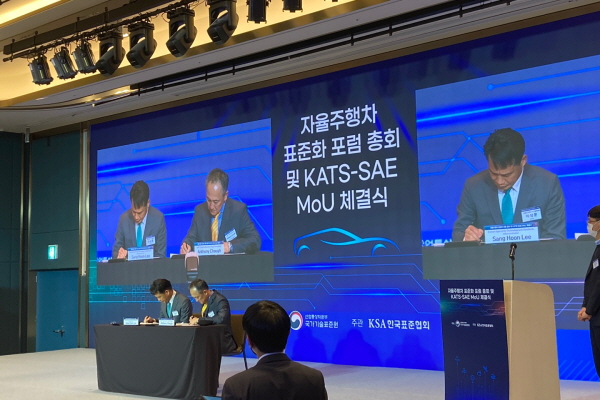
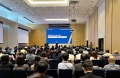
On the 14th, the Korea Agency for Technology and Standards held the 'Autonomous Vehicle Standardization Forum General Assembly and Performance Exchange Meeting' at the Sofitel Ambassador Hotel with the attendance of Korean and American autonomous driving experts, including ISO President-elect Cho Sung-hwan (Hyundai Mobis CEO) and SAE Vice President Anthony Chough.
Lee Sang-hoon, the president of KATS, and Anthony Chopp, vice president of the International Society of Automotive Engineers, signed a business agreement for cooperation in standardization, and they plan to cooperate in the following areas: △supporting joint use of standards held by standards development organizations, △developing standards and publications for areas of common interest, and △implementing joint workshops, seminars, and cooperative programs.
In addition, through the standardization cooperation system, domestic experts participate in the establishment and revision of SAE standards. Strengthening technological cooperation is expected when domestic automobile manufacturers enter the U.S. market.
Lee Sang-hoon, head of the National Institute of Standards and Technology, said, “It is expected that autonomous driving functions will be applied more widely in automobiles, robots, etc. in the future,” and added, “We will actively pursue international standard proposals and national standard establishment through cooperation with international standard development organizations such as the Society of Automotive Engineers.”
In his opening remarks, ISO Chairman Cho Sung-hwan said that it is difficult for companies to participate in standardization activities on a large scale because a considerable amount of budget is invested in standardization activities.
However, he emphasized the participation of the industry, saying, “In order to smoothly proceed with the national autonomous driving standardization development project, the participation of the industry in standardization activities must be expanded,” and “Companies must be encouraged to feel the effects of standardization activities and naturally participate actively in activities.”
Choi Dong-geun, Director of the Korea Standards Association Center, announced the main activities of the Autonomous Vehicle Standardization Forum in 2022 and the main direction of activities for the forum in 2023.
Standards Subcommittee 1, which is in charge of precision road maps, is holding meetings centered around ISO TC 204 WG 3 and is discussing the progress of standardization of database frameworks and data structures related to autonomous driving-related locations, which are being developed domestically.
The vehicle communication standardization sub-committee 2 is reviewing the progress of standardization for the autonomous driving-related vehicle interface ISO 22087.2, which is currently being developed domestically.
Functional safety 3rd division The discussion focused on the application of domestic R&D projects for functional safety and cybersecurity, such as ISO/AWI TS 5083, and in particular, the introduction of national standards for ISO/SAE electronic cybersecurity response processes was reviewed with a focus on this.
The vehicle control division discussed international standards for core technologies of autonomous driving systems, such as the emergency braking system ISO 22733-2, which is being led by Korea, and the human engineering division collected major domestic opinions on the establishment of ISO AWI TR 5283-2 and ISO PWI TR 5283-2, international standards for level 4 driver monitoring systems, focusing on Korea.
The cooperative driving division shared the status of proposals for new standards for ISO/PWI (Preliminary Work Item) TR 17732 ITS communication roles and functional models and shared opinions with relevant domestic organizations.
The Mobility Services Division is discussing the development of international standards such as ISO/PWI 17739-1 and 2.
The 2023 Autonomous Vehicle Standardization Forum will focus on the initial establishment of international standards for a total of four standards: three standards in preparation, three in PWI status, and one standard in progress with the International Telecommunication Union (ITU), and plans to actively reflect industry opinions in international standards.
In January 2023, we expect to develop practical cooperation on data standards, V2X standards, and cybersecurity standards related to SAE through a joint meeting between Korean experts and SAE.
The forum's performance exchange session featured experts from Korea and the United States.They shared the latest trends in the autonomous driving industry and introduced the current status of international, national, and group standards development in the autonomous driving field.
Moon Il-ki, head of the Hyundai Mobis sector and chairman of the forum, introduced the trend of autonomous vehicle technology development and said, “The industry is moving strategically to promote the commercialization of autonomous driving technology development.”
Because autonomous driving requires a lot of research and costs, the automobile industry and the ICT industry are developing it through joint development and cooperation.
However, autonomous vehicles have not yet achieved perfection in terms of perception and judgment.
Moon said that for autonomous driving technology to become widespread, an approach to reliability is also essential.
The market wants a level of autonomous driving that is much safer than that of human drivers, so in addition to cameras, a precise dual safety detection assistance system that combines radar and lidar detection is needed, and attention must also be paid to securing controller redundancy, according to Moon Sek-jang's analysis.