반도체 AI 보안 인더스트리 4.0 SDV 스마트 IoT 컴퓨터 통신 특수 가스 소재 및 장비 유통 e4ds plus

[모빌리티 그랑프리] Fully autonomous driving, law, police role, and education are important

기사입력2023.09.21 14:40


'Road Traffic Safety Roadmap for Fully Autonomous Driving' Presents Mid- to Long-term Directions for Autonomous Driving
Identifying major issues across society… Purpose: Towards a safe future society based on police responsibility

Autonomous driving experts from institutions, academia, etc. presented various opinions on the 'Road Traffic Safety Roadmap for Full Autonomous Driving', and emphasized the need to bring forward the timing of the roadmap, along with the argument that the role of the National Police Agency should be expanded, cooperation with other ministries should be carried out, and education should be provided.

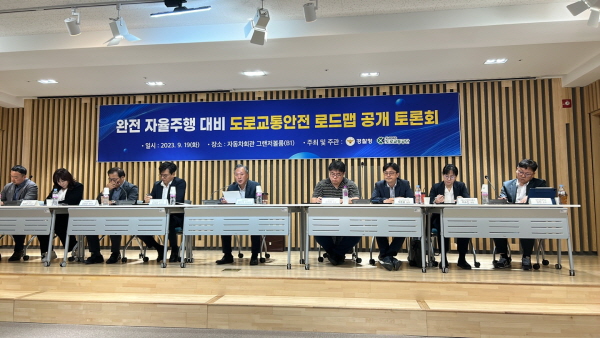
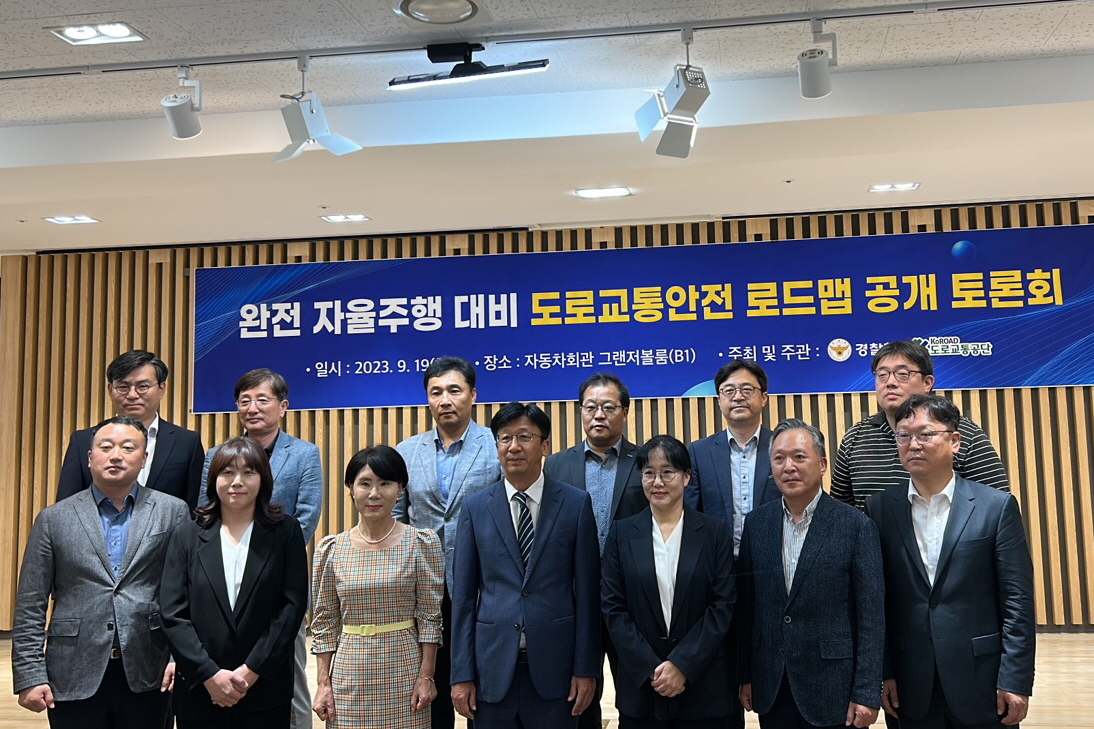
On the 19th, the National Police Agency held a public discussion at the Automobile Association Hall to collect various opinions in the process of establishing a 'road traffic safety roadmap in preparation for fully autonomous driving.'

The 'Roadmap for Road Traffic Safety in Preparation for Fully Autonomous Driving' is intended to present the mid- to long-term direction of road traffic policies related to autonomous driving by synthesizing the 'Comprehensive Police Measures for Commercialization of Autonomous Vehicles (National Police Agency)' in 2019 and the 'Autonomous Vehicle Regulatory Innovation Roadmap 2.0 (Jointly Related Ministries)' in 2021.

In his opening remarks, Myung Myo-hee, director of the Korea Road Traffic Authority’s Transportation Science Research Institute, said, “It is true that there are as many concerns as there are expectations for autonomous driving,” and added, “In order to commercialize autonomous driving, we must work not only on technological development but also on establishing a cooperative system with road traffic infrastructure and on reorganizing laws and systems.”
yle="text-align: center;">
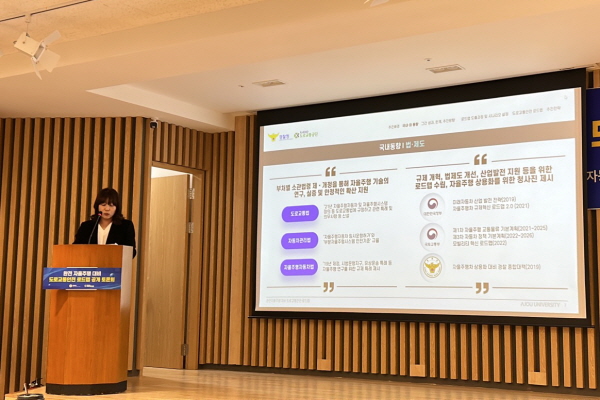
▲Jang Jeong-ah, Professor at Ajou University


Professor Jang Jeong-ah of Ajou University, who gave a keynote speech that day, said, “As autonomous vehicles are exposed to the road more, different types of problems will arise compared to when humans drive,” and “The main purpose of the ‘Roadmap for Road Traffic Safety in Preparation for Full Autonomous Driving’ is to derive major issues that could affect society as a whole in the era of full autonomous driving, to include the main responsibilities of the police, and ultimately to strive for a safe future society.”

The reason it is referred to as ‘preparing for’ fully autonomous driving is because it does not assume that all vehicles are autonomous, but rather that autonomous vehicles at Level 4 or higher are commercially operated on the road, and it is based on a road traffic environment in which general vehicles and autonomous vehicles at various levels coexist.

The roadmap (draft) contains a total of 29 implementation tasks that were implemented through top-down demand analysis, bottom-up demand survey, and consultation.

△Improvement of the autonomous driving verification system including reorganization of the existing driver's license system such as revising the definition of a driver and establishing a method for evaluating the driving ability of autonomous driving systems in line with the shift from humans to systems; △Autonomous driving safety management such as establishing a foundation for digital traffic rules that systems can follow and clear investigations of autonomous driving accidents to ensure the safety of autonomous driving; △Establishment of a comprehensive traffic information platform for autonomous cooperative driving such as collecting and providing real-time signal information and traffic information. The plan is to present a stage-by-stage and year-by-year plan to prepare for the future traffic environment by dividing it into three areas.

The National Police Agency has synthesized the opinions presented at the public discussion held that day, The final draft of the 'Road Traffic Safety Roadmap for Fully Autonomous Driving' will be prepared.

At this discussion, moderated by Professor Kim In-seok of Hanyang University, there were voices calling for the expansion of the role of the National Police Agency, cooperation with other ministries, and education, along with calls for the timing of the roadmap to be brought forward.


Kim Nam-sun, the director of the Institute for Public Safety Policy, who has been involved in the early planning stages of autonomous driving, talked about securing a dedicated organization and personnel. He said, “In a few years, the era of autonomous driving will open and there will be a major paradigm shift in transportation, but the National Police Agency does not yet have a dedicated department.” He added, “We need to establish a new department so that we can focus on related projects, and I hope that we can form an organic cooperation system with agencies under the National Police Agency, such as the Road Traffic Authority, to contribute to the smooth execution of the roadmap.”

Professor Kim Hyun of Korea Transport University focused on laws and systems. Professor Kim said, “There is no specific method for issuing licenses for autonomous driving systems,” and argued, “In order to accelerate the commercialization of autonomous driving, we need to clearly define who is responsible when an autonomous vehicle accident occurs.”

Lim Tae-beom, head of the Korea Electronics Technology Institute, emphasized that research should be continuously conducted to ensure social acceptance while promoting industrial development when various infrastructures and mobility are commercialized in the future. Chief Lim said, “Before establishing a roadmap for traffic safety related to autonomous driving technology, infrastructure improvements and related education must be provided to ensure that autonomous vehicles and regular vehicles can operate legally on roads where they coexist, so that a practical era of fully autonomous driving can open.”

Park Jun-hwan, team leader of the National Assembly Research Service, mentioned the need for a precise definition of autonomous driving and cooperation with other ministries. Team leader Park stated, “The terms for autonomous driving, such as driving and operation, are mixed in the roadmap, so they need to be organized, and I hope there will be a process in which basic definitions such as drivers are legislated.” He added, “I believe that the Road Traffic Act alone is not enough, and true autonomous driving will be possible only when everything works together through cooperation with other ministries.”

Hwang Jae-pil, team leader at Hyundai Motor Company, expressed his hope that measures would be taken to address areas where autonomous vehicles cannot operate, such as school zones, and that he hoped that related issues would also be considered, as autonomous driving using sensors could raise issues under the Personal Information Protection Act.

Team Leader Hwang also talked about autonomous vehicle accidents and argued that police and fire departments should be educated on how autonomous driving systems work and what problems can arise so that they can respond appropriately when accidents occur.

Lee Su-jin, head of the Seoul Metropolitan Government's Future Advanced Transportation Division, said that the roadmap has been systematically prepared in line with the schedule for the launch of mass-produced Level 3 and 4 vehicles, but expressed a wish that the schedule be brought forward. He said, “As autonomous vehicles will be running on the road through various verification efforts, we need measures to fill the five-year gap until 2027, when related laws, including the Road Traffic Act, will be created according to the roadmap.”

Kim Dong-joo, head of the Advanced Traffic Division of the National Police Agency, said, “The roadmap will be developed to review the policies that have been promoted so far, including institutional development and technological development, and to promote them consistently and quickly, we will work together with the Road Traffic Authority.” He added, “We will present a roadmap so that it can be promoted, including the opinions presented today.”

At the end of the event, the chairman of the Korea Road Traffic Authority expressed regret that the police did not participate in the investigation when an accident involving a self-driving car occurred in the autonomous driving pilot operation area.

The CEO emphasized that it is necessary to build up experience in on-site investigations, such as cracking down on vehicles that violate autonomous vehicle regulations.