Techday
Physical AI HBM Smart Factory SDV AIoT Power Semicon 특수 가스 정정·반론보도 모음 e4ds plus

Seoul City Launches World's First Late-Night Autonomous Bus

Google 우선 소스 기사입력2023.12.04 16:04


Hapjeong Station ~ Dongdaemun Station Central Bus Lane Section 9.8km, Operates from 23:30 to 05:10
After stabilization, paid services are expected to be introduced in the first half of 2024, accelerating the establishment of public transportation.

The Seoul Metropolitan Government is introducing a late-night autonomous driving bus to address citizens' late commutes home, early commutes to work, and late-night travel for business purposes.

Seoul City announced on the 4th that the world's first late-night autonomous driving bus (route number: Late-night A21) connecting the city center and the sub-city center will begin regular operation starting at 23:30 on Monday the 4th.

The city explained that while there have been cases of autonomous taxis (robotaxis) operating at night in countries such as the United States, this is the world's first regular operation of autonomous buses dedicated to late-night use, performing public transportation functions used by many citizens.

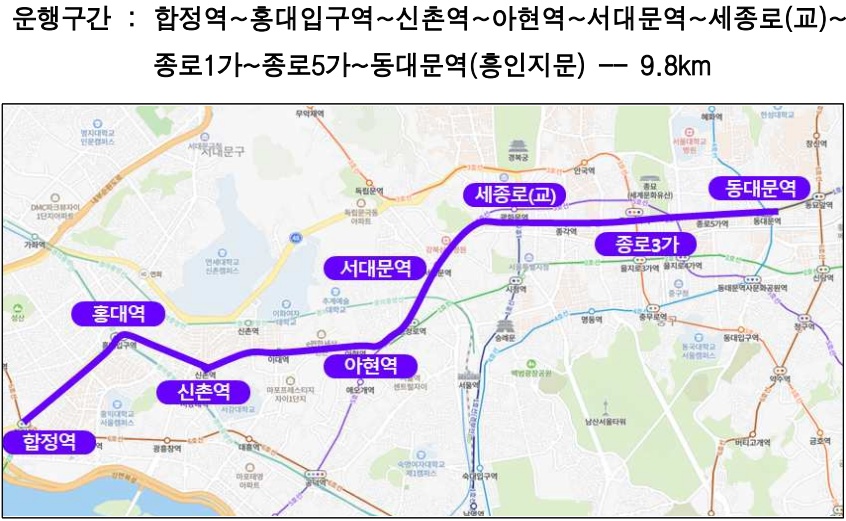
The late-night autonomous driving bus, which will make its debut today (the 4th), will run a 9.8km loop on the central bus-only lane between Hapjeong Station and Dongdaemun Station, a densely populated area with universities and large shopping malls, and will be operated by two large electric autonomous driving buses (modified Hyundai Elec City) of the same specifications as regular city buses.

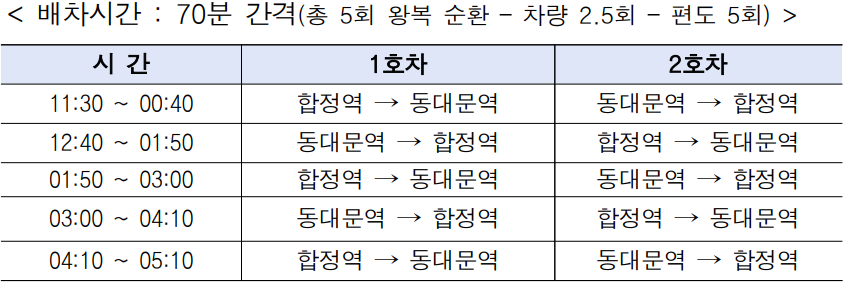
The operating days and times are weekdays only, Monday through Friday, and run until 11:00 PM.It starts running for 30 minutes and ends at 05:10 the next day.

One train departs from Hapjeong Station and the other from Dongdaemun Station at 11:30 PM, and they run in a circular pattern at 70-minute intervals.

You can freely get on and off at a total of 40 central stops (20 each way) located in the center of the road, just like regular city buses, on the route from Hapjeong Station to Hongik University Station to Sinchon Station to Ahyeon Station to Seodaemun Station to Sejongno (Gyo) to Jongno 1-ga to Jongno 5-ga to Dongdaemun Station (Heunginjimun).

When the late-night autonomous driving bus begins operation, real-time arrival times will be provided on the bus information terminals (BITs) installed at central bus stops, and when searching for the 'Late-night A21' route on portals such as Naver and Daum, real-time location and arrival times will be provided.

However, the city requested that customers check in advance whether the service will be available, as there are cases where operation may be suspended for safety reasons due to sudden heavy snowfall, etc.

The late-night autonomous driving bus with public transportation function can be boarded by tagging the transportation card just like a regular city bus without installing a separate app (application), and will be operated for free for the time being.

Although it is free, you must have a transportation card tag, the fare is automatically set to 0 won, and transfer discounts are also applied.

Therefore, if you do not tag your transportation card when getting on or off, you may incur disadvantages such as being charged a fare due to non-application of transfer discount when using other buses or subways. Therefore, you must tag your transportation card when getting on or off, just like a regular city bus.

The city will go through a stabilization process next year. It is planned to be converted to a paid service within the first half of the year, and the fare will be finalized after deliberation by the 'Seoul Metropolitan Autonomous Vehicle Operation Committee'. It is planned to be set somewhat lower than the existing basic fare of 2,500 won for late-night buses so that citizens can use late-night autonomous vehicles more conveniently.

To ensure the safe operation of autonomous driving buses at night, the city has installed traffic signal opening infrastructure (infrastructure) at a total of 59 locations in the central bus lane section, providing real-time information such as traffic light color and remaining time until the next signal via 5G communication, and has conducted safety operation verification with external experts through repeated test runs.

In addition, to prevent safety accidents, various safety measures will be implemented, including installing seat belts in all seats, prohibiting standing, and having additional special safety personnel on board (two people, including a test driver) to prevent intoxicated passengers and guide them to disembark after the bus has come to a complete stop, even though the vehicle is the same as a city bus.

In particular, we plan to strengthen cooperation with related organizations, including establishing a late-night emergency contact system (hotline) with nearby fire stations and police stations.

The city explained that next year, the operation section will first be extended to Cheongnyangni Station (total 13.2 km), and based on the operation results, the city plans to establish a regular route for long-distance autonomous driving buses that connect the outskirts of the city, the city center, and the outskirts of the city, rather than a short-distance loop, so that they can transport citizens 24 hours a day without time restrictions and accelerate the establishment of autonomous driving buses as a means of public transportation that overcomes spatial limitations.

Yoon Jong-jang, head of the Seoul Metropolitan Government’s Urban Transportation Bureau, said, “With the regular operation of late-night autonomous driving buses, Seoul is taking a big step closer to realizing its dream of a future mobility city based on autonomous driving, free from the constraints of time and space.” He added, “We will continue to provide unwavering support so that we can develop into a world-class autonomous driving city.”o; was revealed.