LG U+/CNS-ICTK-EYL, Development of Quantum Security Chip
QRNG, 26% greater cryptographic randomness than TRNG
Applied to ultra-small IoT devices as early as the first half of next year Quantum cryptography technology is expected to be added to the security features of IoT devices.
LG Uplus announced on the 27th that it had successfully developed Korea's first quantum security chip for IoT terminals in cooperation with security SoC development company 'ICTK Holdings', information security startup 'EYL', and LG CNS.

▲ Equipped with a quantum random number generator (QRNG)
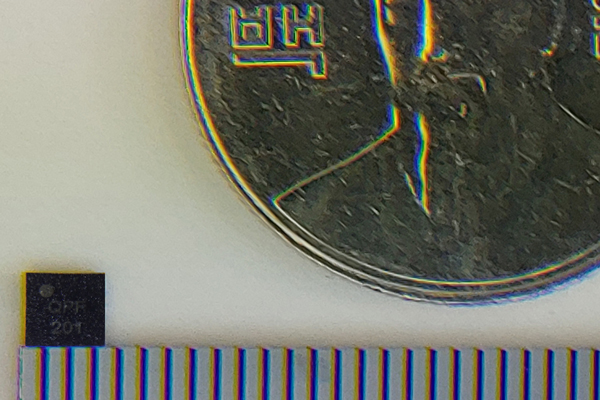
Quantum Security Chip (QPUF) [Photo = LG Uplus]
Quantum security is a technology that prevents encryption key duplication and prediction by generating patternless, pure random numbers using a 'Quantum Random Number Generator (QRNG).'
Compared to the 'True Random Number Generator (TRNG)' used in existing IoT devices, the randomness of the password is higher, making it safer from hacking threats. The randomness of QRNG is 7.69, which is about 26% higher than TRNG's 6.22. The maximum randomness is 8.0.
ICTK Holdings combined the QRNG developed by IWAL with the ‘Security Chip (Physical Unclonable Function; PUF)’ to create a ‘Quantum Security Chip (QPUF)’. This is a method in which the QRNG and PUF directly exchange data within a single chip.
The QPUF integrates two functions that were previously manufactured as separate chips into a single chip, making it less susceptible to information theft than methods of sending and receiving signals from the outside. Its size is also 3 mm × 3 mm, making it suitable for small IoT devices.
LG Uplus and LG CNS designed and created a software tool for using QPUF in IoT devices. Accordingly, QPUF safely stores IoT device data and provides functions such as firmware integrity verification and Secure Boot.
Each company is expecting to be able to apply this quantum security chip to IoT devices in actual use as early as the first half of next year. Jeon Young-seo, head of LG Uplus’ corporate service development division, said, “We will work hard to ensure that it can be applied to autonomous vehicles, drones, CCTVs, and other security-sensitive devices as soon as possible.”
Meanwhile, LG U+ built a dedicated communication line based on quantum-resistant cryptography for LG Innotek and Eulji University Hospital early this month. The technology was applied to the 640km section of the dedicated line connecting LG Innotek’s Pyeongtaek plant and Busan IDC, and the 207km section of the dedicated line between Eulji University Hospital Nowon and Daejeon.