“Optoemulator, Optocoupler Limit Overcoming Performance and Stability Implementation”
Pin-to-pin compatible with optocouplers, integration into existing designs, equivalent signal operation
Meets the latest system requirements, ensuring improved performance, stability, and safety
Optocouplers, also known as optoisolators or optical isolators, have long been an option for designers seeking galvanic isolation for system signals.
These semiconductor devices have played a critical role in providing safety insulation for industrial and automotive end products since the 1970s.
However, despite significant progress, limitations in improving electrical characteristics, high-voltage stability, and integration capabilities have forced designers to seek other alternatives.
Technologies such as electrostatic and magnetic isolation have emerged as alternatives, offering better overall performance than optocouplers.
TI has been investing in silicon dioxide (SiO2)-based digital isolation technology since the early 2000s, and offers digital isolator products that have the same functionality as optocouplers, plus several significant advantages.
■ Bridging the Gap: Introducing the Optoemulator> TI's optoemulator combines the benefits of traditional optocouplers and TI's SiO2-based isolation technology.
The optoemulator is pin-to-pin compatible with the industry's most popular optocouplers, allowing seamless integration into existing designs while providing equivalent signal operation.
These products appear and operate identically to optocouplers from a design engineer's perspective, but differ in that they utilize TI's SiO2 technology for the isolation barrier.
System safety and stability can be ensured through a barrier that effectively blocks high-voltage signals and prevents ground loops, while leveraging the benefits of SiO2 insulation, including improved electrical properties, enhanced high-voltage stability, and the potential for integration of additional system functions.
With these semiconductor products, TI aims to help design engineers implement designs that achieve maximum performance in digital and analog.
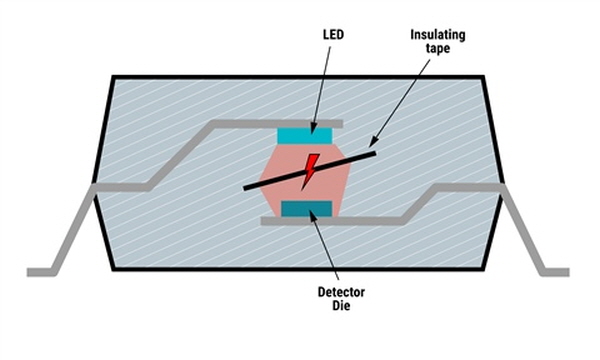
Conventional optocouplers use LEDs to transmit digital or analog information across an isolation barrier, detecting the signal on the other end (see Figure 1).
It is well known that LEDs used in optocouplers exhibit aging or degradation effects throughout their lifespan. These characteristics of LEDs present a significant headache for system designers and are one of the most common complaints they encounter.
Additionally, the insulating materials used in optocouplers vary from air to epoxy or mold compounds.
Table 1 clearly shows the difference in insulation strength of optocouplers and optoemulators using SiO2 dielectric.

▲Figure 1: Typical optocoupler design
.jpg)
▲Table 1: Dielectric strength by insulation material
Both of these problems occurring in optocouplers can be avoided by applying an opto emulator using TI's SiO2-based isolation barrier.
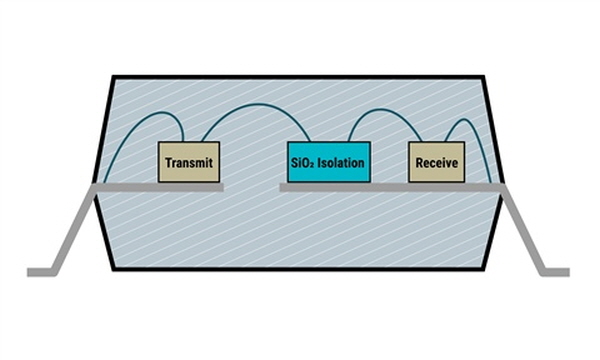
Figure 2 shows the internal structure of the TI opto-emulator, which emulates the functional operation of a conventional optocoupler in transmit and receive circuits and where SiO2 provides high-voltage isolation.

▲Figure 2: TI digital isolator design
■ Advantages of Optoemulator The optoemulator is By incorporating advanced insulation technology, it overcomes the limitations associated with conventional optocouplers, resulting in superior performance and stability.
Below are some representative advantages of optoemulator.
- Lower power consumption: Conventional optocouplers require preemptive overdesign to compensate for the inevitable aging effects of the LED, requiring additional forward current (IF) over the design life. TI’s optoemulators offer much lower IF and supply current, reducing power consumption by up to 80 percent.
- Improved common-mode transient immunity (CMTI): While typical digital optocouplers have a CMTI of about 15 kV/μs, the ISOM8710 has a minimum CMTI of 125 kV/μs, allowing it to be used in applications with very high common-mode switching noise or high ringing noise.
- Stable and precise current transfer ratio (CTR): No more paying extra for a tight CTR range. TI optoemulators like the ISOM8110 come standard with a wide range of tight CTR ranges that are stable over temperature.
- High data rate: Typical high-speed optocouplers support data rates from 1 Mbps up to 10 Mbps, and the ISOM8710 supports 25 Mbps. This support increases throughput and allows the optoemulator to be used in a variety of high-speed applications.
- Bandwidth: The ISOM8110 supports a high bandwidth of 680kHz, which allows for the reduction of the size of essential magnetic components (inductors and transformers). A wider bandwidth can improve the transient response for secondary-side regulated flyback converters. Improved transient response allows for smaller output capacitors, saving board space and reducing overall system cost, such as in high switching frequency gallium nitride designs.
- Wide temperature range: Typical optocouplers support a temperature range of 0°C to +85°C. Some optocouplers support a wider temperature range, but this feature is available at an additional cost. TI optoemulators support a temperature range of -55°C to +125°C as a standard solution, with more automotive-grade devices expected in 2024.
- Reliable isolation: The opto-emulator has enhanced high-voltage capability, making it suitable for applications that require reliable isolation. The TI opto-emulator provides 500 V/μm of isolation with an isolation barrier utilizing SiO2, which is much stronger than air (1 V/μm) used in many optocouplers on the market.
■ Conclusion The optoemulator combines the advantages of optocouplers and SiO2-based isolation, representing a breakthrough in signal isolation technology.
These devices enable you to meet the demands of modern systems, ensuring improved performance, stability and security.
Optoemulators can be used to optimize designs and open new horizons in isolation technology.
※ Reference material
TI White Paper: Solving High-Voltage Design Challenges with High-Reliability, Affordable Isolation Technology
TI Application Note 'Introduction to Optoemulator'