차세대 메모리 반도체 MRAM의 속도와 용량 획기적으로 늘릴 가능성 발견
기사입력 2019.06.10 17:28
| MRAM, 전자의 스핀에 의한 자성을 이용
| 두 자성물질 자화 방향 같거나 반대일 때 0, 1 기록
| 비대칭적 상호작용에 의한 자화 방향도 있음 발견
IT 산업의 발달과 함께 대용량의 정보를 처리하고 저장할 수 있는 새로운 저장 장치에 대한 수요가 지속적으로 증가하고 있다. 이에 동작속도가 빠르고 고집적도를 달성할 수 있는 새로운 메모리 장치 개발에 대한 연구가 주목을 받고 있다.
서강대학교 정명화 교수 연구팀은 자성물질 사이에 숨겨진 자기적 상호작용을 규명함으로써 차세대 메모리 반도체인 자성 메모리(magnetic random access memory; MRAM)의 속도와 저장용량을 한 단계 더 발전시켜줄 가능성을 입증했다.
이번 연구 성과는 재료분야 국제학술지 ‘네이처 머티리얼스(Nature Materials)' 3일에 ’Long-range chiral exchange interaction in synthetic antiferromagnets‘라는 제목으로 게재되었다.
어디서나 동영상을 실시간으로 재생하고 IoT가 익숙해진 정보화 시대인 현재, 대용량 정보 저장장치 개발이 활발하다. 그 중 MRAM은 전원이 끊겨도 저장된 정보가 사라지지 않는 비휘발성, 고속 동작 등의 장점이 주목받으며, 최근 상용화되고 있다.
전류를 기반으로 하는 기존 메모리와 달리, MRAM은 전자의 스핀(회전)에 의한 자성을 이용한다.
두 개의 자성물질에서 자화 방향이 같거나 반대일 때 0 또는 1의 정보가 기록된다. 많은 장점에도 불구하고 자화 방향을 바꿀 때 필요한 소비 전력이 크다는 한계가 있다.
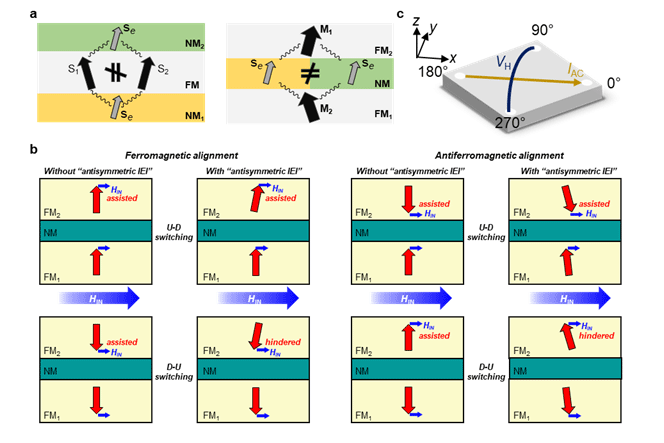
비대칭 층간 상호작용에 대한 모식도
(a) 자성 박막의 단일층 및 다층 단위에서 보이는 비대칭 상호작용의 모식도 (b) 두 자성층의 스핀 방향이 서로 평행한 상태와 반평행한 상태에 수평 방향의 자기장에 의해 변화하는 스핀 상태의 모식도 (c) 실험 방법에 대한 모식도연구팀은 자성물질에서 대칭적 상호작용에 의한 두 가지 자화 방향(동일/반대 방향)뿐 아니라 비대칭적 상호작용에 의한 자화 방향도 있음을 발견했다. 3차원 스핀 구조에 정보를 저장함으로써 MRAM의 속도와 용량을 크게 개선할 수 있게 되었다.
이번 연구에서 밝혀진 비대칭적 상호작용은, 두 자성물질 사이에 있는 비자성 물질에 의해 대칭성이 붕괴되면서 발생한다. 자성물질의 종류에 무관하게 재현된다. 두 자성물질 사이에 숨겨진 새로운 자기적 상호작용을 규명했다는 점에서 학술적인 의미가 있다.
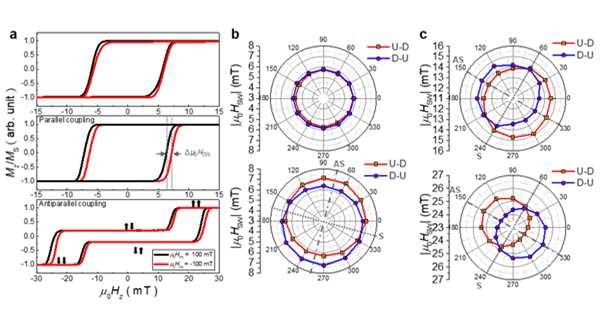
단일 자성 박막과 다층 자성 박막에서 자화 스위칭 곡선
(a) 자성 박막의 단일층 및 다층(스핀 방향이 서로 평행한 상태와 반평행인 상태) 단위에서 수평 방향의 자기장을 인가했을 때 측정된 자화 곡선. (b, c) 수평 방향의 자기장을 다양한 각도로 바꾸며 측정한 대칭적, 비대칭적 스위칭 결과비대칭적 자기 상호작용을 이용하면, 자성물질에서 동일/반대 방향의 대칭적 스핀 구조 뿐 아니라 비대칭적 특이한 스핀 구조를 구성할 수 있다. 이로써 0과 1의 이진법을 뛰어넘어, 빠르고 데이터 용량이 큰 신개념 비휘발성 메모리 소자 응용도 가능하다.

서강대학교 정명화 교수
정명화 교수는 “이 연구는 자성 박막 사이에 존재하는 밝혀지지 않은 새로운 자기적 상호작용을 밝혔다는데 의의가 있다”라며 “향후 메모리 소자의 저장 용량 한계를 극복하고 자성 소재의 구조적 문제를 해결해, 새로운 형태의 MRAM 소자를 디자인하는 데 기여할 수 있을 것으로 기대된다”라고 말했다.
이수민 기자
관련뉴스
-
메모리와 스토리지가 한데 모인 '인텔 옵테인 메모리 H10 솔리드 스테이트 스토리지' 출시
인텔이 인텔 옵테인(Intel Optane) 기술의 응답성과 인텔 QLC(Quad Level Cell) 3D 낸드 기술의 스토리지를 단일 공간 절약형 M.2 폼팩터에 결합한 ‘인텔 옵테인 메모리 H10 솔리드 스테이트 스토리지(Intel Optane Memory H10 with Solid State Storage)’를 발표했다. 인텔 옵테인 메모리 H10 솔리드 스테이트 스토리지는 트북과 올인원 PC, 미니PC와 같이 공간 제약이 있는 데스크톱 폼팩터에서도 인텔 옵테인 메모리 확장을 가능하게 한다.
2019-04-13 오후 12:01:47by 이수민 기자
-
시스템반도체 차세대 원천기술 개발과 고급 인력 양성 위해 산학연 맞손 추진
과학기술정보통신부는 산업통상자원부 등과 함께 발표한 “시스템 반도체 비전과 전략”의 후속조치로 신개념 반도체 소자 원천기술 및 집적·검증 기술 개발, 융합형 시스템 반도체 고급 전문인력 양성 등의 과제들을 추진한다. 과기부는 신개념 소자 원천기술 개발, 시스템 반도체 융합형 고급 전문인력 양성, 공공 나노팹을 활용한 팹리스 기업 지원, 민관 협업 기반의 연구거점 조성, 정부 출연연의 반도체 연구 플랫폼 역할 강화 등 한국이 메모리 반도체 글로벌 1위를 넘어 종합 반도체 강국으로 도약할 수 있도록 사람과 기술에 대한 중장기적 관점의 투자에 특히 집중할 계획이다.
2019-05-09 오후 3:56:16by 이수민 기자
-
급증하는 '5G 시대' IDC 트래픽… 대비책은 FPGA
최근 데이터센터의 중요성과 IoT 디바이스의 사용률이 크게 증가하고 있다. 따라서 기존 프로세서를 주로 이용하던 각종 애플리케이션 분야에서 FPGA의 수요가 점차 증가하고 있다. 특수목적으론 FPGA가 전통적인 프로세서보다 효율이 좋기 때문이다. 인텔이 알테라를 인수하고 내놓은 첫 FPGA인 애질렉스(Agilex)는 인텔의 10nm 공정으로 제작된 반도체라는 점에서 눈길을 끈다. 더욱 흥미로운 부분은 최근 공개된 차세대 인터페이스인 CXL 규격과 PCIe 5.0을 지원한다는 점이다. 애질렉스는 CPU와 GPU 같은 전용 가속기와 함께 사용해도 충분한 대역폭을 확보할 수 있다. 또, DDR5나 HBM2 같은 초고속 메모리를 지원하는데 그치지 않고 인텔 옵테인 DC 퍼시스턴트 메모리까지도 지원한다.
2019-06-03 오후 5:49:04by 이수민 기자



많이 본 뉴스

[열린보도원칙] 당 매체는 독자와 취재원 등 뉴스이용자의 권리 보장을 위해 반론이나 정정보도, 추후보도를 요청할 수 있는 창구를 열어두고 있음을 알려드립니다.
고충처리인 장은성 070-4699-5321 , news@e4ds.com