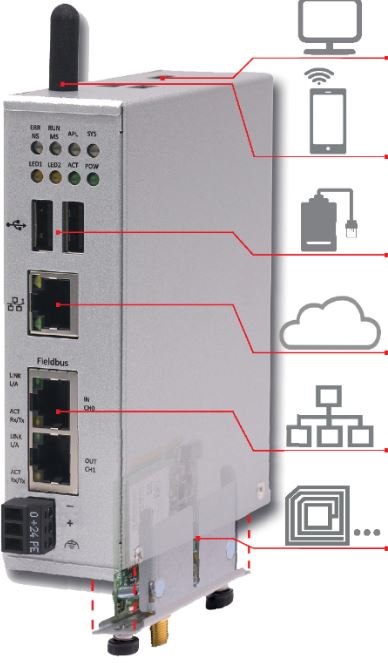
Combining the Raspberry Pi 3 circuit with Hilscher's netX industrial multi-protocol network controller Hilscher has announced that it has teamed up with Raspberry Pi manufacturer Element14 to offer the netPI platform based on the industrial Raspberry Pi 3. It combines the Pi 3 circuitry with Hilscher’s netX industrial multi-protocol network controller on a single board.
netPI improves cooling, allowing the quad-core CPU to operate at full capacity without performance degradation even at ambient temperatures of 50°C. It supports hardware RTC that lasts 7 days when power is lost, and power fail-safe frames that can store data at high speeds. It includes two additional industrial Ethernet ports. It also has wireless communication and is sealed in a rugged metal housing.
By using netX, multiple protocols are supported, including PROFINET IO-Device or other industrial Ethernet slave protocols. netPI is based on the security-enhanced Linux and therefore complies with the IEC 62443 cybersecurity standard. Therefore, functions such as secure boot, updates using approved packages, user and rights management, SSH console access ban, and communication via https secure connections can be implemented to protect against security threats.
In addition, netPI does not allow users to modify the host Linux or install software. Instead, Docker, an advanced virtualization environment, is pre-installed. User applications within Docker are encapsulated and run in containers that protect the Linux host. Hillscher provides free netPI container examples that demonstrate how to leverage Docker technology and netPI features through their official portal, Docker Hub.

It provides examples of containers for Node-RED, an IoT programming tool, such as fieldbus and frame nodes, desktop containers for local display via HDMI port, and Raspbian OS containers.
netPI is particularly useful for companies that work closely with universities and students to encourage research and development and to accelerate innovation through creativity and openness. In the education field, most people are familiar with Raspberry and use it at home.
Now, the use of Raspberry Pi is accelerating in factories through netPI. Also, by using Docker, netPI is open to users like the standard Pi 3, but can also be used for industrial purposes.