| Semiconductor, cloud operators lead server market growth
| System redundancy becomes necessary for IT service continuity
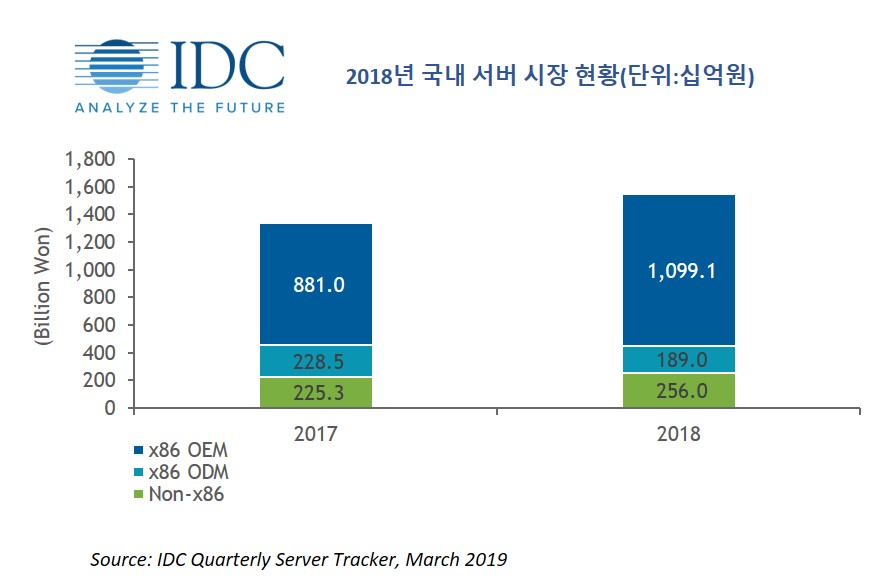
| Increased role of HCI by emphasizing system operation efficiency/agility According to the 2018 Domestic Server Market Report recently published by IDC Korea, the domestic server market sales in 2018 recorded KRW 1.5441 trillion, a 15.7% increase over the previous year.

2018 Domestic Server Market Status
The reasons for the growth include the expansion of semiconductor production lines and advancement of R&D due to increased production in the semiconductor manufacturing industry, as well as increased investment in IT infrastructure by large corporations and cloud service providers.
Looking at sales by server type, x86 servers grew 16.1% to KRW 1.2881 trillion, and non-x86 servers grew 13.6% to KRW 256 billion.
IDC classified x86 servers into two types: OEM servers, which are directly provided by vendors, and ODM servers, which are custom-made servers by users.
OEM servers still have a high share of the domestic server market, accounting for 85.3% of total x86 server sales in 2018. In 2018, the domestic x86 OEM server market grew 24.8% year-on-year to 141,435 units supplied and KRW 1.091 trillion in sales.
The x86 ODM server is mostly demanded by global public cloud service providers. Recently, as global cloud service providers have actively entered the domestic market, the growth of the ODM server market is threatening the market creation opportunities of existing OEM server vendors.
The non-x86 server market, which had been declining, also recorded 13.6% growth compared to the previous year. The growth of the non-x86 server market was attributed to the unusual increase in the introduction of non-x86 servers by financial institutions and the expansion of Unix servers in semiconductor factories, according to IDC Korea.
Kim Min-cheol, head researcher in charge of server market research at IDC Korea, said, “The perception of servers is changing rapidly,” adding, “Even just a few years ago, there was a strong perception that servers were stable, long-lasting hardware that could not be interrupted by the system, and that they had to be introduced through a trustworthy vendor.”
He continued, “Now, we need to assume that the system may be interrupted and prepare alternatives such as ‘system duplication’ or ‘data backup’ to maintain service continuity in the event of a failure, so that we can minimize the damage.”
Researcher Kim also said, “Reflecting this changed perception, it is becoming easier for ODM servers or new server vendors to enter the market,” and “The dependence on hardware, which requires the introduction of expensive premium servers centered around cloud service providers and the stable operation of the system for a long time through maintenance services provided for a certain period of time, is weakening.”
Finally, he added, “The system is designed so that it can be replaced immediately without service interruption in case of unexpected failures at any time.”
Meanwhile, IDC emphasizes flexibility through improved compatibility with storage and HCI in this server market report, as customer requirements are becoming more diverse and operational efficiency and agility are increasingly emphasized due to workloads that are becoming increasingly complex.
As boundaries between IT infrastructures become increasingly blurred, storage capabilities are being strengthened on servers, and storage is becoming It is suggested that as more advanced computing capabilities are demanded, the role of HCI in achieving these will also increase.