5G infrastructure to be built on 121.4km section by the end of 2020
30+ traffic services including jaywalker alerts now available
2,000 5G terminals to be installed in buses, taxis, traffic lights, etc. within the year The transportation environment of Seoul, a city with a population of 10 million, becomes safer with SK Telecom 5G.
SK Telecom announced on the 17th that it will promote a next-generation intelligent transportation system (Cooperative-Intelligent Transport Systems, C-ITS) demonstration project with the Seoul Metropolitan Government.
The 'Seoul City C-ITS' project aims to create a safer transportation system by building cutting-edge transportation infrastructure such as 5G and vehicle communication technology.
According to the project, SK Telecom will install 5G sensors and IoT on major roads in Seoul and distribute 5G vehicle communication terminals to buses and taxis. It will also establish a 5G control center for data collection and safety information transmission, and create a test bed for autonomous vehicles, a future means of transportation.
The project period is until the end of 2020, and the project cost is approximately KRW 25.4 billion. The target is the 121.4 km section of the Gyeongbu Expressway, Gangnam-daero, Gyeongin Mapo-ro, Tongil-ro, and other trunk bus rapid transit (BRT) routes and urban expressways.
5G warns of jaywalking and reports accidents in blind spots at intersections This project is attracting attention as the first C-ITS project to incorporate 5G. SK Telecom will install 5G infrastructure on major roads such as bus-only lanes and automobile-only roads.
As a single 5G business, it will supply approximately 2,000 5G terminals for vehicles to buses, taxis, traffic signal controllers, etc. 5G V2X base stations and terminals will be jointly developed and supplied with Samsung Electronics.

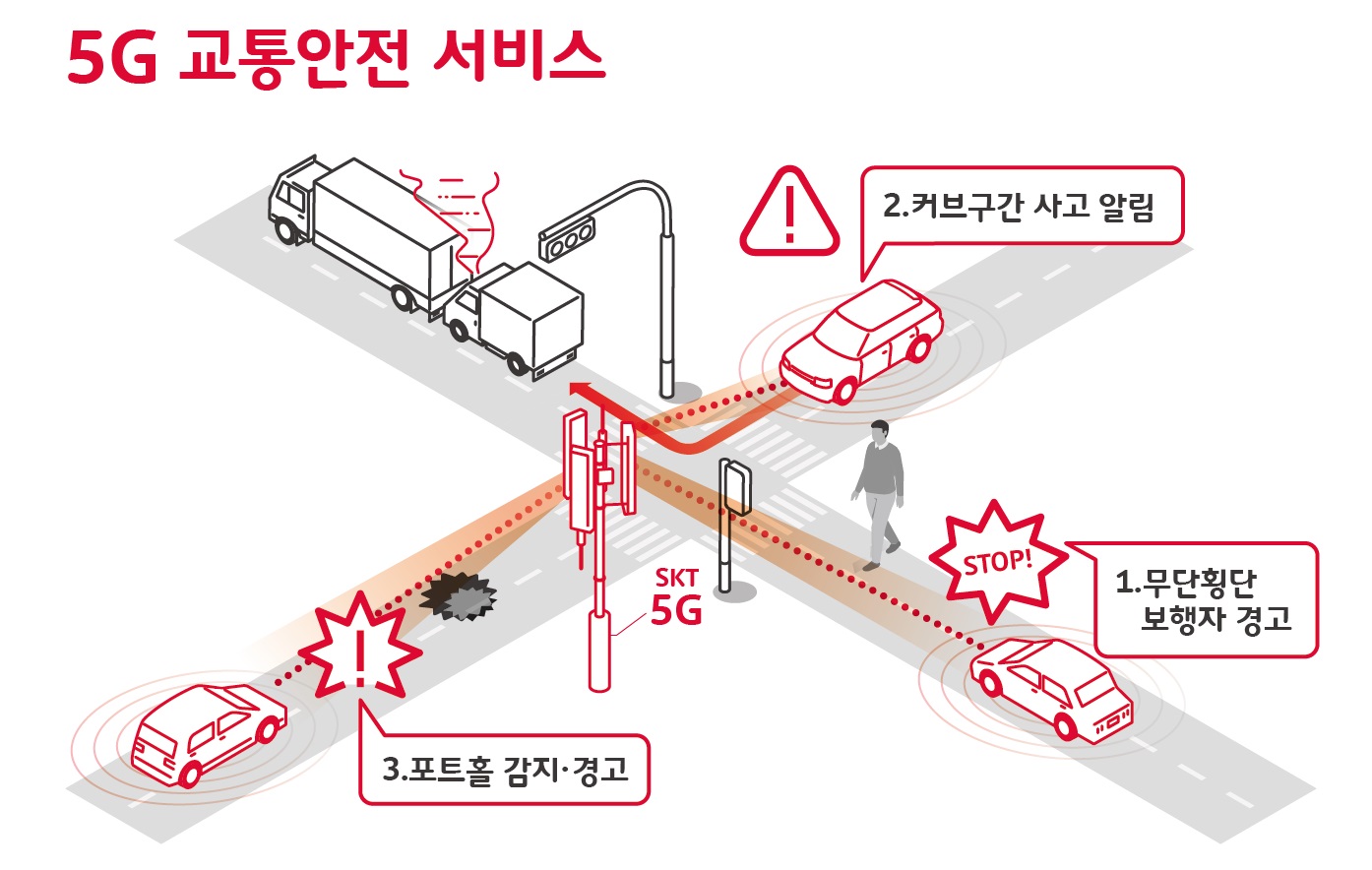
5G traffic safety service examples 5G buses and taxis frequently communicate with bus stops, traffic lights, etc. to collect data. SKT and Seoul City analyze the data in real time to identify dangerous situations and then send warnings to 5G vehicles. Traffic information is also sent to regular vehicles through T Map to reduce traffic accidents.
With 5G’s fast response speed, which is 10 times faster than LTE, the entire process takes place within 0.01 seconds, allowing drivers to respond more quickly. A car traveling at 100 km/h only has to travel 28 cm to detect danger with 5G. With LTE, danger is only detected after 2.8 m, which is 10 times faster.
In addition, when a 5G-based future transportation system is built, more than 30 new safety services will become possible.
For example, 5G can prevent accidents in advance by warning surrounding vehicles of pedestrians crossing the road illegally through detectors installed on the road. According to the Road Traffic Authority, in 2017, there were 9,590 cases of jaywalking accidents, making it the largest cause of all pedestrian accidents. 5G detectors are expected to be of great help in preventing accidents because they can recognize jaywalkers even at night or in bad weather.
SKT 5G can notify vehicles ahead of an approaching emergency vehicle to encourage them to give way. If a bus stop is crowded, it can also notify in advance so that an approaching bus can drive slowly.
It also prevents secondary accidents. It prevents multiple collisions by notifying following cars in advance of accidents at sharp curves where visibility is poor, and it also automatically detects information on road damage (potholes) caused by heavy rain during the monsoon season and provides information in advance to drivers entering the road.
In addition, SKT and the Seoul Metropolitan Government will establish a large-scale autonomous driving test bed in the Sangam DMC area of Mapo-gu, Seoul in the first half of 2019 where autonomous vehicles can be operated on a trial basis. Autonomous vehicles and regular vehicles will run together in the test bed.
SKT's autonomous vehicles that travel between DMC subway station and major buildings are expected to start operating as early as June. A program that allows citizens to experience autonomous vehicles is also being created.
5G, autonomous driving, T-map competitiveness wins business orders SK Telecom won this project based on the technologies it has developed over the years at its ICT Technology Center, including 5G and autonomous driving. SK Telecom’s leadership in vehicle communications and autonomous driving, including operating 5G autonomous vehicles on public roads since 2017, has been highly evaluated in the competitive evaluation.
T Map was a competitive advantage that other proposals could not keep up with. SK Telecom is also developing an ‘ultra-precision map’ essential for autonomous driving through T Map, which is used by 18 million people.
In the 5G era, cutting-edge technologies such as IoT, big data, and AI will be fully integrated, opening up new B2B markets such as autonomous driving and smart factories. SK Telecom has established an opportunity to lead new 5G businesses based on its B2B promotion experience and technological prowess proven through the ‘5G Smart Factory’ showcased at Ansan Banwol Industrial Complex and the ‘C-ITS Demonstration Project’ in Seoul.
Yoo Young-sang, head of SK Telecom’s MNO business division, said, “The C-ITS business is a future business that combines cutting-edge technologies such as 5G, autonomous driving, AI, and cloud, which are at the core of the 4th industrial revolution,” and added, “We will mobilize all of our global best technologies.”
He added, “We plan to provide various traffic safety information to Seoul citizens through 5G and also increase the social value of preventing and reducing traffic accidents.”