Introduced in December 2017, 5G NR Release-15 laid the foundation for extremely high data rates, ultra-low latency, and connectivity for billions of IoT devices. Designers now need to consider that when designing devices that will be part of 5G—smartphones, tablets, laptops, wearables—they will operate on new frequency bands and new technologies. Using mmWave frequencies with wider channel bandwidths can increase data throughput.
mmWave frequency signals, however, suffer from signal propagation challenges such as increased path loss and reduced penetration through walls and windows.
Beam steering and beamforming technologies combine multiple antenna elements to create high-gain, directional beams that can be directed to specific users.
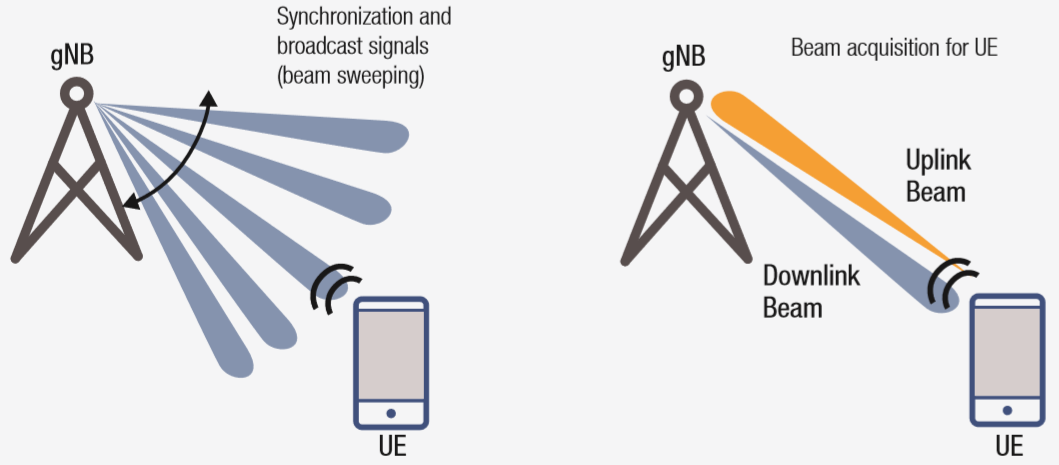
In 5G NR mmWave designs, base stations and mobile devices use narrow beams configured through beam steering.
One of the biggest challenges in using narrow beams is establishing and maintaining a communications link between the base station and the user equipment (UE).
When using a narrow beam, especially when first accessing the network, neither the base station nor the mobile device knows the other's location.
The new initial access and connection procedures for 5G NR involve finding a beam, initiating access, and switching beams as the device moves through the network.
The base station will use beam sweeping to transmit a signal from the base station to find the UE. The UE device will find and select the strongest beam and establish a communication link.

Next-generation Node B (gNB) beam sweeping and initial access and connection procedures Designing a 5G NR device requires multiple stages of testing.
Early in the design phase, designers should verify protocol procedures to ensure that the device can connect to the network. This includes testing initial access and beam management operations as the device moves through the network.
A network emulator simulates network commands during testing and captures the actions occurring on the device.
Designers must also verify the RF performance of their devices through simulations and hardware prototypes. In both models, designers must measure and optimize RF characteristics such as EVM and ACPR.
It is also important to measure the 3D beam performance of the antenna by measuring antenna gain, side lobes, and null depth to understand and maximize the radiated signal efficiency.
Designers must perform these measurements to understand how beam properties change as they move.
A calibrated OTA test method using 5G NR compliant waveforms and 3D analysis tools is an ideal solution to measure 3D beam performance.
In the next article, we will explore the fourth challenge: performing OTA testing on 5G mmWave components and devices.
▒See 5 Challenges 5G NR Device Designers Must Overcome <1> Utilizing variable slot duration <2> Increase throughput at high frequencies and wide bandwidths <3> Effective use of beam steering technology at mmWave frequencies <4> OTA Testing on 5G mmWave Devices <5> LTE and other wireless communicationPeaceful Coexistence with God