| Applying quantum cryptography technology to subscriber authentication server
| Preemptive application of quantum key distribution to key traffic sections
| ITU-T performs 4 quantum cryptography standardization tasks SK Telecom announced on the 18th that it will build a secure 5G infrastructure by introducing quantum cryptography technology to the 5G communication network.

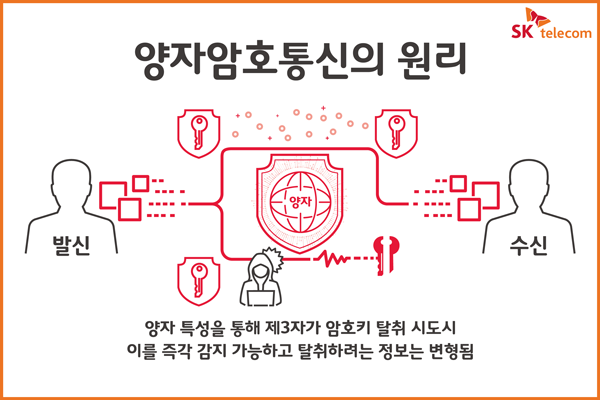
SK Telecom to Introduce Quantum Cryptography Technology to 5G Network Quantum cryptography is a communication technology that uses the characteristics of quantum to create an encryption key that only the sender and receiver can decrypt, preventing eavesdropping. It is considered the most secure communication encryption method among existing security technologies.
If we compare the existing communication method to the act of passing a ball back and forth, it would be difficult to know whether a third party has intercepted the ball and sent a copy. On the other hand, quantum cryptography communication is like passing soap bubbles back and forth. If a third party touches the soap bubble, its shape changes, making hacking or copying impossible.
Current communications encryption systems use numbers that appear irregular but actually have a certain pattern. As quantum computers, which process data 100 million times faster than supercomputers, become fully developed, the predictability of existing encryption systems increases, and the importance of security to prepare for this is growing.

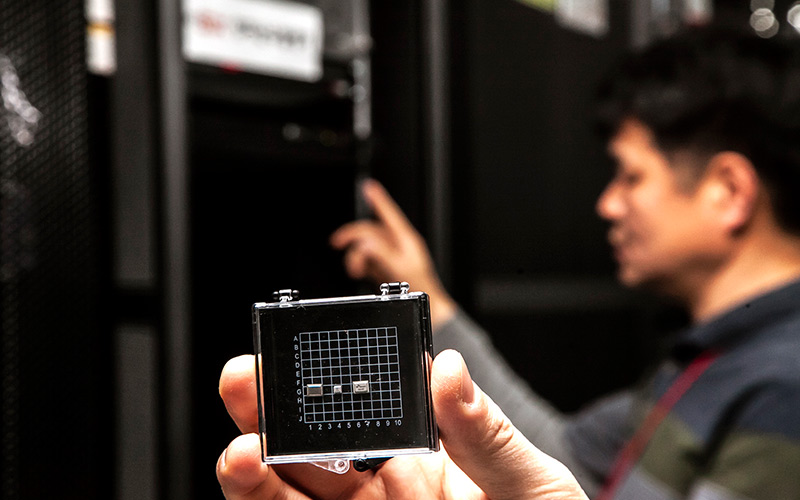
Quantum random number generator chip SK Telecom has applied ID Quantique (IDQ)’s Quantum Random Number Generator (QRNG) to its 5G subscriber authentication server since this month. A quantum random number generator is a device that uses the characteristics of quantum to create random numbers whose patterns cannot be analyzed, thereby blocking the risk of hacking through communication networks.
The subscriber authentication process is the first and essential step for terminal users to be authenticated as normal subscribers before connecting to the mobile network to send and receive voice/video data, SMS, etc. If the authentication key value is leaked, customer information can be used for crimes such as wiretapping and hacking, so security is of the utmost importance.
SK Telecom has applied a quantum cryptography-based authentication server to its 5G network ahead of the era of popularization of 5G, and plans to expand its application to the LTE network in April.
In addition, SK Telecom will strengthen the security of 5G and LTE data transmission and reception by linking IDQ's Quantum Key Distribution (QKD) technology to the Seoul-Daejeon section, a key transmission section for nationwide data traffic, in April.
Quantum key distribution is a core technology of quantum cryptography that creates an untappable encryption key that can only be decrypted by the transmitter and receiver. SK Telecom plans to advance its quantum network by gradually expanding the application of quantum cryptography technology.
.jpg)
SK Telecom employees are checking a subscriber authentication server with a quantum random number generator applied at the Seongsu Exchange Center. “By preemptively introducing quantum cryptography communication technology to 5G, SK Telecom customers will be able to experience differentiated communication services,” said Kang Jong-ryeol, head of SK Telecom’s ICT Infra Center, adding, “SK Telecom will provide the safest 5G communication network in the world.”
Meanwhile, at the ITU-T meeting held in Geneva, Switzerland in February, two new technologies related to quantum cryptography communications utilizing quantum key distribution proposed by SK Telecom were adopted as international standardization tasks.
In addition, SK Telecom is not only serving as an Associate Rapporter in the quantum standards field at ITU-T, but is also participating as a co-editor in a project to establish international standards related to quantum cryptography keys.
ITU-T stands for International Telecommunication Union Telecommunication Standardization Sector. It is a subsidiary organization of ITU, the world's top international organization related to telecommunications, and sets standards in the telecommunications field.
Professor Yeom Heung-ryeol of Soonchunhyang University, chairman of ITU-T SG17, a division in charge of security standards at ITU-T, said, “SK Telecom is playing a pivotal role in establishing international security standards at ITU-T,” and added, “This time, SK Telecom is“Introducing and operating a quantum cryptography communication system on the network is of great significance to the nation in terms of securing leadership in security technology,” he said.
SK Telecom established a quantum technology research center in 2011 and has been developing quantum cryptography communication technology. In 2016, it applied quantum cryptography communication to the LTE backhaul between Sejong and Daejeon for the first time in the world, and in 2017, it developed the world's smallest quantum random number generator (QRNG) chip.
SK Telecom ICT Technology Center Director Park Jin-hyo said, “As security becomes more important in the 5G era, we will take the lead in expanding the ecosystem through the development of quantum cryptography communication technology, a key 5G security technology, and lead the 5G era in Korea.”