4K performance video streaming service available
50Mbps transmission over existing Internet networks Opportunity to eliminate regional cultural gaps expected The Electronics and Telecommunications Technology Institute (KETI) announced on the 21st that it has developed a screening platform that can stream encrypted 4K cultural and artistic content Live/VOD using a general Internet network.
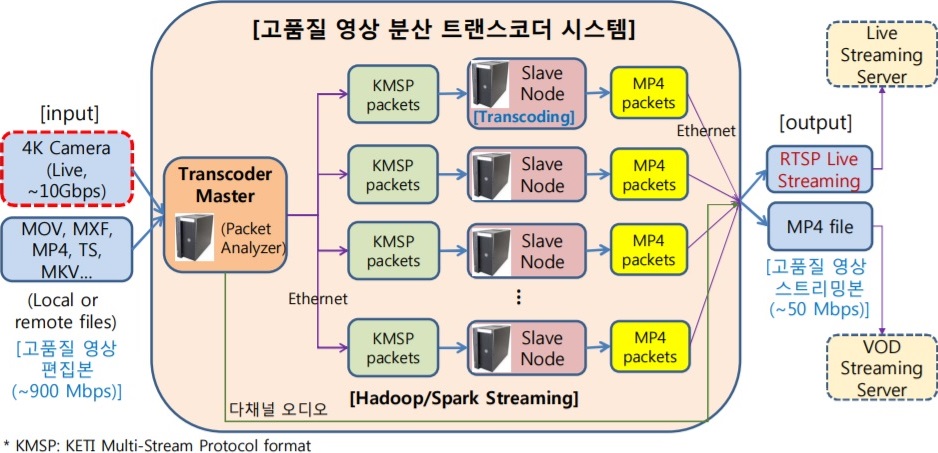
The core of the development technology is that it enables 4K video transmission using the existing infrastructure by applying the latest high-quality compression codec standard (HEVC Main 4:2:2 10/12 profile) using a chroma format of YCbCr4:2:2 with a bit depth of 10.
Specifically, video content with a resolution of 3840×2160 (4K), 60 frames per second (fps), which is twice as good as existing UHD broadcasting and about 10 times better than HD broadcasting, can be transmitted at 50 Mbps through the existing 100 Mbps general Internet network.

KETI Distributed Transcoder System Architecture Supporting 4K Content Live/VOD Streaming px;" />
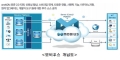
High-quality content Live/VOD service platform configuration diagram
The screening platform is equipped with technology to optimize the quality of cultural and artistic content, enabling high-quality video screening. Previously, when screening cultural and artistic content such as opera, ballet, musical, play, and classical music in other venues such as art centers or art halls, only medium quality (HD) was possible due to technical limitations.
The research team developed an MCTF-based preprocessing filter to remove low-light noise that inevitably occurs during filming due to the nature of cultural content performed in low-light environments in real time, thereby improving the compression ratio and image quality.
MCTF (Motion Compensated Temporal Filtering) is a method of filtering by referencing the movement of frames before and after the current frame on the temporal axis.
In addition, unlike actual performance halls, we have added technology to calibrate screen picture quality and speaker sound to suit the needs of small and medium-sized halls where standard lighting and projector performance are not standardized during screenings.
KETI expects that with this technological development, it will be possible to replace domestic technologies in the fields of domestic cultural and artistic content production and real-time streaming services that currently rely on foreign technologies, and to pioneer the 4K content streaming service market utilizing public networks.
In particular, it is expected to play a major role in reducing the cultural gap between the metropolitan area and underprivileged areas by easily providing high-definition cultural and artistic content to small and medium-sized cities and military bases, which lack or have poor performance facilities.
“We have verified the technology through 21 pilot streaming screenings in small and medium-sized performance halls and art centers over the past two years,” said Kim Yong-hwan, a senior researcher at KETI’s Intelligent Image Processing Research Center who oversaw the technology development. “We expect that the era of event cinema will open in the future, where high-quality performance content for large theaters will be enjoyed not only in small and medium-sized cities where cultural experiences are difficult to obtain, but also in small art centers in urban areas.”
This technology was developed by the Ministry of Culture, Sports and Tourism and the Korea Creative Content Agency.It was jointly developed with Arte, Pandora TV, and Sounders as part of the 'Development of high-quality video content provision technology for popularizing creative culture in marginalized areas' project supported by the 'Uo; Cultural Technology Research and Development Project'.