Check for obstacles in buried areas where vehicle access is difficult
The possibility of drone ports is also confirmed through the control system. LG U+ announced on the 9th that it had successfully demonstrated a 'precise inspection of social infrastructure' that prevents risks in advance by monitoring natural gas pipeline installation areas in real time using the U+ drone control system on the 5th.

LG U+ succeeded in demonstrating precision inspection of social infrastructure using drones This demonstration was carried out as part of the Ministry of Land, Infrastructure and Transport’s ‘Drone Regulatory Sandbox Pilot Project’ to discover new business models and freely perform safety tests, etc. without regulations for a certain period of time in the drone field to promote the practical use and early commercialization of drones. LG Uplus formed a consortium with Korea Gas Corporation, Korea Gas Technology Corporation, Hanwha Precision Machinery, and InnoPharm.
LG U+ demonstrated protecting the area from potential damage through ▲real-time filming of natural gas pipeline installation areas using 3D maps, aerial radio maps, and aerial weather information based on non-visual autonomous flight ▲real-time surveillance of the installation area and request for cessation of illegal construction ▲detection of ground displacement, etc.
There are approximately 5,000 km of natural gas pipelines laid across the country. The need for drones is emerging as there are vulnerable areas that are difficult for vehicles to access during pipeline inspection work.
For this demonstration, LG U+ installed the U+ drone control system in the Korea Gas Corporation control room located in Daejeon Metropolitan City, and the actual drone flight was conducted in a natural gas pipeline installation area approximately 2.8 km long located in Cheongju-si, Chungcheongbuk-do.
The demonstration first monitors the area surrounding the natural gas pipeline installation site in real time using 3D maps, aerial radio maps, and aerial weather information. Using 3D maps, it is possible to overcome the limitations of 2D maps, which check for obstacles at each altitude when setting the drone’s path.
In addition, the route can be set to avoid areas with weak signal strength through the aerial radio map that measures and visually displays the LTE signal strength in the sky, and the drone can be flown safely by minimizing the impact of wind speed through the aerial weather information.
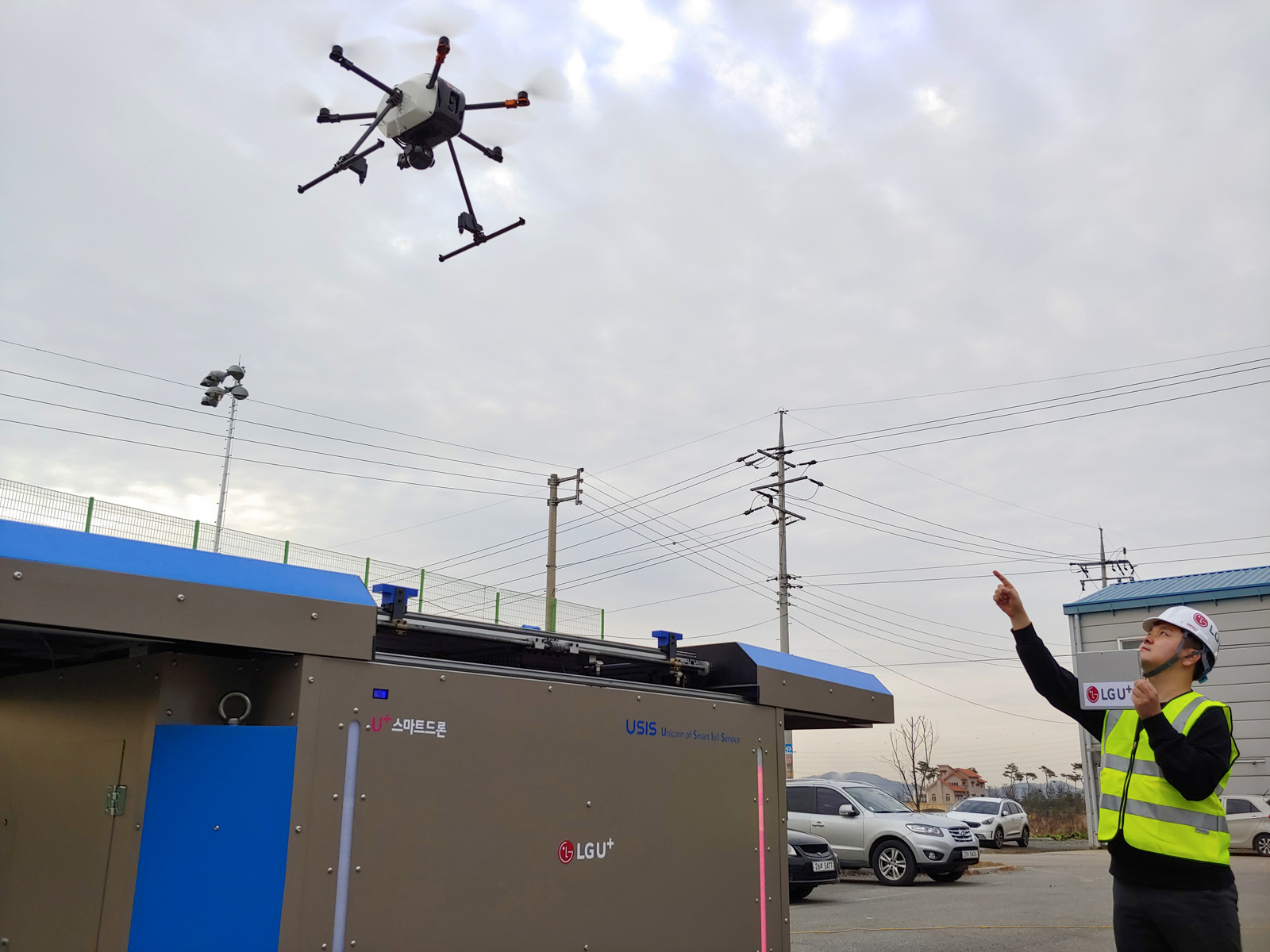
The drone used in the demonstration was characterized by taking off from a drone port located near the pipeline installation area. The drone port installed this time is linked to the control system of the headquarters control room to enable remote control and is also equipped with a wireless charging function. The possibility of the drone port was also confirmed through this demonstration.
Next, a drone linked to the U+ Drone Cloud Control System monitors the surrounding area of the pipeline installation in real time. The drone captures footage with an FHD camera, recognizes an excavator in an illegal construction area with an object detection deep learning engine, and notifies the control system via a pop-up.
The Korea Gas Corporation control room uses the excavator location information received through the control system to dispatch a new drone equipped with a VoLTE speaker. It continuously transmits a voice to the excavator to stop construction, and when the excavator stops construction, the drone receives a command from the control system and returns.
Finally, the ground displacement occurrence area was detected using a drone. The uncontrolled mapping drone produced in the pilot project flies at an altitude of 80m at a speed of 14m/s and continuously takes pictures of the area around the natural gas pipeline installation site. The captured images are processed and analyzed using InnoPam’s ground displacement detection solution to detect ground changes such as sinkholes, landslides, and land loss.
Seo Jae-yong, executive director of LG Uplus’ future service division, said, “Once commercialized, a system will be established that will first identify the area to be monitored by drones, monitor the area in real time to stop illegal construction, and detect areas where ground displacement is occurring in advance,” adding, “This will effectively prevent potential risks.”
An official from Korea Gas Corporation who also participated in the demonstration that day said, “There are areas across the country where natural gas pipelines are installed that are inaccessible to humans, so the need for drones is growing,” and “Through this demonstration with LG Uplus, we have confirmed the practicality of drones, and we hope that we will continue to improve and supplement this project so that it can be successfully commercialized and increase convenience and safety not only in natural gas pipeline installation areas but also in various other social infrastructure inspections.”