“Level 4 autonomous vehicles to be commercialized by 2025”
Sonnet autonomous vehicle sensor integrated detection, GPU-equipped, AI deep learning
Full-scale autonomous public transportation in 2030… Support for autonomous robotaxis
[Editor's Note] Autonomous driving technology, a core technology of smart cars, has entered full-scale growth since 2020. Dozens of technologies are needed to realize autonomous vehicles, and can be divided into six levels from level 0 to level 5 depending on the level of development. Recently, the market has been focusing a lot of attention on when autonomous vehicles can be commercialized. In the midst of this, we met with Chairman Son Jun-woo of Sonet, a company specializing in autonomous vehicles and SW, to hear about the latest development trends in autonomous vehicles and Sonet's autonomous robotaxi services and technology.
■ Please introduce Sonnet Company.
The company name 'Sonnet' comes from a form of European formal poetry that follows strict rhyme.
This company was established in 2017 as the first startup by DGIST researchers with the aim of developing safe autonomous driving SW according to such strict rules.
Sonet is a company that upgrades regular vehicles to Level 4 autonomous vehicles and manufactures, sells, and services them in the form of autonomous robotaxis.
In particular, it is an artificial intelligence SW specialized company that develops and operates its own full stack of autonomous driving SW.
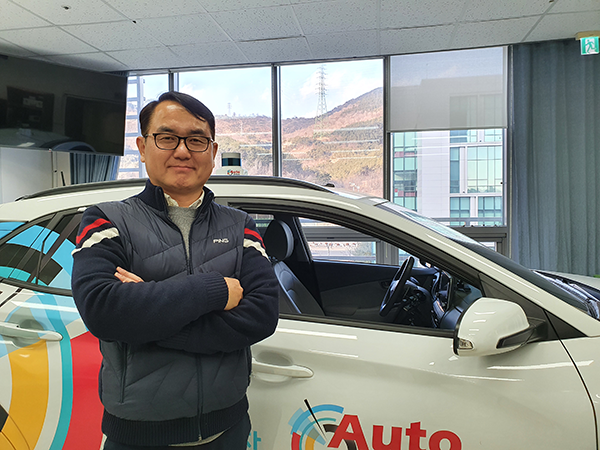
▲ Sonnet, Chairman Son Jun-woo, a company specializing in autonomous vehicles and SW
■ What are the key considerations in the autonomous vehicle development stage?
The most important thing to consider when developing autonomous driving technology is driver safety.
That is, any emergency situation is detected immediately and poor The most important technology is to minimize sensor false detection in the environment and to safely control the vehicle by appropriately filtering incorrect sensor inputs.
Sonnet's autonomous vehicle is a Level 4 vehicle that must be able to drive safely without a driver, so it uses integrated sensors such as cameras, lidar, and radar to detect and make judgments.
In this way, in designing for safety, we believe that rather than considering whether a specific sensor can operate normally under certain circumstances, we should consider how to integrate complementary sensor technologies to complete safe and comfortable autonomous driving technology.
Another key consideration when developing self-driving cars is security.
Considering Sonnet's target level 4 autonomous driving and safety response method through remote control, if a hacker infiltrates the remote control network and disrupts control commands or sensor information, it could lead to a serious accident.
To prevent this, it is essential to install communication security and encryption technology between servers and autonomous vehicles. Sonnet is establishing security measures centered on SW, and ultimately, it seems necessary to install security modules that comply with international standards.
■ Please introduce technology related to rapid response speed in dealing with unexpected situations, which is an important issue in autonomous driving technology.
Sonnet uses GPU-equipped systems to increase speed, and the processing power of both CPU and GPU is important for processing large amounts of data immediately.
Artificial intelligence deep learning, such as lane recognition, is also being implemented through optimization to enable processing within 10ms.
In addition, the Sonet autonomous vehicle uses radar, lidar, and cameras to detect and comprehensively assess surrounding objects such as vehicles and pedestrians.
Therefore, even in an emergency situation, at least one sensor can detect it and immediately apply the brakes to prevent an accident.
Since Sonnet develops the SW full stack itself, it is working on improving the SW structure that can complement the vulnerabilities of each sensor with other sensors and the proprietary map standard, 'Safety Map'.
■ Was there any impact on Sonnet due to the semiconductor component crisis?
I couldn't help but be greatly influenced. Due to the semiconductor component crisis, there were problems such as delays in purchasing new cars and MCUs, and the plan was delayed by at least 6 months.
Sonet minimizes the use of hardware such as sensors and controllers used in most vehicle modifications, and reduces the burden of price increases by purchasing most of them directly from overseas headquarters.
■ What is Sonnet’s vision for the commercialization of autonomous driving and its future prospects?
The commercialization period is being viewed as dividing the autonomous driving market into the concept of a 'product' that is sold as part of a car, such as Tesla and Hyundai, and the concept of a 'service' that provides a transportation service, such as Google Waymo and GM Cruise.
From a service perspective, it is expected that Level 4 or higher autonomous driving will be commercialized around 2025, with Level 4 autonomous shuttle vehicles running on designated routes.
It is expected that the era of autonomous public transportation will begin in earnest from 2030.
The sonnet sees the future of ideal transportation as one where one can go anywhere with ease. That is, the ideal is to be able to travel anywhere easily without having to own a car.
From a product perspective, Sonnet supports autonomous robotaxis that provide convenient transportation.
Sonnet sees the time when transportation companies will be able to purchase and service Level 4 vehicles as more important than when individuals will be able to purchase autonomous vehicles.
Some areas will develop into a service provider through direct operation, while others will develop into a service provider through collaboration with transportation companies.
■ Lastly, please say a word to your readers.
We hope to create many opportunities for cooperation with industry professionals who are interested in or curious about autonomous vehicles, a recent issue.