엘리먼트14 4월
Physical AI HBM Smart Factory SDV AIoT Power Semicon 특수 가스 정정·반론보도 모음 e4ds plus

Deep learning technology that preemptively diagnoses manufacturing equipment failures has been developed

기사입력2021.08.02 11:58

Biotechnology and Pohang University of Science and Technology, Explainable AI-Based
Development of equipment failure diagnosis technology and algorithms
Visualize AI's judgment criteria to improve understanding


Automation equipment shows signs of abnormal vibration, noise, and overheating before failure. However, it is not easy for field workers to notice these in advance, and even if they do notice them, it is not easy to judge the possibility of failure and respond in advance. In particular, sudden equipment failures in manufacturing sites can be fatal to operations, and if defective products are shipped, it can also threaten consumer safety.
▲ Dr. Jongpil Yoon of Saenggiwon uses deep learning models and frequency changes
Diagnosing whether there is a malfunction in the equipment [Photo = Saenggiwon]

On the 29th, the Korea Institute of Industrial Technology (KITECH) and the Department of Electrical and Electronic Engineering at Pohang University of Science and Technology (POSTECH) jointly developed an 'Explainable AI-based Facility Fault Diagnosis Technology' that captures signs of failure in manufacturing equipment using deep learning technology and visually expresses the cause and judgment criteria.

Existing AI fault diagnosis technology only provides simple judgment information of ‘normal or faulty’ and does not provide explanations or grounds for the reason for which a fault is predicted. When a fault signal is received, workers have to analyze it again in another way or directly inspect the manufacturing equipment to determine the cause, which is cumbersome and time-consuming.

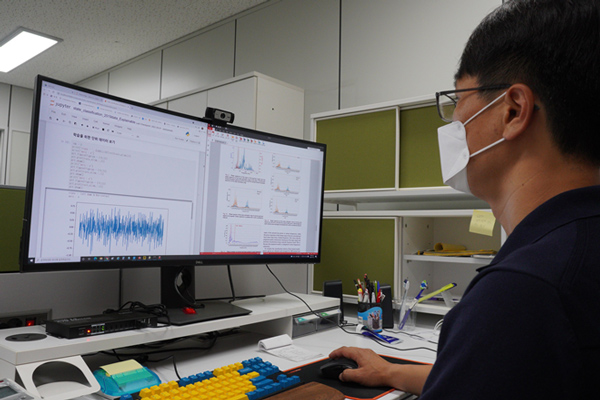
The research team at POSTECH-Sanggiwon has designed a deep learning model that diagnoses equipment status in real time using time-series vibration signals acquired from various sensors attached to the equipment. Most manufacturing facilities perform repetitive processes that generate constant vibrations, so changes in frequency can indicate signs of failure. The designed deep learning model determines that when the vibration is constant, it is 'normal', and when the frequency is misaligned or the flow changes suddenly, it is 'failure'.
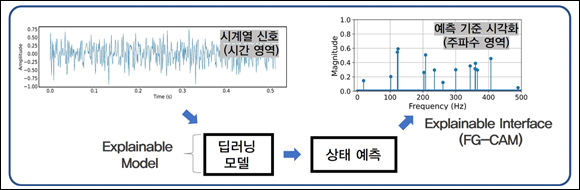
▲ Explainable AI-based facility status diagnosis technology [Image = Saenggiwon]

The research team applied an end-to-end model that uses the basic time series vibration signals sent by the sensor as input values without frequency conversion, thereby significantly reducing the diagnosis time. It also provides frequency features that are helpful in identifying the cause along with the judgment results, thereby increasing reliability and usability. We also developed the 'FG-CAM (Frequency-domain based Gradient-weighted Class Activation Mapping) algorithm, which visualizes AI judgment criteria for normal or faulty state classification in the frequency domain.

This has enabled workers to trust AI's judgment and quickly diagnose faults as soon as abnormal signs are detected in manufacturing equipment, and has also made it easier to identify the cause.

Dr. Jongpil Yoon of Saenggiwon said, “This result is the first outcome of the ‘AI-based manufacturing innovation business agreement’ signed between Saenggiwon and Pohang University of Science and Technology in July of last year,” and added, “This is a source platform technology that can be widely used for diagnosing manufacturing facilities, power generation facilities, rotating equipment, and transportation equipment that can obtain repetitive vibration signals, and we are currently promoting a verification project with a parts manufacturing company.”

This achievement was published in June in the IEEE Transactions on Industrial Informatics, a journal in the field of industrial AI.
이수민 기자
기사 전체보기