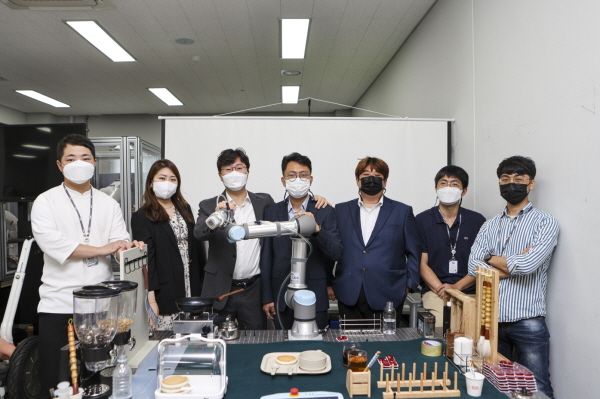
▲Research team led by Senior Researcher Song Seong-hyeok of the Robot Mechatronics Lab, Advanced Manufacturing Equipment Research Department, Korea Institute of Machinery and Materials (from left: Student Researcher Lee Jae-young, Senior Researcher Park Jeong-ae, Robot Mechatronics Lab Director Park Chan-hoon, Senior Researcher Song Seong-hyeok, Senior Researcher Park Jong-woo, Senior Researcher Han Byeong-gil, and Student Researcher Seo Yong-shin)
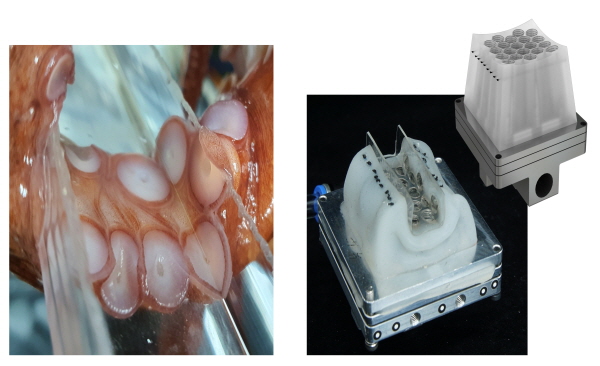
Adsorption type resembling an octopus leg, grasping various shaped objects
The gripper is designed to hug an object when it touches it.
A universal gripper designed to wrap around an object when it touches it, like an octopus's leg, has been developed, and it is expected to be applied to implement various tasks in daily life in the non-face-to-face era.
The Korea Institute of Machinery and Materials (President Park Sang-jin) under the Ministry of Science and ICT announced on the 13th that it has developed an all-purpose suction-type robot gripper that resembles an octopus' leg.
This new suction gripper technology, which takes the vacuum suction gripper technology widely used in industrial sites to the next level, is expected to become a key robot technology for implementing non-face-to-face services, as it enables complex tasks in daily life, such as preparing breakfast, calligraphy, hammering, and vaccination, with just one simple suction gripper.
The suction-type universal gripper developed by the research team led by Senior Researcher Song Seong-hyeok of the Robot Mechatronics Laboratory of the Advanced Manufacturing Equipment Research Department of the Korea Institute of Machinery and Materials can grip various objects and then firmly fix their positions, allowing the gripped objects to be used for a variety of tasks in daily life.
br /> The suction-type universal gripper was developed based on the idea that octopuses can grasp various objects using both their legs and suction cups. Just as an octopus first wraps its legs around an object to grab it, the gripper is designed to wrap around the object when it touches it.
To implement this, the research team placed micro-wire structures side by side on a flexible gripper surface, so that when an object starts to press on the micro-wires, the gripper structure contracts toward the object.
Also, just as the suction cups of an octopus change according to the detailed shape of the object to stably adsorb it, the flexible holes on the gripper surface change according to the detailed shape of the object while wrapping it around the object to adhere tightly and then strongly adsorb it. The flexible holes have a soft honeycomb-shaped structure, so they can effectively adhere to objects with severely curved surfaces.
The outer structure of the newly developed suction universal gripper can be changed to be hard or soft in real time, inspired by the way octopuses change between hard and soft legs.
Senior Researcher Song Seong-hyeok explained, “Since the gripper’s outer structure hardens after gripping an object and fixes the object’s position, various daily tasks can be performed with the gripped object.”
The research team confirmed that this suction-type universal gripper can be used not only to simply grasp everyday objects, but also to provide various non-face-to-face services. It can also be used to hold a spatula to flip and fry hotteok while preparing breakfast, or to handle objects such as an inkstone, ink, rice paper, and a brush for calligraphy to write calligraphy. They were also successful in a variety of actions, such as handling vaccine vials or syringes needed for vaccination.
Park Chan-hoon, head of the Robot Mechatronics Lab, said, “The developed suction-type universal gripper is the world’s first technology that can perform complex tasks with simple suction alone, without a motor or complex mechanical mechanism.” He added, “We expect it to play a major role in the development of non-face-to-face service robots that must effectively handle various objects in various situations in the future.”
Meanwhile, this study was conducted with the support of the basic project of the Korea Institute of Machinery and Materials, ‘Smart End Effector for All-in-One Robot Work System.’