3D Experience Platform, from battery material development to production
Visualization, Modeling, and Simulation in the Virtual World... Achieving Sustainability
Concerns about the environment are also an important factor in the mobility sector. Dassault Systèmes is driving innovation in the manufacturing process that takes sustainability into account in the battery industry, which is the core of electric vehicles.
Dassault Systèmes claimed that “digital experiences such as 3D virtual twin experiences can promote eco-friendly business innovation across the entire life cycle, from battery material development.”
On the 12th, Dassault Systèmes held the 'High Performance Battery Seminar' at the COEX conference room and announced the latest battery industry trends and technology strategies. Dassault Systèmes introduced each solution that provides virtual twins through the 3D Experience platform.
As electric vehicle production expands, the demand for environmentally friendly development methods starting from the material level is increasing. According to Kim Tae-hoon, CTO of EV Link, the production of electric vehicles is expected to continue to increase, including by domestic companies, as an eco-friendly means, and the entire aftermarket market for electric vehicles is formed on a large scale of approximately 130 trillion won.
■ 3D Experience Platform, Connecting All Manufacturing Stages
Dassault Systèmes’ 3DEXPERIENCE platform provides virtual twin technology through modeling, simulation, and data fusion. It supports an integrated medium that connects suppliers, OEMs, and developers in a linked manner across all design, development, and operation stages, enabling all stakeholders involved in development to collaborate without time and space constraints.
Unlike digital twins, which represent physical entities in 3D, virtual twins visualize, model, and simulate entities and the entire environment surrounding them. Starting with designing a product or system as a 3D model, you can then run simulations on that virtual model to test infinitely how the product will assemble, operate, or behave when affected by various events.
This allows for design, material and production processes to be optimized, while ensuring sustainability as all testing is performed virtually.
Jeong Ho-rim, Dassault Systèmes’ technology director, said in a presentation, “Battery specifications are all connected to the equipment, and ultimately, the entire manufacturing process from the cell must be connected and developed.”
To overcome the difficulty of identifying which equipment needs to be changed when the specifications of battery cell materials change, battery product level factory engineering and operation management must be connected on a single platform.
Jeong Ho-rim, CTO, added, “When Dassault Systèmes’ platform was introduced, 9 out of 10 EV companies improved the time required for collaboration with other companies by about 85%.”
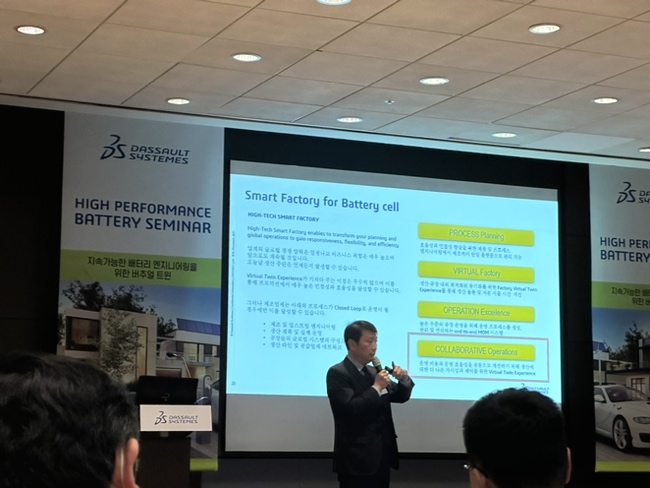
■ Utilizing Virtual Twin Technology to Build a Smart Factory

Sales representative Son Tae-ik said, “Battery demand is growing rapidly by more than 30% every year. “By 2030, there will be more than 300 gigafactories,” he predicted, and mentioned three advantages of virtual twins as a methodological approach to address concerns about securing supply chains due to environmental and raw material price increases.
These include: △ a ‘time machine’ function that analyzes past data, understands the present, and discovers efficient solutions for the future; △ a ‘digital continuity’ that can manage traceability by digitizing the entire life cycle; and △ a ‘virtual experience’ in which products (batteries) - space (factory) - people - environment are linked and managed in various manufacturing environments.
Based on the above functions, we ultimately aim to create a smart factory. A smart factory is an organic, autonomous, and eco-friendly factory where all elements within the factory are organically connected, and even suppliers outside the factory are all connected.
For example, in order to build a smart factory, Dassault Systèmes' virtual twin technology can be used to manage parameters entering the process during the battery manufacturing process to match quality and demand, and a single connected process facility can be created to enable reverse tracking.
“By comparing the past, present, and future on a single platform for product development, we will be able to build better factories,” added Son Tae-ik, Sales Director.
■ Dassault Systèmes provides solutions for the entire battery manufacturing cycle
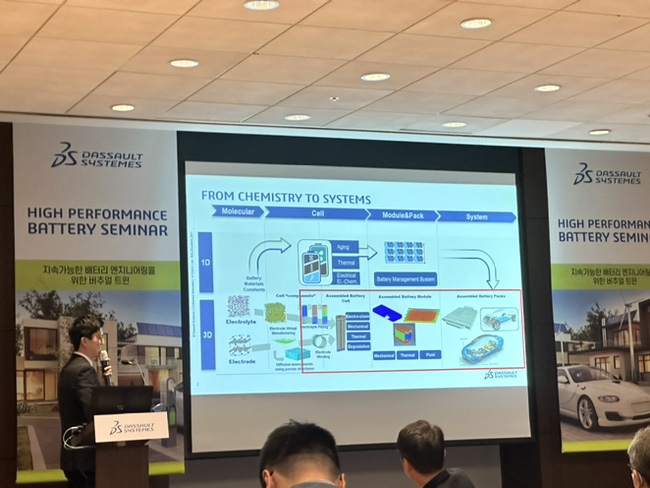
At the event, Dassault Systèmes presented its sustainable battery engineering strategy solutions from the material level to the industrial unit of the gigafactory.
Among the solutions provided by Dassault Systèmes through the 3D Experience platform, 'BIOVIA' is a solution for chemical research and material science suitable for battery material level modeling. It can reduce the overall project execution period by reducing and automating the number of duplicate experiments. In addition, 'SIMULIA' as a battery module pack verification and analysis simulation solution and 'DELMIA' as a digital process planning and verification solution were introduced.
For example, 'BIOVIA' enables scientists to search and analyze data and share information with other workers to make decisions. For example, it digitizes battery research notes and enables overall lab process data management as an all-in-one management solution for project management.
Dassault Systèmes' Chief Technology Officer, Lee Sang-hoon, said, "Dassault Systèmes has all solutions from chemical research to system development in various fields, not just batteries, and this is expandable."