.png)
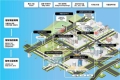
▲C-ITS frequency allocation plan
Next-generation intelligent transportation system frequency allocation plan confirmed The lower 20 MHz bandwidth of the 70 MHz bandwidth (5,855–5,925 MHz) supplied for the next-generation intelligent transport system (C-ITS) pilot project will be allocated to LTE-V2X, and the upper 30 MHz bandwidth to WAVE, and the deployment plan has been finalized.
The Ministry of Science and ICT (Minister Lim Hye-sook) announced on the 16th that it will finalize the 'Next Generation Intelligent Transport System (hereinafter referred to as C-ITS) Pilot Project Frequency Allocation Plan' after collecting opinions from the Ministry of Land, Infrastructure and Transport (Minister Noh Hyung-wook). It is expected that this will provide momentum to the construction of C-ITS infrastructure being promoted by the Ministry of Land, Infrastructure and Transport.
C-ITS is a road communication infrastructure that enables advance sharing and response to traffic hazard information through vehicle-to-vehicle and vehicle-to-road communication. In August 2021, the Ministry of Science and ICT and the Ministry of Land, Infrastructure and Transport decided to promote pilot projects for various communication methods.
In order to conduct demonstration projects for both technologies, a new frequency allocation plan was needed, and the Ministry of Science and ICT comprehensively reviewed frequency utilization efficiency, international trends, usage safety, and protection of existing users to finalize the allocation plan.
Looking at the confirmed deployment plan, the lower 20 MHz bandwidth of the 70 MHz bandwidth (5,855–5,925 MHz) supplied by C-ITS will be distributed to LTE-V2X, and the upper 30 MHz bandwidth will be distributed to WAVE.
In addition, the remaining 20 MHz bandwidth will be set as a guard band, but will be used for the development of next-generation C-ITS technologies such as 5G-V2X.
Choi Woo-hyeok, director of the Radio Policy Bureau, said, “With the frequency allocation plan finalized, the foundation has been established for conducting pilot projects for both C-ITS technologies,” and “We will continue to cooperate between ministries to achieve the policy goals of C-ITS, which are the world’s first commercialization of fully autonomous driving and improved traffic safety by 2027.”