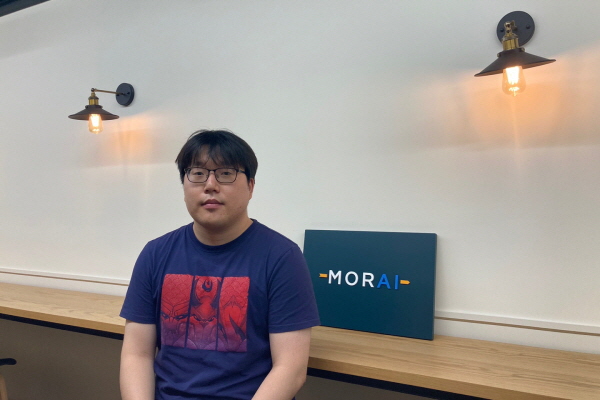
[Editor's Note] As research and development on autonomous driving are actively progressing, the era in which humans do not need to control fast-moving objects is approaching. Verifying whether the system performs the same tasks as humans did, but more safely, is a major task in autonomous driving research. Simulation based on precision map data enables efficient data acquisition while reducing costs in this verification process. Paying attention to the usability of such precision maps, our magazine spoke with Park Hyun-jin, head of the Moray Software Module Group and a speaker at the '2022 e4ds Automotive Tech Concert', about simulation technology using precision map data and industry issues.
■ Please introduce Morai and the software module group.
Morai is a company that develops autonomous driving simulation, a software that virtualizes real roads so that autonomous vehicles can be tested in a game-like virtual environment rather than on real roads.
It is built to reproduce tens of thousands of situations of complex real road environments in real time through automatic construction technology of digital twins based on precision maps.
The software module group is a department that develops various toolsets and software that require a lot of technical background.
△It includes a vehicle dynamics development department and a development team that manages vehicle movement, △a scenario development team that is in charge of writing, processing, and executing scenarios, △an interface development team that is in charge of external communication with various third-party tools, and a data team that creates an autonomous driving environment by compiling models based on map data or applying other GIS toolsets.
■ What are the technical capabilities and advantages of the Morai simulator?
Morai is We are currently developing a technology to build a 3D simulation environment without any manual work by receiving raw data for specific locations.
One of the challenges the simulation industry is trying to solve is that there is a lot of demand to test in specific areas, but there are clear limitations in labor and capital.
There are ways to map some areas with complex roads and provide them in 3D, but this is meaningless to businesses that don't go to those areas.
So, Morai took the approach of receiving local raw data on-demand and building a 3D simulation environment using only that data, without any input from technicians or engineers.
Basically, it is a technology that creates an actual 3D surface using road surface data. This will also be presented at the 2022 e4ds Automotive Conference.
■ Why is simulation attracting attention in autonomous driving testing?
As a simple example, let's say a self-driving car is approaching a crosswalk and a person suddenly appears. This requires more than 100 scenarios, not just one scenario where a person appears.
Even a single incident can be broken down into many components because the speed at which a car approaches, the braking system, etc. are different, and people's heights and weights vary.
It is time-consuming, expensive, and risky to test all of these things on actual roads, and general companies cannot restrict general roads for testing purposes, so simulations that can create a free testing environment are gaining attention.
■ Please explain what you will be presenting at this Automotive Tech Concert.
We will share the importance of simulation and how it relates to high-precision map data, and present the technology pipeline and the work that has been done to leverage it.
Next, we plan to show a video example of the Seoul City scenario test environment and explain how it was utilized.
Finally, the task of building a precision map, Through this, we plan to proceed with the session with examples and videos of what kind of scenarios can be done.
■ What are the recent issues in the autonomous driving simulation and precision map industry?
There are differing opinions in the industry about the concerns about map updates and how to address them.
Roads are subject to change in speed limits, construction, and new traffic lights.
In this case, there are many realistic concerns, such as the need for auxiliary tools and systems to be updated and verified as well.
I would like to cautiously suggest that Morai could serve as a bridge if you want to quickly set up a test environment when map data is updated.
■ Please tell us about Morai’s future strategy.
The direction of developing safe and efficient autonomous driving technology based on simulation is the same. It started as a startup and is gradually getting on track.
At this point, validation of the company's technology must be done. At the stage of proving technological prowess, I believe that building trust with customers is the top priority.
Our goal is to perfect high-quality technology that is easy for customers to use and satisfies their needs.
■ Lastly, please say a word to the readers.
There is still a long way to go, but there is still a lot to go. We will further advance our technology, increase the level of completion, and come back with a more mature product.
더욱 스마트하고 안전한 차량을 위한 “GMSL SerDes..
5G 무선통신칩과 AI솔루션