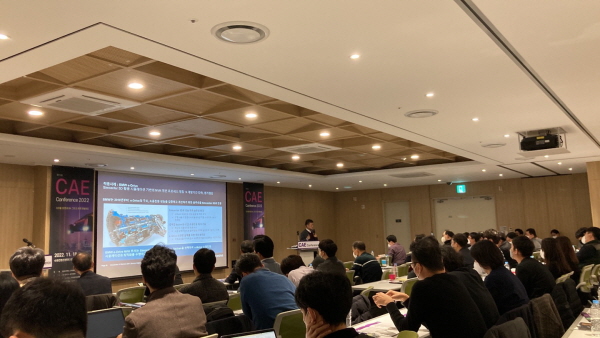
▲ Panoramic view of CAE Conference 2022
Experience/physical verification → data-based digital twin movement
Siemens builds digital twins for vehicle configuration system units The case was introduced along with an expert's presentation that digital twins are becoming an important element in all areas from the development of electric vehicle drivetrain components to integrated development.
Konkuk University's Department of Mechanical Design, Stage 4 BK21, held the 'CAE Conference 2022' on the 18th at the Suwon Convention Center with the theme of 'Digital Twin, DX, and Future Mobility.'
Shin Sung-won, Executive Director of Siemens Digital Industries Software, who took the stage as a presenter, introduced a method of developing electric vehicle drive components and integrating them into the vehicle using Siemens' simulation solution, Simcenter.
CAE stands for Computer-Aided Engineering and refers to the use of computer software to simulate performance to improve product design or assist in solving engineering problems across a wide range of industries.
CAE plays an important role in the R&D of domestic manufacturers and has become an essential element that cannot be omitted in the product development process.
“A development system using digital twins that can clearly reduce design time and costs has been established,” said Executive Director Shin. “Many companies, including Hyundai Motor Company, have “Automakers are also working to transform their development systems from experience-based, physical verification-based systems to data-driven, digital twin-based systems,” he said.
The digital twin that Siemens envisions is an accurate representation of a physical product or process in a virtual environment.
He cited the two-way connectivity between physical and virtual representations as advantages of digital twins, as well as the ability to optimize products and production.
Under the goal of Comprehensive Digital Twin, Siemens is working to build digital twins not only of products but also of production processes.
Digital twin production means using digital twins to verify, simulate, and improve manufacturing and production plans in advance until they are turned into actual products.
In addition, we built a closed loop system to enable continuous development by incorporating data generated during actual operation to continuously improve the product.
Through the above method, Siemens builds a digital twin so that performance development can be done at the vehicle configuration system level.
Mr. Shin introduced an example of how Siemens' Simcenter is applied to the design of motors and batteries, which are directly related to the operation of electric vehicles.
Simcenter is an integrated solution that enables product development based on digital twins, from conceptual design to detailed design and verification.
This can be used to shorten the development period through early discovery and improvement of problems before developing a prototype, and reduce development costs through quality improvement.
In the motor concept design, design variables such as shape, material, and winding are changed to improve efficiency, heat generation, etc.The design performance can be reviewed and optimized, and in the detailed design stage, Siemens' Star CCM+ can be added to use 3D CAD to predict and improve electromagnetic performance, structure, heat flow, noise and vibration performance.
In the electric vehicle battery development stage, electrochemical review at the microstructure level is performed using Simcenter's starCCM+.
The influence of electrode shape on the electrochemical performance of the battery can be represented in 3D, and the movement of battery components can also be simulated.
In cell-level design, performance is quickly reviewed using design variables of electrodes and batteries, and a digital twin of the cell is built by combining the cell shape model and performance model.
In the design of the battery pack unit, starCCM+ is used to review the structure of the module and pack, as well as cooling performance, and it enables review and improvement of thermal runaway.
“Digital twins can also be effectively used to solve noise and vibration problems in electric vehicles,” said Executive Director Shin. “This development method will accelerate the development of electric vehicles and bring forward the era of eco-friendliness.”