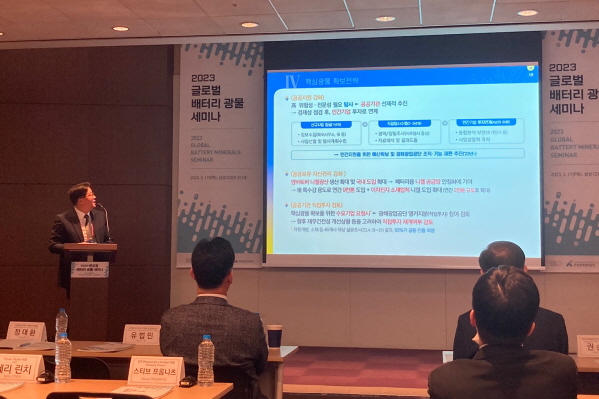
▲Director Jeong Dae-han of the Mineral Resources Team at the Ministry of Trade, Industry and Energy is giving a presentation
Reduce dependence on specific countries for 10 key minerals by 50% by 2030 Establishment of an early warning system based on the 2025 supply and demand stabilization index
The Ministry of Trade, Industry and Energy is moving forward in earnest to secure key minerals for a stable supply chain in Korea, which has an industrial structure that relies on imports of key minerals for secondary batteries.
Jeong Dae-han, head of the Mineral Resources Team at the Ministry of Trade, Industry and Energy, announced three strategies for securing key minerals at the '2023 Global Battery Mineral Seminar' held at COEX on the 17th.
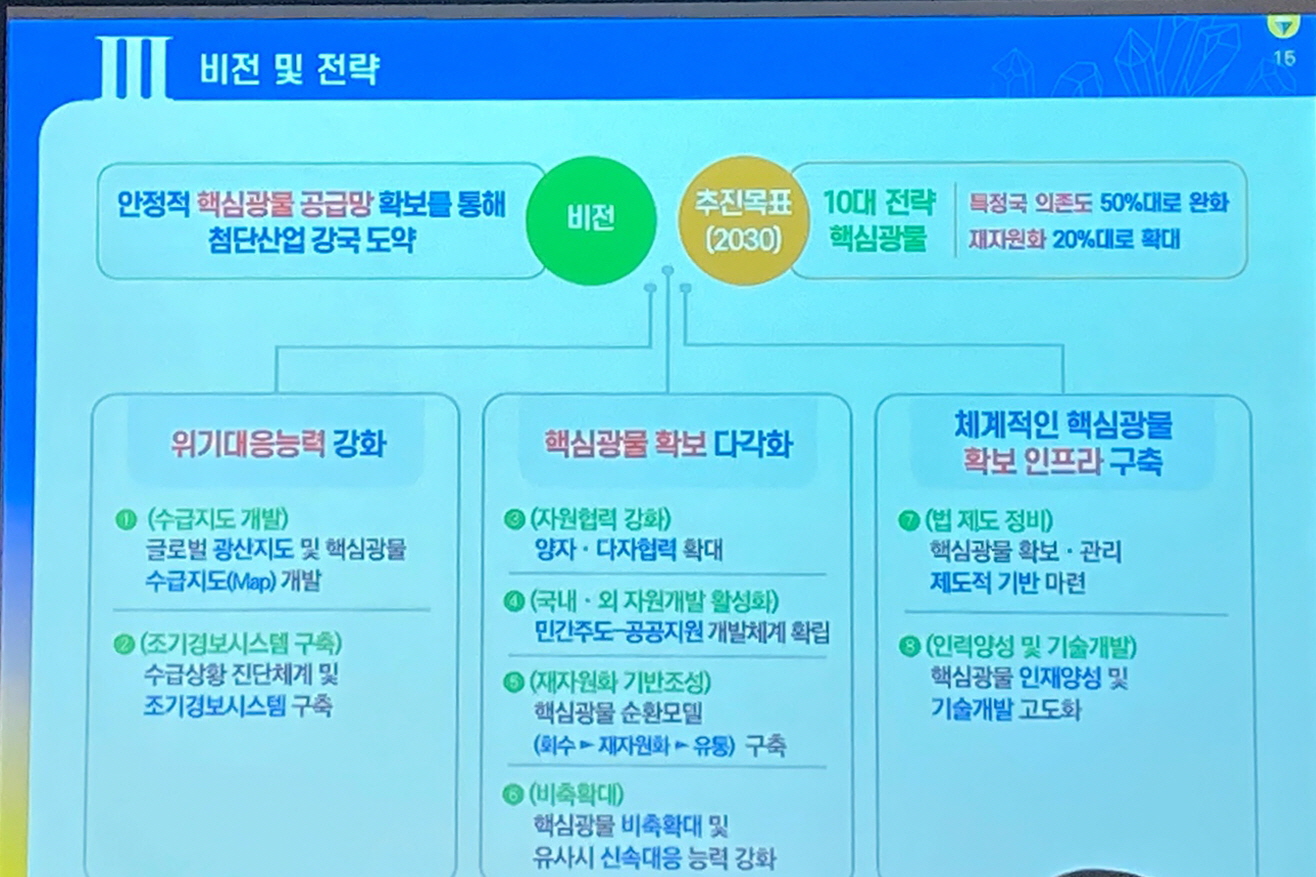
The Ministry of Trade, Industry and Energy has set a goal of reducing dependence on specific countries for 10 strategic key minerals to 50% and increasing recycling to 20% by 2030, with the vision of becoming a cutting-edge industrial powerhouse by securing a stable supply chain of key minerals.
400px;" />
The three core mineral acquisition strategies to achieve the above goals are: △Strengthening crisis response capabilities, △Diversifying core mineral acquisition, and △Establishing a systematic core mineral acquisition infrastructure.
The Ministry of Trade, Industry and Energy will develop a 'Global Mine Map' that provides overseas mine information such as mining rights (exploration, development), reserves (drilling status), and infrastructure conditions (accessibility) by exploration, development, and production stages by 2023, and develop and distribute a 'Core Mineral Supply and Demand Map' that integrates global core mineral supply and demand information on the map by 2024.
In addition, an early warning system will be established by 2025 using a supply and demand stabilization index based on mid- to long-term price risks, domestic imports, and demand growth rates.
The Ministry of Trade, Industry and Energy plans to monitor the supply and demand status of key minerals using the above system, and if an issue of supply disruption is detected, it will be disseminated through companies' web services, etc., and take preemptive measures such as preparing to release reserve minerals.
The details of the strategy for diversifying key minerals include: △ bilateral and multilateral cooperation, △ revitalizing domestic and international resource development, △ establishing a foundation for recycling key minerals, △ expanding key mineral reserves and strengthening rapid response capabilities in times of emergency.
The bilateral cooperation plan will see the Ministry of Trade, Industry and Energy select strategic cooperation countries and establish and implement country-specific advancement strategies. Strategic cooperation countries will be considered for their development attractiveness and accessibility factors, and long-term supply contracts will be concluded and mining investment support will be provided through public-private cooperation such as MOUs and working group formation. Multilateral cooperation measures include actively utilizing the Mineral Security Partnership and the International Energy Agency cooperation system, and providing policy funds to Korean companies when making joint investments with allies.
Activation of domestic and international resource development included: △ expansion of financial and tax support, △ project discovery, △ review of direct investment by public institutions, △ inducing participation of private companies, and △ safe mining.
The strengthening of public support includes the content that in the case of exploration that is high risk and requires expertise, public institutions will preemptively promote it and then link it to private sector investment. Private sector investment linkage will be carried out after four years of new business discovery and exploration, and it is expected that details will be explained through business briefing sessions.
In addition, based on the survey results showing that 93% of 46 companies in resource development, materials, etc. hope to jointly advance, the Ministry of Trade, Industry and Energy plans to review whether to resume direct investment by taking into account factors such as improved financial soundness.
The Ministry of Trade, Industry and Energy will establish a circulation system to prevent the disposal and leakage of secondary batteries and other materials and secure raw materials in order to establish a foundation for recycling key minerals.
It is expected that a demonstration center will be operated to provide joint corporate infrastructure for the demonstration of recycling of core minerals by small and medium-sized enterprises and to support early commercialization. A preliminary feasibility study, including a plan to build and operate a demonstration center, will be conducted in 2024-2025.
The Ministry of Trade, Industry and Energy will also expand the stockpiling of key minerals and strengthen the ability to respond quickly in times of emergency. The stockpiling of rare metals will be expanded from 54 days in 2022 to 100 days in 2031, and items with high supply risk will be expanded to 180 days or more.
In addition, the number of items will be significantly increased from 19 types and 28 items in 2022 to 20 types and 35 items in 2031. The expanded items are magnesium, cobalt, tungsten sulfide, dysprosium oxide, yttrium oxide, and neodymium oxide.
The final strategy, the establishment of a systematic infrastructure for securing key minerals, includes the following: △reorganization of laws and systems, △expanding of training of professional personnel and technological development.
The Special Act on Resource Security based on industrial support for key minerals is scheduled to be reflected in 2023, and the training of specialized personnel in the fields of mineral processing, refining, and recycling will be promoted to increase the added value of key minerals.
In addition, various technological developments are expected to be carried out, such as technologies that can replace core minerals with low cost proportions, and development of ESG-tailored smart exploration and mining technologies.