Microchip _ Nov 25
반도체 AI 보안 인더스트리 4.0 SDV 스마트 IoT 컴퓨터 통신 특수 가스 소재 및 장비 유통 e4ds plus

Tesla's 48V E/E Architecture Introduces Strengthening Components Ecosystem

기사입력2023.04.10 16:20


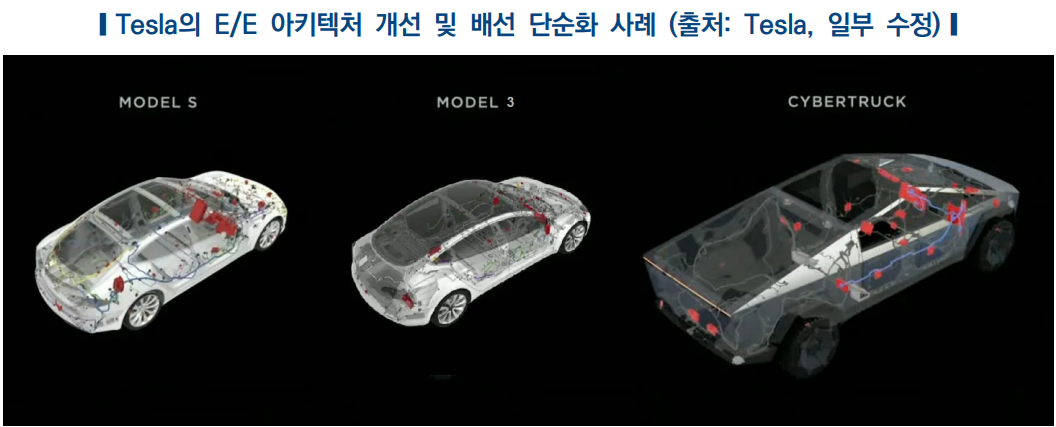
▲Tesla's E/E architecture improvement and wiring simplification case (Image source: Hanjayeon Industry Analysis Report)

Transition to 48V-based E/E architecture starting with Cybertruck, scheduled for release in late 2023
Legacy automakers expected to face increased burden of chasing 48V conversion benefits

Tesla has proven that its dominance in the components ecosystem has been sufficiently strengthened by declaring that it will transition to a 48V-based E/E architecture starting with its next model, the Cybertruck.

In an industry analysis report titled “The Significance of Tesla’s Introduction of 48V Architecture” published on the 10th, Lee Ho-jung, a senior researcher at the Korea Automobile Research Institute (hereinafter referred to as Hanjayun), interpreted the transition to a 48V-based E/E architecture as a symbolic case showing that Tesla’s grip on the parts ecosystem has been sufficiently strengthened, and that consultations with relevant parts companies have been completed to enable mass production of new standard parts at a reasonable cost.

The research director also predicted that if the practical benefits of the 48V transition are proven, legacy automakers will likely shoulder the burden of catching up.

Some legacy automakers are predicting that the actual transition will likely take a long time even if they acknowledge the need for a 48V transition due to the relational and organizational inertia that has developed from long-term collaborations with component companies at multiple tiers.

Lee Ho-jung, a researcher at Hanjayeon, said that the purpose of this decision is to structurally increase power efficiency and further advance vehicle weight reduction.This means that SLA's parts ecosystem has been strengthened, and it is expected that other automakers will have to keep up.

Since the standard voltage for automotive electrical components changed from 6 V to 12 V in the 1960s, most automobiles today use 12 V as their standard for electrical components, except for some powertrain components.

On the other hand, as the latest automobiles are faced with problems such as the various electronic devices installed in them handling up to 250A of current, making the in-vehicle wiring complex and increasing the weight of the wires, Tesla has come up with a solution to switch to a 48V-based E/E architecture starting with its next model, the Cybertruck.

Tesla announced plans to apply 48V architecture to all of its Cybertrucks, which are scheduled for mass production in the second half of 2023, as well as future vehicles and its humanoid robot Optimus, and to design the main control units required for them in-house.

There is room to reduce power loss in general electrical components such as lighting, infotainment, and steering, which consume about 3 to 7% of electric vehicle power when converted to 48V, and also improve the efficiency of other HVAC systems and power conversion systems.

In theory, loss can be further reduced by increasing the voltage, but considering human safety, the appropriate value is usually around 48 V.

It also has the advantage of simplifying wiring and reducing the weight of wires, which can contribute to vehicle weight reduction and cost reduction.

Additionally, since the current is reduced, the overall length can be up to 4 km, and the volume, weight and related costs of in-vehicle wiring can be reduced, and it is also easier to install power-intensive computational and audio systems or 48V custom accessories.

There was also concern that the transition to 48V could result in increased costs in the short term.

As 48V parts for vehicles are not common in the market, the unit price of delivery will be lower than before in the short term. There is room for improvement.

While many 12V parts are mass-produced by component companies and then supplied to multiple automakers, creating economies of scale, it is expected that in the short term, 48V parts will be limited to Tesla, making it difficult to lower manufacturing costs.

Meanwhile, Tesla is expected to continue its strategy of pursuing both architectural and modular innovation, as it unveiled permanent magnet motors that do not use rare earth elements, power conversion components that reduce silicon carbide (SiC) usage by 75%, and the transition to 48V at its Investor Day in March.