인피니언 Dec
반도체 AI 보안 인더스트리 4.0 SDV 스마트 IoT 컴퓨터 통신 특수 가스 소재 및 장비 유통 e4ds plus

China to Overtake Korea as World's Second-Largest Auto Exporter by 2022

기사입력2023.07.03 14:34

China aims to conquer overseas markets with electrification and autonomous driving technologies.
The Chinese government is fostering industry by linking it with the development of a smart transportation system.

The Korea Automobile Mobility Industry Association (KAMA) reported that the growth of local Chinese companies leading the way in electrification and autonomous driving technologies is expanding beyond the Chinese domestic market and into overseas markets, and predicted that competition with Korea will intensify.

In its report titled “Current Status of Competitiveness in the Chinese Automobile Industry” released on the 28th, KAMA predicted that as China enters the advanced market for future vehicles such as electric vehicles and autonomous driving systems, competition with Korea will intensify.

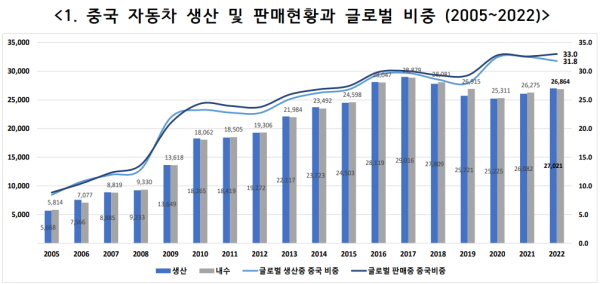
China surpassed South Korea to become the world's second-largest automobile exporter in 2022.

▲China's automobile production and sales status and global share (Image source: KAMA China Automobile Industry Competitiveness Status Report)

China's automobile exports in 2022 reached 3.111 million units, up 54.4% year-on-year, while passenger car exports surged 81.3% year-on-year to 2.529 million units.

Even in 2023, the growth of China's automobile exports continued unabated.

From January to May 2023, exports reached 1.758 million units, an 81.5% increase over the same period last year and amounting to 266.78 billion yuan, or approximately 48.0657 trillion won.

KAMA is ChinaThe analysis showed that the expansion of trade volume, diversification of automobile export destinations, and expansion of NEV exports drove export growth, and that the withdrawal of competing manufacturers from Russia was also a major factor in the increase in exports.

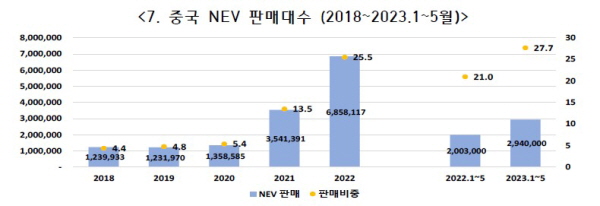
China's NEV exports from January to May 2023 increased by 162.6% year-on-year, accounting for 26.0% of total automobile exports, an 8 percentage point increase from 18.0% in the same period last year.
▲China NEV sales (Image source: KAMA China Automobile Industry Competitiveness Status Report)

In its early stages of entering overseas markets, China prioritized cost-effectiveness and secured export and production bases in Central and South America, the Middle East, Russia, and neighboring countries. With the acceleration of the transition to electrification due to strengthened environmental regulations, China is also expanding its overseas expansion and exports to Asia.

China is also rapidly expanding its autonomous driving policies and market size.

KAMA analyzed that the Chinese government envisions the development of the smart connected vehicle industry as a breakthrough for the establishment of smart transportation, and is fostering the industry by linking it with the establishment of a smart transportation system.

China is further emphasizing autonomous driving standards and technology R&D policies starting in 2021, with the goal of having Level 2-3 autonomous vehicles account for 50% of new car sales by 2025. The country is also fleshing out its systems through measures such as the announcement of safety service guidelines for autonomous vehicle pilot operations.
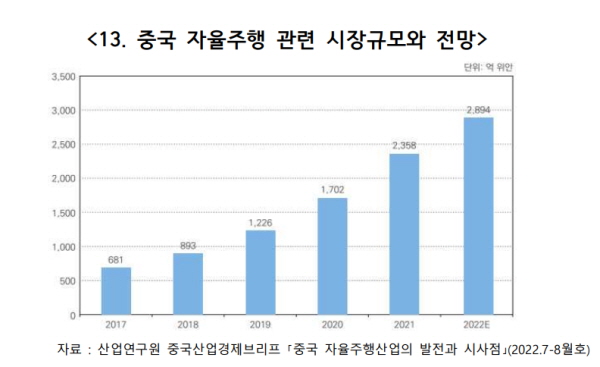
In support of this, the size of China's autonomous driving market increased from 68.1 billion yuan to 289.4 billion yuan from 2017 to 2021.The growth rate was 36.4%.
▲China's autonomous driving market size and outlook (Image source: KAMA China Automobile Industry Competitiveness Status Report)
To enhance the competitiveness of their products, local Chinese automakers are accelerating the development and operation of ADAS and autonomous driving technologies. They are also securing price competitiveness for autonomous driving systems by enhancing the efficiency of driving data collection and reducing development costs through comprehensive partnerships with ICT, semiconductor, and LiDAR companies.

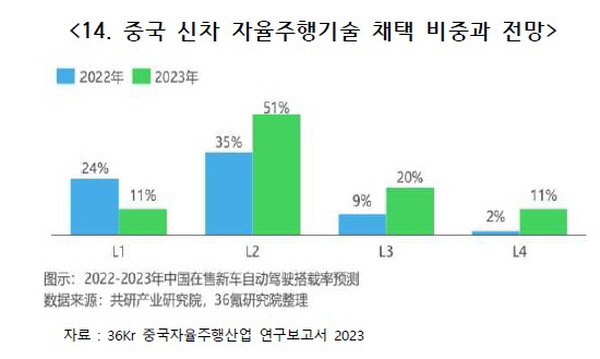
China is expanding pilot cities for Level 4 autonomous vehicles, which accounted for only 2% in 2022, and is expected to increase to about 11% in 2023.
▲Proportion and outlook for autonomous driving technology adoption in new Chinese vehicles (Image source: KAMA China Automobile Industry Competitiveness Status Report)

Although export controls on advanced technologies, including semiconductors, are being strengthened due to the US-China trade conflict, there are also predictions that the commercialization period may be brought forward as Chinese companies are leading the fields of autonomous driving hardware such as sensors, software systems, and basic technologies such as V2X.

KAMA is developing new markets in Korea with high growth potential, such as the Middle East and Central and South America. It was analyzed that it would be necessary to create a favorable trade environment utilizing technical cooperation and ODA along with the early conclusion of the FTA, and to explore ways to expand exports of the automobile and related industries through this.

He also emphasized the need for a strategy to prioritize strengthening the domestic automobile industry's production base and competitiveness, and the need to establish a comprehensive support system to strengthen the future automobile industry ecosystem.

In addition, as automakers continue to announce their future vehicle investment plans, the urgent need for parts companies to transition to electrification is increasing, and it is urgent to enact a special law to provide comprehensive and systematic support for companies transitioning to parts and to create a future vehicle ecosystem.

To establish a legal basis for the designation of specialized parts complexes for future vehicles, government R&D projects, various government support projects, and regulatory exemptions, it is necessary to swiftly enact special laws. Furthermore, measures to secure human resources through job-transition training and specialized personnel training are also crucial.

In the autonomous vehicle sector, the importance of government-led early market support systems is growing to accelerate commercialization.

Korea was the first country in the world to establish safety standards for Level 3 in 2019, but the launch of Level 3 models has been delayed. Therefore, KAMA analyzed that the government should increase social acceptance by providing support for the purchase of autonomous vehicles in areas with strong public service, such as route buses, call services in underserved areas, and the logistics and delivery markets, and try to stabilize the initial market.