4.2 million electric vehicles expected to be distributed by 2030… Charger inconvenience must be resolved
Increasing convenience of charger use, strengthening prevention and response to battery fires
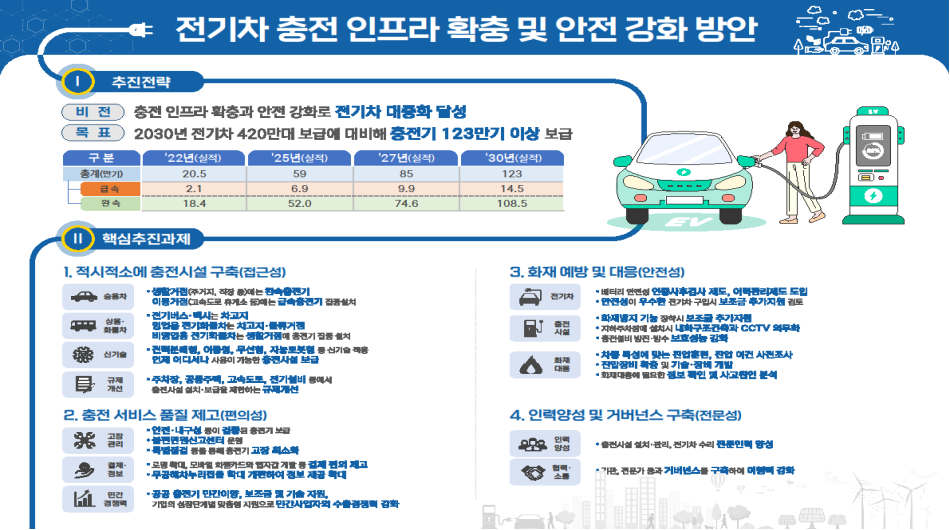
The Ministry of Environment announced that it will supply more than 1.23 million chargers by 2030 in preparation for the supply of 4.2 million electric vehicles by 2030.
The Ministry of Environment announced that the 'Electric Vehicle Charging Infrastructure Expansion and Safety Enhancement Plan' was finalized at the 25th State Affairs Ministerial Meeting held on June 29.
This plan was prepared jointly by related ministries, including the Ministry of Trade, Industry and Energy, the Ministry of Land, Infrastructure and Transport, and the National Fire Agency, and its main contents include expansion of electric vehicle charging infrastructure and fire prevention and response.
In line with this goal of increasing the number of electric vehicle chargers nationwide by five times to approximately 240,000 by the end of May 2023, the plan is to focus on installing slow chargers in residential areas and other living centers, and rapid chargers in mobile centers such as highway rest areas.
In older apartment buildings where it is difficult to install chargers due to insufficient electrical equipment capacity, power distribution type chargers that automatically adjust the amount of electricity needed for charging during times when the building’s electricity usage is low will be installed without the need for additional power equipment, and new technology chargers such as mobile and wireless types will be distributed to areas with a sharp increase in charging demand.
In addition, some regulations will be improved, such as improving the criteria for appointing electrical safety managers from 1 per 60 charging facilities to 1 per 120 charging facilities when remotely monitoring electrical equipment at charging facilities.br />
To minimize charger failures, the Ministry of Environment is also working to resolve user inconveniences by distributing chargers with proven durability and operating a complaint reporting center.
In addition, the Ministry of Environment announced that it will expand payment information linkage (roaming) between charging service providers so that all chargers can be used with a single membership card, and develop a mobile membership card and app wallet by 2023 so that payments can be made easily with smartphones.
In addition, in order to shift the electric vehicle charging market to a private sector-centered one, public rapid chargers (approximately 7,000 units) will be sold to the private sector in stages, and chargers transferred to the private sector will be required to maintain their public nature for a certain period of time.
We will introduce a battery safety certification and post-inspection system and a history management system to ensure that only electric vehicles equipped with safe batteries are released to the market.
In order to prevent fires in charging facilities, we will expand the scope of regular inspections to include charging devices and accessories, and consider providing additional subsidies to electric vehicles and chargers with excellent safety.
It also appears that issues related to fire have been taken care of.
In order to respond quickly to fires, we develop fire suppression methods and expand equipment suited to the characteristics of vehicles, secure battery status and charging history information necessary for responding to electric vehicle fires, and analyze the causes of fire accidents to utilize them for accident prevention.
In addition, through the project to train professional personnel for charging facility installation and management, we will produce more than 100 experts every year, and strengthen cooperation and communication between institutions to secure the ability to implement the tasks of this plan.
Environment Minister Han Wha-jin said, “This plan will solve the problem of inconvenience in charging electric vehicles and prevent fire accidents,” and “It will greatly contribute to popularizing electric vehicles and realizing carbon neutrality.”